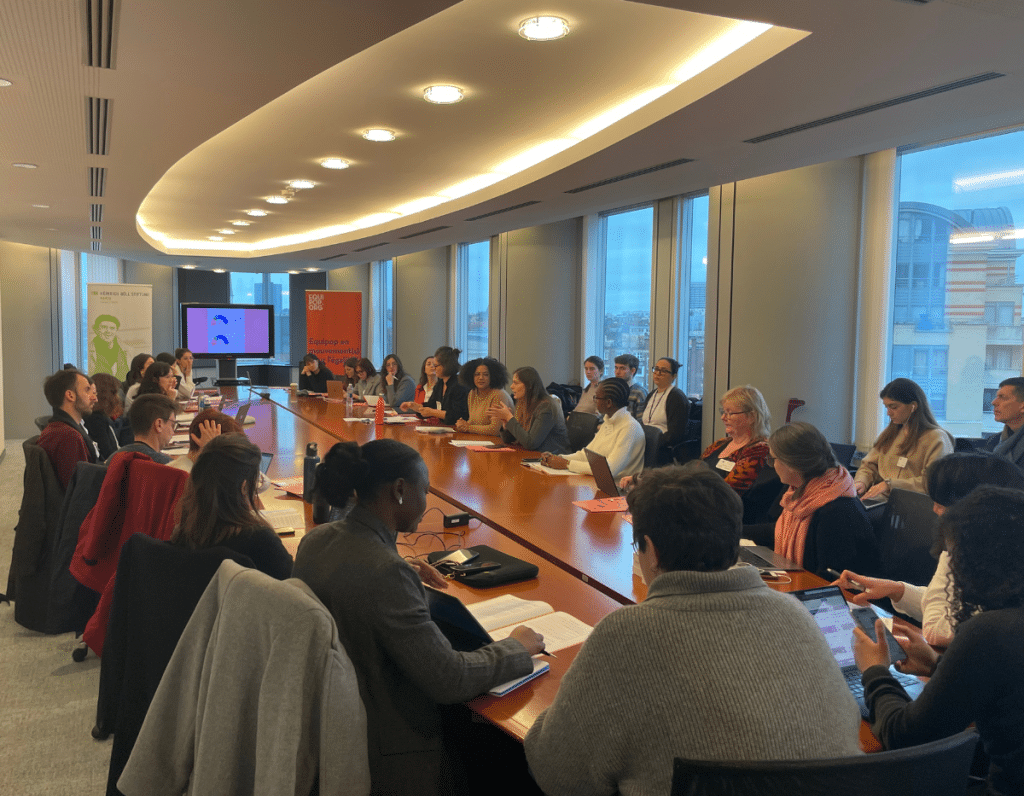
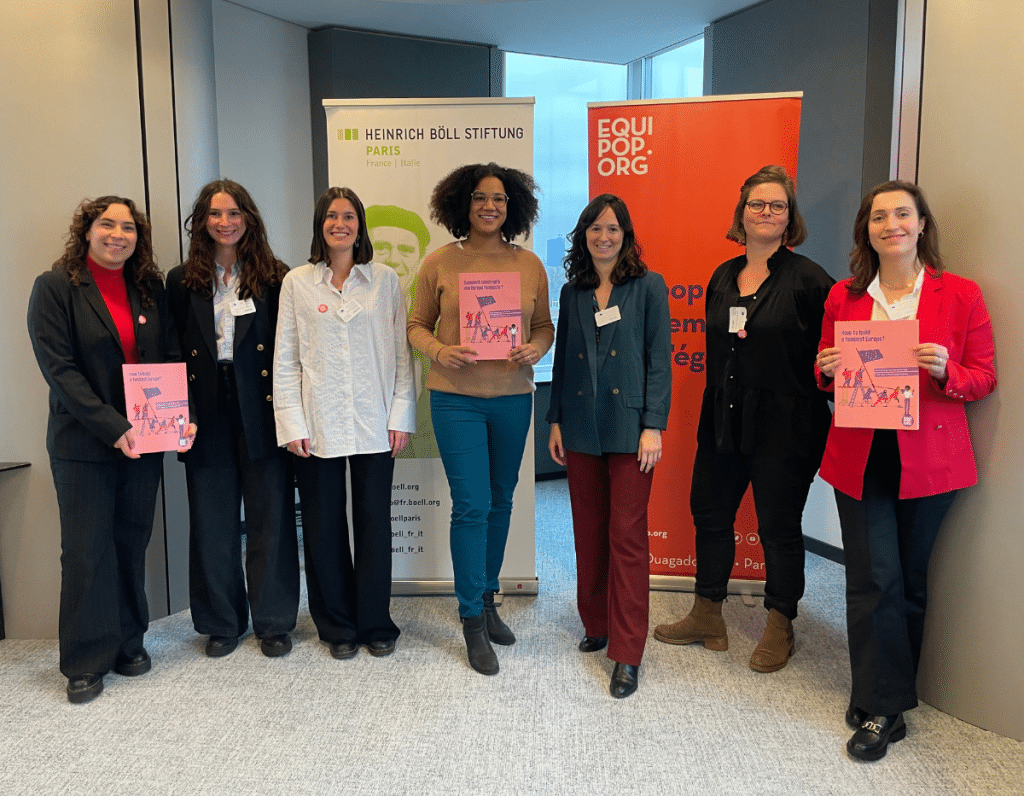
On Tuesday, December 10, 2024, on the occasion of International Human Rights Day, Equipop co-organized, in collaboration with MEP Mélissa Camara, a launch event at the European Parliament to present its new report entitled " How to build a feminist Europe? The challenges facing the far right ." This report, produced in cooperation with the Heinrich-Böll-Stiftung Paris association, is part of a series of Equipop's work on anti-rights movements and the rise of conservatism, including the recent study " When the far right advances, women's rights retreat ." It takes stock of the post-election European Union, focusing on the rise of far-right parties, their strategies, and the repercussions on the rights of women and LGBTQIA+ people.
Brussels: a strategic location to launch Equipop's new report
The venue for the event, Brussels, was particularly strategic for the launch of Equipop's new report: the European Parliament is a democratic institution that plays a key role in promoting human rights, including the rights of women and LGBTQIA+ people, in Europe. The European Parliament has been behind many major advances in gender equality and the fight against violence against women. For example, in June 2023, pressure from the European Parliament was decisive in pushing the EU to accede to the Istanbul Convention, a fundamental text for the promotion of gender equality. More recently, in April 2024, the European Parliament adopted the directive on combating violence against women and domestic violence, marking a new major legislative milestone in favor of women's rights. The launch event for the Equipop report "How to Build a Feminist Europe? Challenges Facing the Far Right" brought together a wide range of participants at the European Parliament, including media, associations, students, and MEPs, who gathered to discuss ways to take action against the far right and work towards building a feminist Europe. Several speakers shared their analyses and perspectives, including Lucie Daniel, Advocacy Manager at Equipop, and Morine Chauvris, Advocacy Assistant, who presented the report and its conclusions. MEPs Mélissa Camara and Emma Rafowicz also spoke, as did Equipop partners such as Marie Tempesta (IPPF) and Aline Burni (Walking the Talk), to explore synergies for action against the far right and in favor of gender equality.
A shared observation: the rise of the far right and the dangers for women's rights
A unanimous conclusion emerged: the feminist revolutions currently underway are provoking and/or encountering a backlash, with reactionary movements across Europe deploying strategies to undermine progress in gender equality and roll back hard-won rights. And the far right is both fueling and exploiting this backlash. In its report, Equipop analyzed the historic rise of far-right parties following the 2024 European elections. These far-right parties are the main force opposing the rights of women and LGBTQIA+ people. In addition to their gains in the European Parliament, the far right came out on top in five countries: France, Italy, Austria, Belgium, and Hungary. Furthermore, Equipop pointed out that, although the European far right is often perceived as fragmented due to economic and geopolitical differences, these parties easily agree on the most reactionary positions on immigration, women's rights, and LGBTQIA+ rights. In recent years, the far right has adopted a strategy embodied in femonationalism, a trend analyzed and conceptualized by researcher Sara R. Farris. This refers to the exploitation of feminist struggles for racist electoral purposes, particularly visible in the rhetoric of several far-right figures, who present immigration as one of the main threats to women's rights in Europe, wrongly accusing migrants of being primarily responsible for sexual and gender-based violence. Furthermore, as pointed out by Aline Burni, Head of Policy and European Engagement at ODI Europe, women represent only 20% of the members of "influential committees" such as the Committee on Foreign Affairs (AFET) or the Committee on Budgets (BUDG), and the presence of women as committee chairs continues to decline. Furthermore, there is a noticeable disengagement among male MEPs in the FEMM committee, as women's rights and gender equality are still perceived as "exclusively female" issues. One telling factor is the growing presence of the far right in the FEMM committee. This new strategy by the far right, also analyzed in the new Equipop report, aims to undermine progress on gender equality, while paying lip service to these issues. In addition, the threat to the "cordon sanitaire" in the European Parliament was a central topic of discussion at the event, in particular the EPP's tendency to "radicalize" towards the far right. This political group no longer hesitates to ally itself with European far-right parties on issues such as the Green Deal and immigration policy. Women's rights, an issue on which the EPP has an ambivalent position, could suffer as a result of such alliances in the future.
Let's organize against the far right!
However, this reactionary offensive is not unstoppable. Wherever it strikes, feminist organizations and social and political movements are organizing to resist it. Although the situation is serious, one slogan has emerged: "If we organize, we can do it!" As Mélissa Camara and Emma Rafowicz have pointed out, progressive forces in civil society and the European Parliament must show ambition and not give in to the far right. By organizing together—civil society, MEPs, and feminist movements—we have the capacity to ensure that feminist principles prevail. Several courses of action were discussed to counter this backlash and block the far right. Among the priorities, as Marie Tempesta of IPPF mentioned, increasing the gender budget within the MFF (Multiannual Financial Framework) is crucial. Secondly, the creation of a budget line specifically dedicated to funding feminist associations must be considered. MEP Emma Rafowicz also emphasized the need to advocate for a feminist foreign policy at the European level and to create alliances beyond the Greens and S&D groups. Furthermore, although the ratification of the Istanbul Convention by the EU is an important step forward, it remains imperative that all EU Member States ratify it at their level as well. Another concrete action was also suggested in the short term: to collectively call on European Commissioner Ursula Von der Leyen to clarify the political line of her party, the EPP, within the European Parliament in the new term, especially since the latter has already started voting with the far right. Finally, European citizens' initiatives such as My Voice, My Choice. Led by feminist activists and organizations, this initiative calls for justice and respect for fundamental rights, particularly sexual and reproductive rights, by working to guarantee access to abortion throughout Europe. Through the dissemination of this report and, more broadly, as part of its work at the European level, Equipop will continue to foster this type of exchange and meet with MEPs as part of an international and cross-party mobilization effort. The association will closely monitor the actions of European Commissioners on gender issues and will mobilize to maintain media visibility around these issues. Other events, in Brussels and elsewhere in Europe, are planned for 2025 with a view to building a feminist Europe.
The full report , “How to build a feminist Europe? After the European elections, the challenges facing the far right,” is now available.