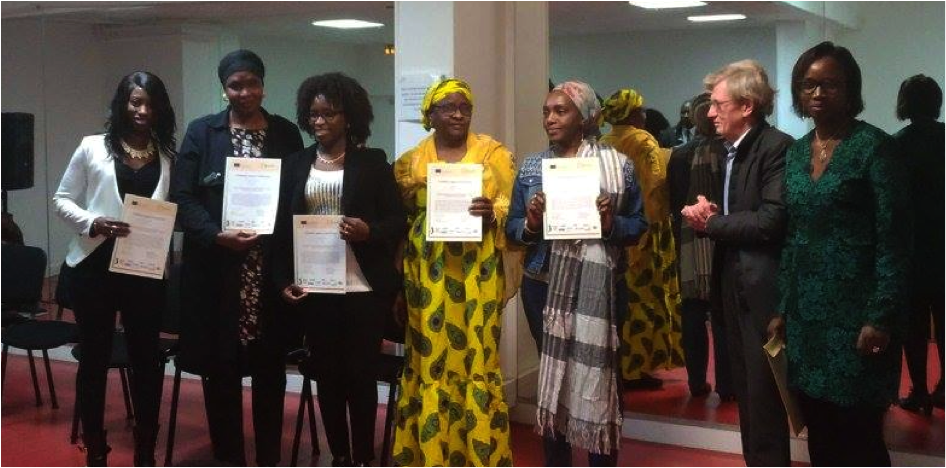
After a year marked by the implementation of numerous behavioral change workshops for immigrant populations in the Ile-de-France region, Equipop's change mediators received their diplomas, recognized by the European Commission, during a ceremony held in their honor on December 16, 2017.
"When it comes to female genital mutilation, change can only come from within the community itself. The project is viewed much more positively if members of the community talk to other members of that same community. It's a relevant project." This is how mediator R. Sissoko described her experience with the Change Plus project.
A project that empowers mediators
The project's goal of training resource persons in communities who will continue to provide information and guidance beyond the project period has thus been achieved. Projects aimed at changing attitudes and behaviors regarding women's health and rights are typically funded for short periods of time. For example, Change Plus was funded and implemented over two (2) years. However, behavioral change is a long process that requires support. To overcome this constraint, the project strategy was to rely on the internal resources of the communities.
D. Ball, mediator: "The Change Plus project was an opportunity for me to grow personally. It allowed me to develop many skills, receive good training, participate in initiatives in France and Europe, and become part of a network. I had the opportunity to speak at the European Parliament in Brussels during an advocacy meeting and to be in contact with African partners."
"We received training that strengthened our experience in terms of communication, community outreach, and advocacy," F. Dia
A ceremony attended by a diverse group of participants
This graduation ceremony brought together more than 45 people: families of mediators, workshop participants, partner associations, and artists.
To offer new perspectives, speaker and writer Halimata Fofana, author of Mariama, l’écorchée vive (Mariama, the Raw Skin), published by Karthala, spoke on the topic of "Excision and Identity." According to Halimata Fofana, excision cannot be separated from the question of identity: "When young girls are circumcised, it is to show them where they belong. It shows them that they are part of a group, a community. And when they become adults, they wonder if they are normal. They feel like they are only half a woman, or not quite a woman. There is a real process of reconstruction to be done. By resorting to surgery, women seek to become like everyone else again."
His presentation was followed by a lively discussion. Participants' questions and contributions focused on topics such as the experiences of women who have undergone FGM, with one participant who had been subjected to the practice speaking openly about her "disability"; FGM and religion, and the fundamental role of religious leaders in ending the practice; and the importance of psychological support in the surgical repair process.
A Senegalese journalist collected testimonials for an audio documentary as part of the "Building Bridges" initiative between Europe and Africa. The "Building Bridges" initiative, supported by UNFPA and UNICEF, advocates "a sustainable, community-based, and multisectoral approach to renouncing these practices [harmful to women's health, including female genital mutilation], with the ultimate goal of eradicating them within a generation." According to the same source, the fight against female genital mutilation requires a coordinated and collective approach. The large diaspora from West African countries living in Europe must be mobilized to abandon harmful practices such as female genital mutilation. Immigrants have an influence on their families in Africa, with whom they are increasingly connected thanks to the development of communication technologies. They can pass on the knowledge they have acquired in Europe. Immigrant populations are in turn informed of events taking place in their countries of origin, such as abandonment ceremonies and progressive stances taken by community leaders, thus demonstrating that social and cultural changes are also taking place there.
Reiterating their commitment, the mediators expressed their desire to continue the work they had begun in the communities alongside Equipop. "I hope that we will continue to pass on our knowledge so that excision is finally abandoned," saidA. Kane.