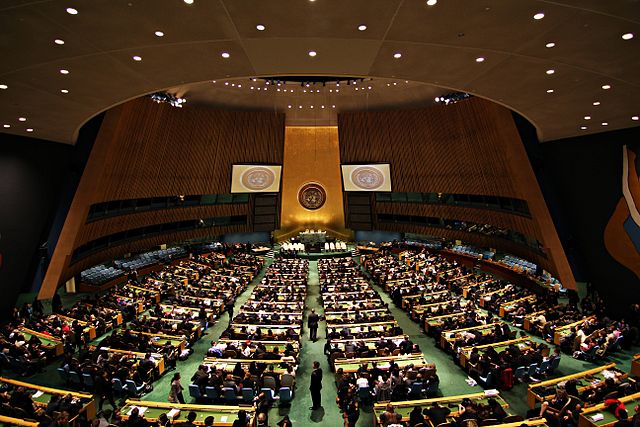
One month after the G7 summit, Emmanuel Macron is attending the United Nations General Assembly in New York. This is a key moment for advancing gender equality, and France must use all its influence to intensify international mobilization. The president must take a clear stance to finally embody the "feminist diplomacy" that his government has been promoting for the past year and a half.
This opinion piece appeared in Huffpost on September 23.
Opinion piece by Nicolas Rainaud, advocacy manager at Equipop and member of the HCE (High Council for Gender Equality).
A year ago, at the United Nations, Emmanuel Macron called for gender equality to be made a "major global cause." France's presidency of the G7, which began in January, was the main driver of this initiative, with the aim of holding a "feminist G7." Almost a month after the summit of heads of state and government in Biarritz, what conclusions can be drawn?
Yes, the 2019 G7 summit enabled progress to be made. In a difficult context, French diplomacy secured the signing of the "Biarritz Partnership for Gender Equality" by the seven G7 members and four other states; this number could grow in New York. Substantial funding has been put on the table to support the AFAWA initiative promoting female entrepreneurship in Africa. Finally, France will contribute €6.2 million over three years to the fund dedicated to survivors of sexual violence in times of conflict, created by Nadia Murad and Denis Mukwege.
A G7 that is moving in the right direction, but not yet a feminist G7
To move towards gender equality, we need both concrete, funded commitments and a firm political stance. In Biarritz, it is clear that France has favored compromise on these three initiatives at the expense of defending the ideal of equality. Donald Trump declared at the start of the summit that gender equality, climate change, and development in Africa were "niche" issues ." No one contradicted him. Showing Franco-American collaboration on other issues may have been relevant to preserving multilateralism—it is not for us to judge—but this choice contradicts the ambition of holding a feminist G7.
Furthermore, the "family photos" from Biarritz, which mostly feature one or two women among fifteen or twenty leaders, speak for themselves. A G7 cannot be considered "feminist" when gender parity is so blatantly disregarded. Of course, the fact that the leaders of the G7 states and invited institutions are men is not the responsibility of the French presidency, but it was possible to mitigate this unbalanced image, for example by eliminating the appearances of the "first ladies," which perpetuate certain stereotypes. Tradition is undoubtedly difficult to break, but Emmanuel Macron did so in other areas of this G7 summit, by claiming to break with convention and imposing a new format, without a joint final declaration.
The G7 is over, there is no longer any reason to proceed under cover.
The omnipresence of the United States in the G7 has made diplomatic maneuvers extremely delicate; and the very essence of the G7, an informal group of powerful states, is questionable. But the G7 is now a thing of the past. The horizon is clear, and France must move forward openly. The United Nations General Assembly and the coming year provide an opportunity to place these issues in a more legitimate and institutionalized context.
The United Nations is the scene of a power struggle between states that promote women's rights and conservative states that are trying by all means to roll them back. Emmanuel Macron's stance on this issue must be uncompromising and form a major focus of his speech.
In addition to the hoped-for impact within the international community, this will have a positive effect internally. French diplomacy has not yet fully integrated the reflex to defend gender equality, which is relatively normal given that the concept of "feminist diplomacy" is recent. Regular and convincing impetus at the presidential level is not sufficient, but it is essential to systematize the approach throughout the diplomatic corps.
Aligning international and national policies
In the near future, pursuing feminist diplomacy must mean two things. First, listening to what feminist movements, in all their diversity, have to say. Recently, the President of the Republic consulted several bodies that he himself appointed and which represent part of civil society. This interesting development cannot replace consultation with movements that organize themselves and make their own recommendations. The success of the Generation Equality Forum, which will be held in Paris and attended by 5,000 people, including around 50 heads of state, depends largely on this shift.
Secondly, a feminist approach implies allocating substantial financial resources to the issue. Since gender equality is both the "global cause" launched by Emmanuel Macron and the major cause of his five-year term at the national level, consistency requires that the President's speech in New York be accompanied, in the coming weeks, by budgetary decisions in favor of significantly increased resources to implement policies related to the "Grenelle" on domestic violence.
It is undoubtedly difficult to change the political norm that has meant this cause has always had to advance without any real resources until now. Now is the time for Emmanuel Macron to show the boldness he repeatedly called for from ambassadors in the aftermath of the G7 summit, and to break with this norm. Gender equality is indeed a great cause, and it can only be advanced with real resources.

Nicolas Rainaud is Head of Advocacy for France and International Affairs at Equipop. A graduate of Sciences Po Paris, he has been working in the field of international solidarity for ten years. He monitors the process of integrating gender issues into French development policy and international initiatives. A member of the High Council for Gender Equality, he is also active in the gender commission of Coordination SUD and the Women 7 engagement group.