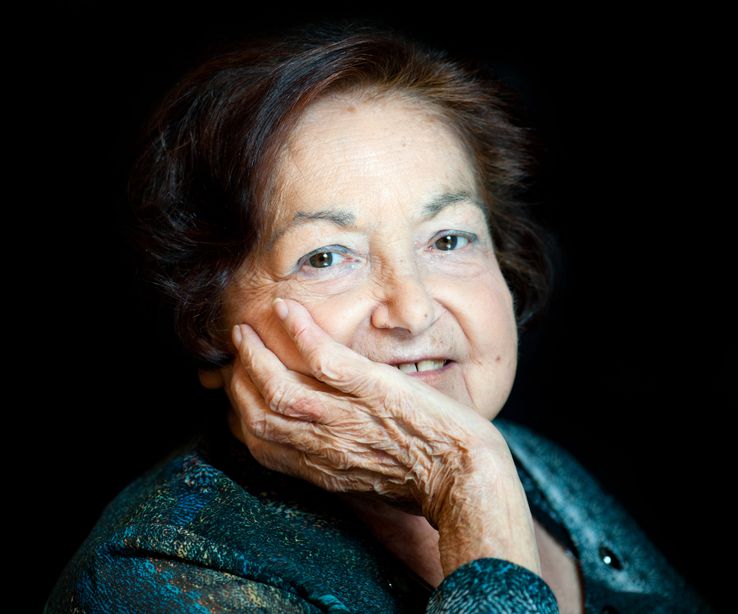
Françoise Héritier, one of the greatest intellectual figures of our time, died on Wednesday, November 15, at the age of 84. Her prolific thinking articulated a keen understanding of African societies and the anthropological foundations of gender inequality. Through her participation in the scientific council of Equilibres & Populations and, of course, through the works she published, which have become established as references, she greatly influenced the NGO's thinking and positioning.
Anthropologist in the city
Intellectual honesty and thinking in action were two remarkable traits of Françoise Héritier's personality. A renowned anthropologist, she spent her early years in the field in West Africa, working with the Samo people of Burkina Faso. An honorary professor at the Collège de France, where she succeeded Claude Lévi-Strauss, she headed the Laboratory of Social Anthropology for sixteen years and inaugurated the chair of "Comparative Study of African Societies." Over the years, she decided to focus her seminar on the anthropologist's commitment to society. Driven by this desire to participate in the construction of the world in which she lived, she made valuable contributions to many causes. She chaired the National AIDS Council and was a member of the Advisory Committee on Ethics in Life Sciences, the Ethics Committee for Science at the CNRS, the High Council for Francophonie, the High Council for Population and Family, the Universal Academy of Cultures, and the National Council on Disability. Throughout her career, Françoise Héritier also spoke out on many social issues, such as civil unions, gender equality, the wearing of the veil, anonymous childbirth, adoption, and same-sex marriage.Just last week, on France 5, she took part in the public debate to support the freedom of speech for women who have been assaulted and/or harassed. We must give victims a voice and shift the shame to the other side, she liked to remind us.
Thinking about gender inequality
At the heart of Françoise Héritier's thinking lies the innovative concept of "differential valence of the sexes," based on the observation that the distinction between feminine and masculine is universal and that, everywhere, at all times and in all places, the masculine is considered superior to the feminine. At the origins of this unequal symbolic system lies the terror of the maleHomo sapiensat the fact that females of his species could give birth to men, and thus produce something different. Male domination is therefore a universal response, an "anthropological constant," a "buffer for thought."
Levers for change: working on social norms and promoting women's autonomy
While Françoise Héritier was convinced that gender inequality was universal, she was equally convinced that the situation could change. It was a social construct that could and should be deconstructed. To achieve this, two avenues need to be explored simultaneously.
First step: changing mindsets. For the researcher, it was important to take action on the political and legal framework, but even more so to promote social communication. Promoting access to accurate information, encouraging dialogue, and showcasing alternative models of behavior are all levers that can be used to change mindsets and move toward gender equality. All channels of communication should be used in a complementary manner to deconstruct stereotypes: education in schools from an early age, mobilization of journalists, use of television series or theater, discussions under the shade of the baobab tree, in neighborhoods or within boards of directors.
Second avenue: promoting women's autonomy. In this regard, contraception was an essential lever for her because it acts at the very heart of where domination occurred: "Thanks to contraception, women become masters of their own bodies and are no longer considered mere resources; they exercise their free will in matters of fertility, including the choice of spouse, the number of children they wish to have, and when they wish to have them."
In an interview with Mediapart in February 2016, Françoise Héritier responded to the question "How do you assess the evolution of the situation of women today?" as follows: "This question you are asking me comes at a time when, with the rise of fundamentalism of all kinds and the resurgence of manifestations of male domination, I am less optimistic than in the past. The goal still seems far away, whereas it used to seem within reach, at least in developed countries."
Equilibres & Populations and its partners will take Françoise Héritier's words as an invitation to redouble their efforts in the years to come, continuing to explore the paths she has laid out to advance the cause of women around the world.
Photograph: Françoise Héritier • Credits: Yannick Coupannec / Leemage – AFP – On theFrance Culture website