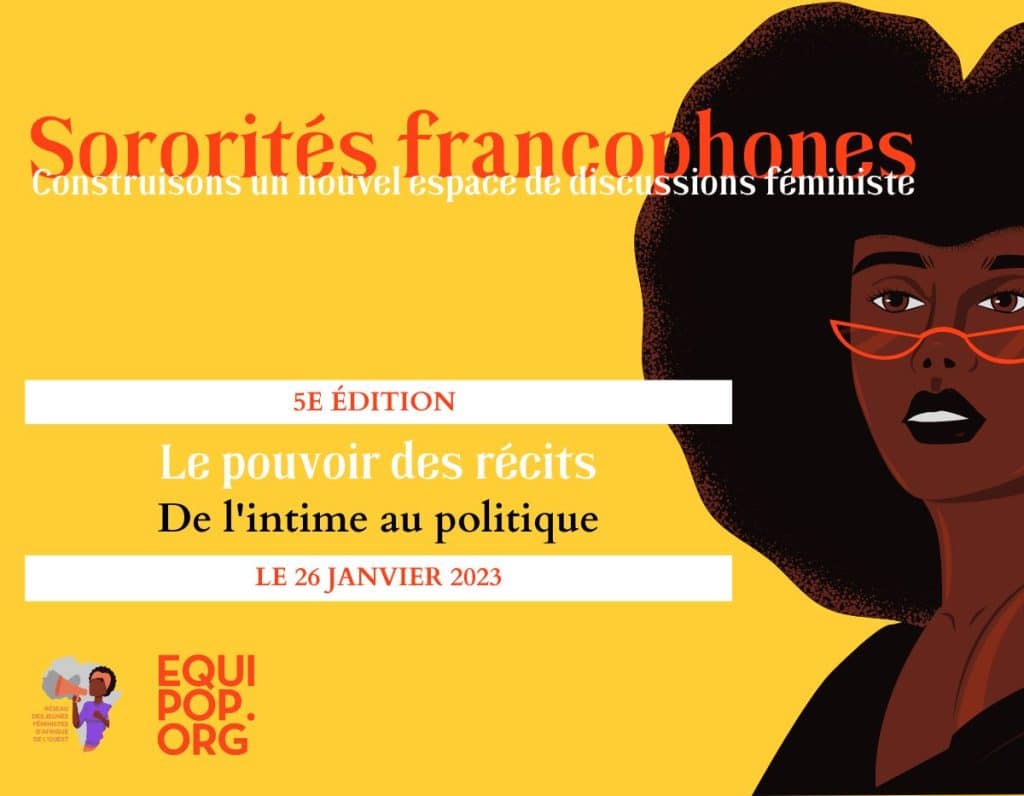
On January 26, 2023, the West African Young Feminists Network and Equipop organized the fifth edition of the Sororités francophones cycle. The aim of this meeting was to gain a better understanding of the issues surrounding feminist narratives.
Talking about yourself is difficult. It means laying yourself bare, exposing yourself to the gaze of strangers. But it can also be a way to help women and girls by giving them a voice they can identify with and in which their own stories are reflected. Influenced by the stories of other black feminist figures such as Maya Angelou and Alice Walker, three personalities enriched the discussion on feminist narratives and their transmission during the Sororités francophones meeting:
- Axelle Jah Njiké, Afropean author, playwright, sound content creator, producer, columnist, and pagan feminist activist;
- Pascale Solages, from the feminist organization Nègès Mawon in Haiti;
- Fabiola Mizero, consultant on organizational development and gender issues in Africa, and creator and host of the South Side Stories podcast.
From intimate to political narratives
For Pascale Solages, talking about oneself allows one to build " her fight for women and girls, not from a selfish point of view because she is trying to heal herself, but to say that these are experiences, shared experiences." This is a political approach that allows women who have had painful experiences to use them consciously. Storytelling is a tool for self-reflection and personal development that can take on a political dimension and allows individuals to convey knowledge and thoughts and express emotions through their voices. This is the approach taken by Axelle Jah Njiké, who gives the microphone to others to address intimate topics that have a universal aspect and have until now been neglected in Black feminist conversations, such as entering puberty or the first kiss. "Talking about intimacy helps build bridges between people who think they have nothing in common.". For her, the issue of female genital mutilation has a universal aspect: "We tend to think that this issue only affects women who have been mutilated [...]. Collectively, it is not brought to the forefront as an attack on all of us, because at the heart of this practice is the idea that women's pleasure is undesirable." The narrative is therefore unifying, capable of bringing women together on issues that they might not have felt concerned about at first glance.
The power of words
To talk about yourself and turn it into something transformative, you need to find your intention, your goal, to dare to open up to others. Through meeting people who had shared similar experiences, Fabiola Mizero decided to build on her own experiences to take collective action. These spaces, places of healing, have become mediums for expression and organization over time. The three speakers emphasized the importance of certain keywords in their stories. For Pascale Solages, the word that defines her struggle is negesse, the Haitian Creole word for "negress." For her, saying and writing this word is a form of rebellion against a language that systematically renders women invisible in her country's struggles. She is waging a linguistic battle with the aim of bringing women into the national discourse, but also of changing the very meaning of the word. As for Axelle Jah Njinké, it was while searching for the definition of the word Viol in the pages of a dictionary that she was able to understand and reclaim part of her past and her intimacy. Later, when she discovered works of erotic literature written by women, she relearned female intimacy and understood the importance of these subjects in feminist discussions.
The right medium
The medium of expression has a role to play. The podcast, chosen by Axelle Jah Njiké and Fabiola Mizero, allows them to free themselves from the stigma suffered by black women. The voice becomes a means of resonance with others, regardless of their skin color: "this type of content is not only for black people.". The art of storytelling becomes a means of transforming societies. Thus, the common goal of the three speakers is to bring women, specifically black women, together in a space where they can identify with each other and exchange ideas. Pascale Solages wants to "create spaces where women can exist for themselves". Fabiola believes that her stories are aimed at women who share a small part of her experience, and more generally at Black women. For Axelle Jah Njiké, the reason she shares her stories is more therapeutic. She writes "for the young girl, the teenager that I was, who so desperately needed these stories.".