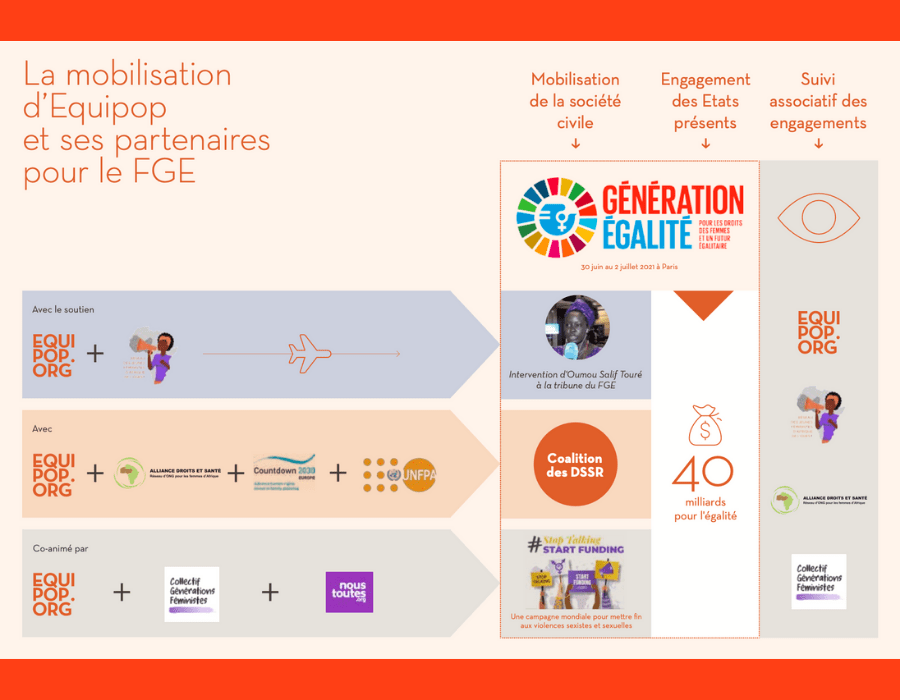
A total of $40 billion for gender equality was announced in Paris in early July 2021, including $23 billion from governments. This impressive aggregate figure will remain an abstraction unless each individual commitment is fulfilled.
Equipop and its partners will now focus particularly on monitoring the commitments made by West African states on SRHR and by France. We plan to support the official accountability work of the FGE, which will be set up under the auspices of UN Women, but also to continue to support the various associations in which we participate. The participation of young people in these monitoring processes and in the implementation of the resulting public policies is one of the main areas to be consolidated. The sustainability of funding for feminist associations is another, and perhaps the most important, if we want the ideas outlined at the FGE to bring about transformative change.
[vc_column css= ».vc_custom_1640695045486{background-color: #c4c4c4 !important;} »]
Interview with Oumou Salif Touré, member of the West African Young Feminists Network, who attended the WEF in Paris. Last June, the WEF brought together states, international organizations, civil society, and the private sector to define a series of concrete actions to advance gender equality and women's rights around the world in six areas. As a member of the young feminists network, it is very important for us to position ourselves for the post-WEF period. Six countries from the Ouagadougou Partnership (Benin, Burkina Faso, Guinea, Mali, Niger, and Togo) have mobilized under the leadership of Burkina Faso, co-leader of the SRHR Action Coalition, to develop joint commitments. In total, the Minister of Health of Burkina Faso presented eight commitments in Paris, including family life education, coordination of actions, allocation of resources for health, promotion of inclusive national social dialogue on ending GBV, and improving young people's access to SR/FP services. A process of ownership of these commitments and increased monitoring at the level of our different countries is more than necessary to achieve effective implementation and ensure that the FGE triggers a sub-regional dynamic for gender equality.