
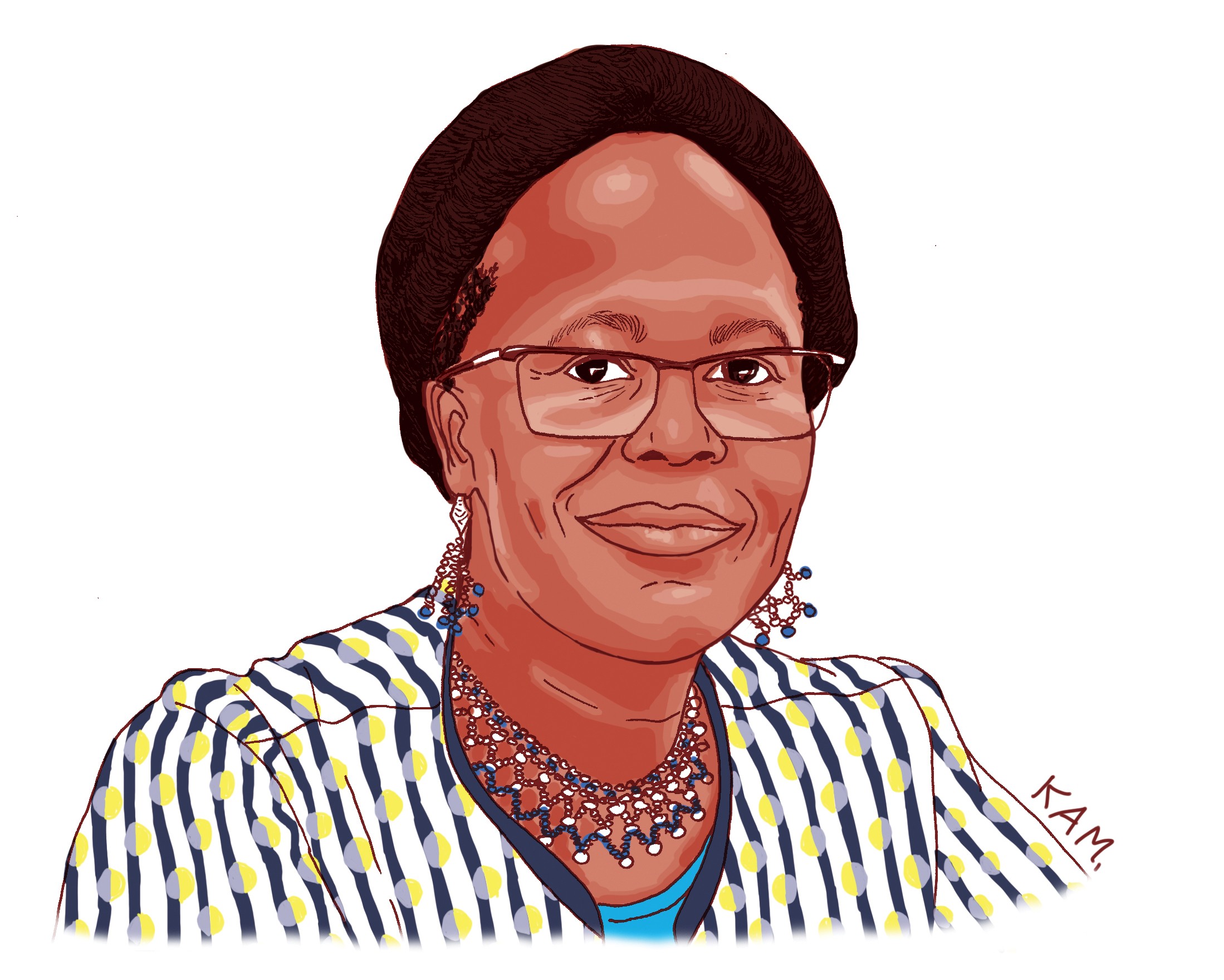
Interview with Pascaline Fagninou, Executive Director of the NGO Le BACAR. A Beninese organization created in 2000 in Savalou, Le Bacar (African Support and Advisory Office for Achievements) implements programs that promote the development of women and children. It obtained Level 1 of the Ampli Label during the first session in 2021 and is already aiming for Level 3!
How is BACAR's activity structured?
 Even before embarking on the certification process, we already had a highly structured organization, with key areas defined in our strategic plan thanks to the implementation of several improvement projects identified and developed following various organizational assessments (OA) of the NGO funded by EQUIPOP. One of these projects resulted in the NGO adopting a Strategic Plan for 2018-2022.
The first focus area is public health, which covers community health, family planning (FP), SRH, and SRHR. We are working on this aspect with Equipop, Oxfam Canada, the Global Fund through the Department of Health, particularly as part of the SWEDD project (Women’s Empowerment and Demographic Dividend Project), as well as with the World Bank. In this regard, we work with girls who have dropped out of school or never attended school, sex workers who are registered or unregistered, people living with HIV (PLHIV), and people living with disabilities. We train apprentices—seamstresses, mechanics, carpenters, laborers, etc.—to promote their skills. and nutrition. The second focus is agriculture, through support for women's groups and farmers' organizations to improve food crops (cassava, soybeans, etc.) and the products derived from their processing. This is actually our program. “from farm to fork”, which aims to help women successfully produce, process, and market cassava, soybeans, and their derivative products.
Our third focus area brings together cross-cutting areas such as: governance at local and national level, gender and development, child and maternal protection, and the environment. This has enabled the NGO Le BACAR to become involved in several networks such as the FODDEB (Forum of Organizations for the Defense of Children's Rights in Benin) for coordination at the Collines Department level, the Federation of NGOs of Collines (FODEC), of which BACAR is Vice-President. BACAR also holds the position of Secretary General of the Board of Directors of Social Watch Benin, a network of associations created in 2005 to promote citizen oversight of public action.
Finally, I would like to emphasize that we have long advocated for gender, development, and the environment across all of our programs.
Even before embarking on the certification process, we already had a highly structured organization, with key areas defined in our strategic plan thanks to the implementation of several improvement projects identified and developed following various organizational assessments (OA) of the NGO funded by EQUIPOP. One of these projects resulted in the NGO adopting a Strategic Plan for 2018-2022.
The first focus area is public health, which covers community health, family planning (FP), SRH, and SRHR. We are working on this aspect with Equipop, Oxfam Canada, the Global Fund through the Department of Health, particularly as part of the SWEDD project (Women’s Empowerment and Demographic Dividend Project), as well as with the World Bank. In this regard, we work with girls who have dropped out of school or never attended school, sex workers who are registered or unregistered, people living with HIV (PLHIV), and people living with disabilities. We train apprentices—seamstresses, mechanics, carpenters, laborers, etc.—to promote their skills. and nutrition. The second focus is agriculture, through support for women's groups and farmers' organizations to improve food crops (cassava, soybeans, etc.) and the products derived from their processing. This is actually our program. “from farm to fork”, which aims to help women successfully produce, process, and market cassava, soybeans, and their derivative products.
Our third focus area brings together cross-cutting areas such as: governance at local and national level, gender and development, child and maternal protection, and the environment. This has enabled the NGO Le BACAR to become involved in several networks such as the FODDEB (Forum of Organizations for the Defense of Children's Rights in Benin) for coordination at the Collines Department level, the Federation of NGOs of Collines (FODEC), of which BACAR is Vice-President. BACAR also holds the position of Secretary General of the Board of Directors of Social Watch Benin, a network of associations created in 2005 to promote citizen oversight of public action.
Finally, I would like to emphasize that we have long advocated for gender, development, and the environment across all of our programs.
Everything seems to be in place, so how has certification improved your work?
BACAR has been involved in organizational development (OD) with Equipop since the very beginning, and obtaining the label has led us to reorganize our intervention strategy. By digging deeper and adopting a quality approach based on OD for several years, we have been able to lay the fundamental groundwork for improving our decision-making bodies. From there, our organization's approach and general culture were put to the test of the ampli label. During this test, we highlighted a distinctive feature of our organization that can be summarized as follows: previously, we worked directly with the targets. During the DOs, we identified that we were not involving all stakeholders in our actions enough, but this proved to be an asset for the sustainability of our actions. In terms of leadership and governance, we also understood that we needed to involve local actors more. The board members were very distant from our activities. But today they are very involved in the DO and the Label, which has heightened their attention. They have mobilized with us to move forward with the certification process. Every week, we had to report on what we had put in place. Today, members no longer skip meetings. We also established a communication plan. We had a strategy, but no plan. The Plan allows us to implement and evaluate our communication strategy. Communication is essential for promoting our organization and our achievements. There has also been a clear improvement in our resources, in terms of human, material, and organizational resources. We weren't paying enough attention to this.
In concrete terms, what impact has this had on your activities?
Obtaining this label has enabled us to make very concrete improvements to the way we work. The support provided by the DO and the Ampli Label has enabled us to work more effectively with our partners and develop our skills with the parents of apprentices, trainers, workshop leaders, and above all, improve our system for mobilizing various resources. In terms of community health, we have long been working in the field of public health with sex workers (SWs) who are registered—working in brothels—and those who are not registered, working in bars and restaurants. In particular, we raise community awareness about HIV, hepatitis, tuberculosis, and other diseases. We have realized that it is not enough to simply point the way to the hospital and say, "Go to the hospital to get treatment." In a community setting, it is important to accompany the target individuals (those identified as suffering from a particular illness). Now, in each community where we work, in Savalou and Savè, we have a nurse or midwife whom the sex workers know, and they can go and see her for a check-up every month. They are more likely to go to the hospital and follow their treatment. This also allows us to have a good relationship with the coordinating doctor responsible for each health zone in our area of operation. We also feel very close to the bar and restaurant managers in our areas of operation and, better still, very comfortable working with them. So much so that they understand the benefits of allowing sex workers time off to seek treatment and benefit from our advice on life skills, sexual and reproductive health, and sexual and reproductive health and rights. This not only allows them to stay healthy, but also improves their productivity.
Would you recommend this approach to other organizations?
This is an excellent approach. If you really follow the DO and try to identify your strengths and weaknesses as well as threats and opportunities, it provides a solid foundation, especially in terms of institutional strengthening, to move confidently toward certification. But above all, it allows you to identify the areas that need to be focused on for capacity building that can lead to institutional and functional improvement of the organization. Once you obtain certification, internalize it and externalize it! Put the label on your letterhead, documents, and all your communications. It is a way to increase visibility, credibility, and support for grant applications. Certification improves your vision and the visibility of your actions. The label is a springboard for consolidating our institutional and functional base. It has enabled us to maintain and increase our credibility with technical partners, particularly financial partners, and all stakeholders in our organization.