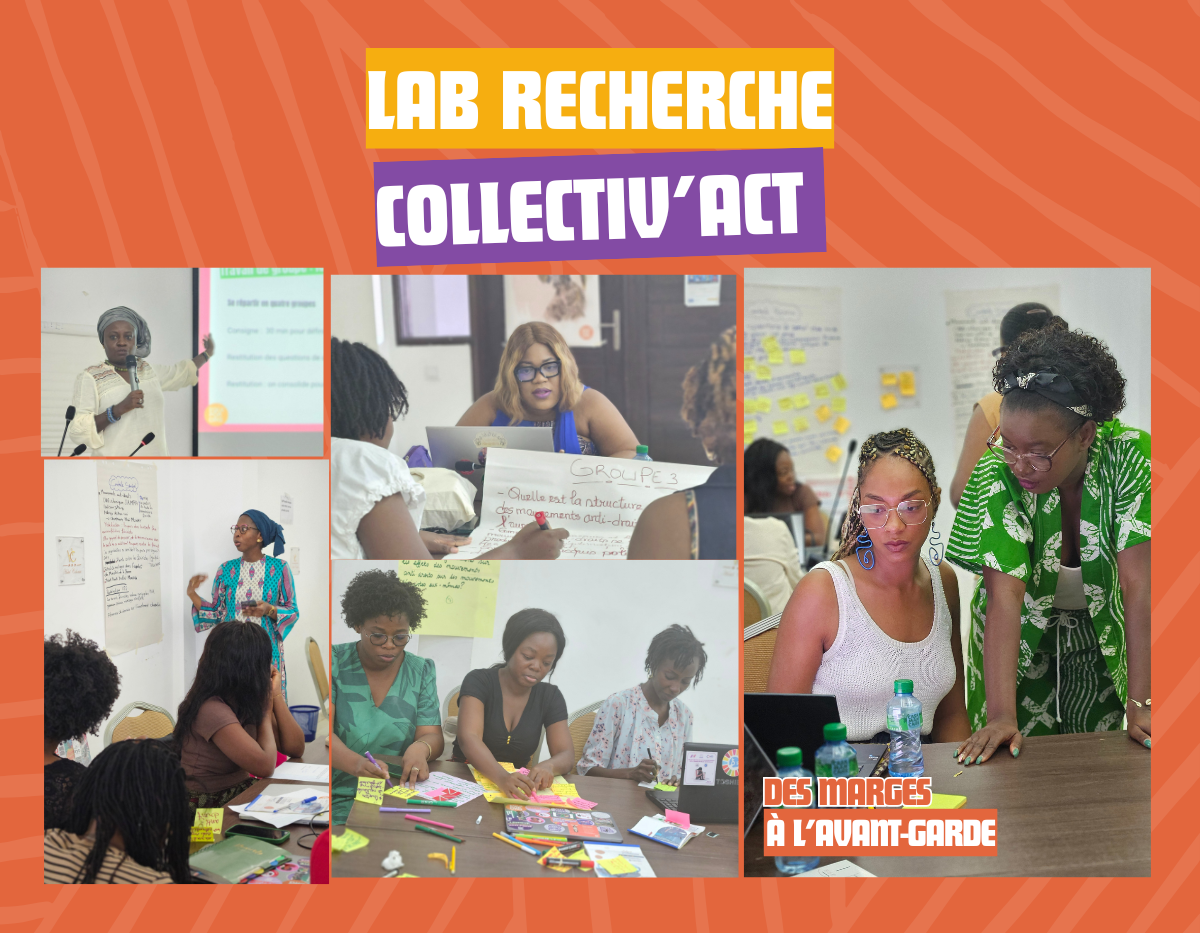
From June 16 to 20, 2025, the Collectiv'Act Recherche incubation lab was held in Dakar, an initiative led by Equipop as part of its Des Marges à l'Avant-garde project. Five days of intense discussions enabled feminist activists, researchers, and committed experts from various African countries (Côte d'Ivoire, Senegal, Benin) to design a feminist and intersectional research project rooted in the realities of the movements, capable of providing appropriate tools to strengthen their advocacy.
For feminist movements in West Africa, the stakes are high. Faced with the rise of anti-rights movements and the persistence of gender-based and sexual violence (GBV), the need to produce relevant data has emerged as a priority. The goal was not only to design a research methodology, but also to produce concrete knowledge to support action strategies and amplify the voices of activists in public and political spaces.
A committed and collective hybrid methodology
The Lab brought together activists, researchers, and feminist organizations around a common goal: to devise research tools that reflect the realities experienced by French-speaking feminists. Far from traditional academic frameworks, the approach adopted is based on co-construction, creativity, and recognition of the legitimacy of activist knowledge.
Faced with the stark reality of a glaring lack of structured, inclusive, and adapted spaces for producing feminist knowledge directly informed by movements, participants established an inclusive and collective framework.
This hybridization combines scientific rigor with feminist commitment, making each participant not only a subject of study, but also a contributor and actor in the research.
The Lab aims to bridge the gap between activism and academic research in order to generate engaging, relevant knowledge that provides concrete tools for advocacy. The project thus seeks to forge links between activist and academic circles in order to strengthen the scientific credibility of research while preserving autonomous spaces for the production and dissemination of feminist knowledge.
The goal is to: restore the voice and legitimacy of activists in the production of feminist knowledge, by promoting an approach that integrates social sciences, political engagement, and local contexts.
A collective dynamic at the heart of knowledge production
One of the key lessons learned from the Lab is the power of a collaborative approach that brings together different voices from activism and research. The Lab has shown that research can both document and transform. By placing activist experiences at the center, it paves the way for a scientific practice that is not limited to analysis, but actively contributes to social change.
Over the course of a week, the collective developed a rigorous yet flexible feminist participatory research project designed to meet the concrete needs of activists while incorporating an innovative methodological strategy combining qualitative and quantitative methods. This project is based on the conviction that feminist knowledge is more robust when it is produced through a dialogue between field experience and scientific rigor.
A joint scientific committee, composed of researchers and activists from various backgrounds, has been set up to ensure feminist and scientific consistency throughout the process. It will accompany each stage, from framing to dissemination. To ensure the consistency and rigor of the approach, a joint scientific committee has been formed. Composed of researchers and activists from various backgrounds, it will accompany each stage of the process, from framing to dissemination. In addition, the effective implementation of the project will be ensured by the consortium led by ROAJELF Benin, which is currently being set up. This consortium will finalize the action plan, protocol, and budget.
A collective momentum for the future
The CollectivAct Research Incubation Lab has reached a decisive milestone: establishing a collective and shared framework, both technical and political, for intersectional feminist participatory research, integrating diversity of experiences and plurality of struggles. By going beyond the traditional divisions between activism and academic research, this initiative offers an innovative response to the challenges facing feminist movements in the face of rising conservatism in the region.
In light of the constant challenges posed by anti-rights movements and gender-based and sexual violence, this project will be a cornerstone for strengthening the capacities of organizations, fueling their strategies for action, and amplifying their voices in public and political spaces.
What next?
In closing, one strong feeling emerged: the Lab did not just produce tools, it opened up a space of trust and solidarity. From Dakar to other territories, this dynamic marks an essential milestone: feminists are not only subjects of study, but also actors and authors of the research that concerns them.
Equipop and its partners are breaking new ground: feminist research rooted in the reality of struggles, serving social transformation and the empowerment of movements.