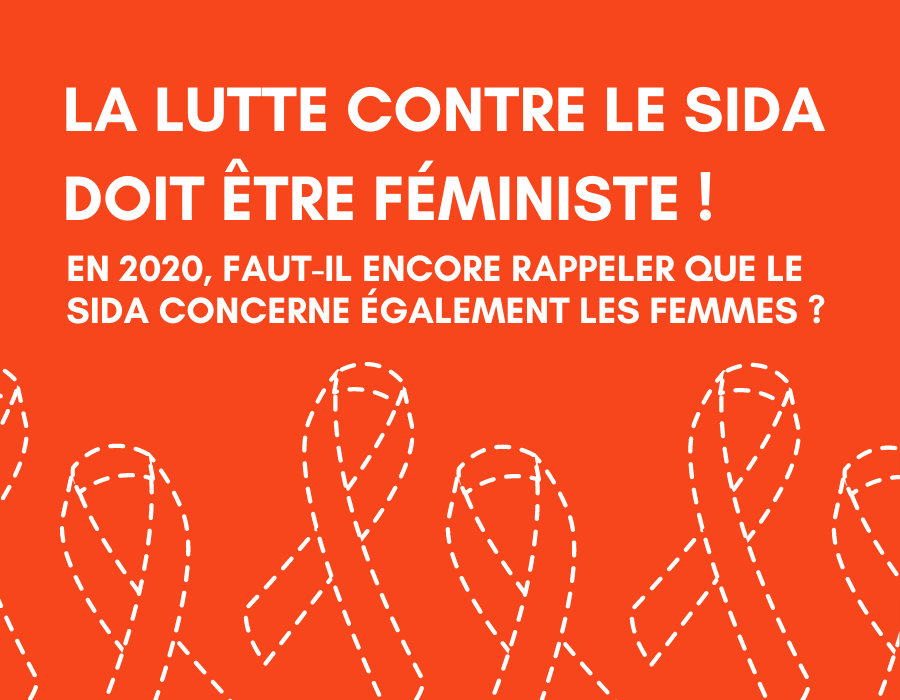
Faced with conventional discourse and political resistance, feminist activists still struggle to make women's voices heard and to promote the solutions they propose in the fight against HIV/AIDS. On World AIDS Day, what are we waiting for to listen to them?
by Aurélie Gal-Régniez, Executive Director, Equipop, and Lucie Daniel, Advocacy Expert, Equipop
This opinion piece appeared in the HuffPost on December 1.
In 2020, do we still need to remind people that AIDS also affects women? Globally, girls and women account for more than half of the 38 million people living with HIV, and in some regions, adolescent girls are particularly affected. These situations are partly linked to patriarchal power relations, which are deeply rooted in our societies and are also and primarily exercised in the sphere of sexuality. In heterosexual relationships, women, particularly those who face multiple forms of discrimination (related to economic status, age, disability, etc.), are often unable to negotiate safe sex. A significant number of them are also victims of rape. Furthermore, women also play a crucial role in caring for the sick, compensating for the shortcomings of the social and health systems in many countries free of charge.
However, women's role in the fight against HIV/AIDS has long been viewed solely through the lens of preventing mother-to-child transmission. Although tremendous progress has been made in this specific area since the 2000s, this only covers part of the issue. Women are not just mothers, so a broader, gender-based approach is needed. International institutions have recognized this, but responses have been slow in coming.
In 1995, at the Fourth World Conference on Women, UN member states committed to taking women's needs into account and ensuring their participation in AIDS policies and programs. But it was not until 2017, fifteen years after its creation, that the Global Fund to Fight AIDS, Tuberculosis and Malaria made gender equality one of the pillars of its strategy. Why has progress been so slow?
A lack of political will and insufficient operational responses
The obstacles are primarily political and institutional. Taking gender into account in the fight against HIV/AIDS requires states to implement proactive policies on comprehensive sexuality education, recognize the sexual rights of all women, and make the fight against gender-based and sexual violence a priority. However, we know that on these issues, we often see setbacks or, at best, incremental progress. Furthermore, the dominant culture in national programs and international organizations remains patriarchal, with gender inequality issues and the participation of women, individually or collectively, marginalized.
The second obstacle, which is directly related, is operational. While the Global Fund has relevant strategic frameworks and tools in place, we are still a long way from concrete implementation. Gender-based approaches are often diluted in technical jargon, subject to an inappropriate results-oriented culture, and discarded when budget decisions are made. There is a huge gap between institutional discourse and the analyses carried out by women's associations, which do not see the effects of these approaches, even at the height of the COVID-19 crisis.
Working with feminist organizations to bring about a turning point in the fight against HIV/AIDS
Given this situation, how can we break out of collective inertia? First, we must provide political and financial support to feminist organizations that have been fighting for years to address the causes of women's vulnerability to the pandemic, raise the visibility of the most marginalized women, and promote their knowledge. These organizations must be systematically involved in the development of public policies to combat HIV/AIDS and in decision-making processes.
Next, gender equality must be made the guiding principle of all public policy on HIV/AIDS. This requires proactive and binding policies that mobilize clear resources to combat structural inequalities between women and men and empower women individually and collectively.
Finally, it is important to repoliticize the gender approach in the fight against HIV/AIDS, i.e., to pursue a resolutely feminist agenda, particularly within international organizations. In line with its "feminist diplomacy," France could play a key role in building a common front by joining forces with countries such as the Scandinavian countries and Canada. The Generation Equality Forum, which will take place in Paris in 2021, is an opportunity to finally raise this issue.
The fight against HIV/AIDS has made a mark on the collective consciousness with its boldness and ability to shake up dogmatic approaches. Its next turning point must be feminist.