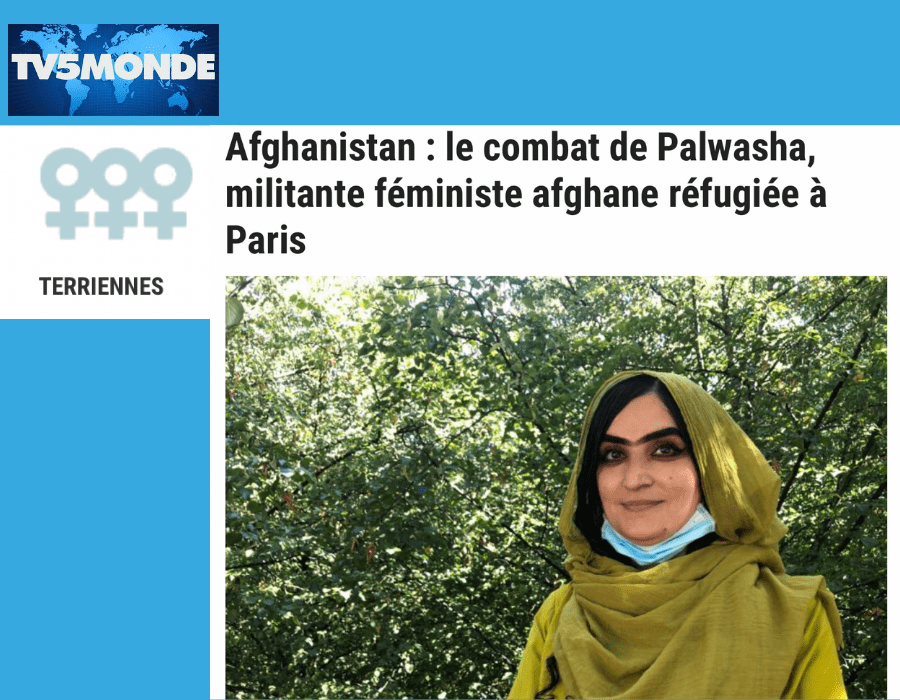
Palwasha arrived in France with her mother Anissa at the end of August, shortly after Kabul was taken by the Taliban in Afghanistan. Due to their commitments, particularly in support of women's rights, both were under serious threat. Their evacuation was made possible thanks to a wave of solidarity from France, in which Equipop played a part. From the south of France, Palwasha continues her feminist activism.
What were feminist movements like in Afghanistan before the Taliban came to power?
When the first Taliban regime ended, I was still in school. That's where my feminist commitment began. I had the opportunity to learn a lot by going to school and then to university. Other activities stemmed from the fact that women had received an education. Before, families only thought about educating their sons, but thanks to the actions of feminists, girls' education also became important. There has been a lot of progress in the field of education. Education empowers women and girls. Access to work stems, among other things, from education. These successes have led to other successes. And the view of women was changing in Afghanistan. Certain rights have been acquired, such as the right for women to own property. Women have also been able to take on a greater role in the media, and women's networks have grown in size. The priority struggle for women, and particularly feminists, is to achieve equality between women and men. Equality that would include the inclusion of women in peace negotiations is a major demand and struggle for Afghan feminists. When I was there as a community leader, I was able to contribute to the peace negotiations and ask for women to be included in these processes.
What does it mean to be a woman involved in politics in Afghanistan?
It was extremely difficult to be a female politician in Afghanistan. Women don't count; they are not seen as people who can contribute to change. Female doctors and professors are now respected, which is progress. But in other professional fields, especially politics, women are considered incapable. There were many security issues for women in politics. To be more precise, the situation was particularly dangerous for women involved in politics but not members of a party. Members of a political party have people to protect them and ensure their safety. For my part, I did not want to depend on a political party. I became involved in politics when I was a law student. I wanted to see my country progress and my people enjoy lasting peace and stability. It was this dream that convinced me to work in politics. I want to bring change for my people, not work for a political party. So I was in constant danger. People wanted to discourage me, to prevent me from doing my work. Above all, they wanted to stop me from speaking to the media. The media, both Afghan and international, supported women activists by making their voices heard inside and outside Afghanistan. Whether it was television, radio, or newspapers, such as the BBCor Deutsche Welle. This visibility gave us the opportunity to prove to Afghans and the rest of the world that Afghan women can be agents of change and contribute to the advent of this peace. I too wanted to change attitudes and awareness about women, and show that women can be involved in politics and really bring about change. I even believe that one day we will have a female president in Afghanistan!
How can you continue your fight for Afghan women from Europe?
I'm not the type to rest now that my mother and I are safe. I've already started putting together a group of Afghan refugees. We've started a WhatsApp group for rotating discussions on topics such as peace and feminist activists. We would like to start activities soon, but for the moment it is complicated because it is not easy for us to meet up; one is in Germany, another in Lyon, and I am in the south of France. But if we organize ourselves, we will be able to bring the voices of Afghan women to the world, and in particular to the UN, to ask for help for peace in Afghanistan and, in the immediate term, for the women who have remained in Afghanistan. I am also in contact with feminists on the ground. We are working secretly because they are in danger. One has already had to fly to Islamabad because she was in danger in Kabul. We have no news of five other activists with whom we are working on girls' education. For my part, I want to continue coming to Paris to meet with prominent figures and organizations, participate in demonstrations, working groups, and forums, and be received by parliamentary organizations. I am available, and we need this support.
What can French and international feminist networks do to help Afghan women and feminists who have remained in the country?
I myself am alive thanks to sisterhood! I was surprised by the overall sisterhood and solidarity in France. I received a lot of support to help my mother and me have a more peaceful life in France, but also material goods, such as food, clothing, etc. I am deeply grateful for this sisterhood and solidarity. The French and international actors can still help refugee women to find each other, put them in touch so that they can speak out on behalf of Afghan women and work for peace. They must be given a voice in Europe. The French media can also contribute by giving Afghan women a voice. There is still time to react!
What does the term "feminist diplomacy" mean to you?
Feminist diplomacy is a concept that promotes best practices in terms of gender equality within government. It must ensure that all women have access to human rights through diplomatic relations, combat sexual violence, ensure that girls and boys receive the same education, guarantee women's economic and financial independence, and ensure women's presence in politics and peace negotiations. All these issues must be part of feminist diplomacy. France has a reputation for supporting gender equality. In particular, it works hard to promote the role of women in politics and the economy. And even if Afghan women are not French, they are women. So if France has a feminist diplomacy, it must help Afghan women.
What are your hopes and prospects?
Istill have hope for Afghan women. I believe we can bring about change, peace, and security in Afghanistan. But above all, I want to continue working as an activist to turn this hope into reality. But right now, what worries me is that I left several members of my family in Afghanistan: a sister-in-law and her four children, without a man. When I lived there, I was their financial support. Now I can't do anything for them. I am very worried, I am always afraid that they will rape one of my little nieces. Here again, I hope that feminist sisterhood can come to our aid.
[vc_column css= ».vc_custom_1639583417594{background-color: #c1c1c1 !important;} »][vc_column_text css= ».vc_custom_1640595621310{background-color: #c4c4c4 !important;} »]You can also follow Palwasha's journey:- Article by Isabelle Mourgère and Lilianne Charrier on Terriennes / TV5 Monde;
- On France Inter, in Giulia Foïs'sprogram Unique en son genre;
- In Libération, a portrait by Marlène Thomas.