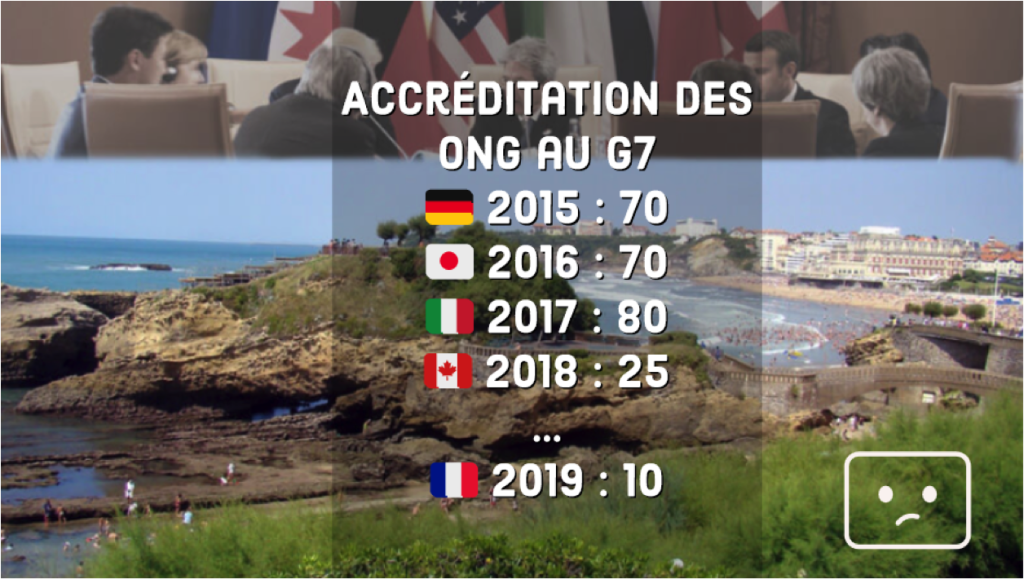
From August 24 to 26, 2019, France will host the G7 summit in Biarritz. To date, the government is only prepared to grant around ten accreditations to NGOs, representing the lowest level of civil society representation since 2005. The conditions for civil society access to the press during the summit remain unclear. These restrictions break with a long tradition of openness to civil society presence at G7 summits.
France has placed the 2019 G7 summit under the banner of combating inequality, a theme at the heart of NGO action. The commitments made by G7 leaders will be scrutinized by NGOs, which will ensure their effective implementation both within G7 countries and beyond. The seven countries are far from exemplary when it comes to combating climate change, preserving biodiversity, education, and gender equality.
On all these issues, national and international NGOs, particularly members of the C7 (Civil Society 7) and W7 (Women 7) engagement groups, have developed recommendations that they have put forward throughout the G7 and at each ministerial meeting. That is why they are demanding a full and equal place at the Biarritz summit, so that solutions to global inequalities and climate change are not decided behind closed doors but are genuinely discussed with representatives of civil society. To date, the government's proposal for participation in the G7 summit is not acceptable.
According to Philippe Jahshan, president of Coordination Sud: " Although France has repeatedly stated its desire to involve all actors in society in the discussions, the Biarritz summit does not reflect this intention and has been met with incomprehension by NGOs. Civil society as a whole, in all its diversity, must be represented at the summit. We have only been offered 10 accreditations. Is this serious? " asks Philippe Jahshan. " We expect much more. This representation would be the lowest in history since civil society organizations became involved in the G7 and would set a dangerous precedent."
NGOs are also asking that the texts negotiated during the three days of the summit be made available to them in real time and that they be able to be in direct contact with all journalists covering the summit in Biarritz, so that they can share their analyses and reactions. This includes access to the international media center, which is currently prohibited, unlike in previous editions.
This right to freedom of expression is an integral part of NGOs' missions. Preventing them from communicating freely with the press would simply lead to an unprecedented muzzling of civil society. It is also a legitimate demand in a G7 that claims to be "renewed and inclusive."
This year, the Élysée Palace proposed meeting with NGOs on three occasions, and on three occasions the President canceled his attendance at the last minute. These reversals raise questions about the President's genuine desire to engage with civil society and to feed France's proposals with contributions from NGOs. On August 23, the eve of the summit, a meeting is scheduled between NGOs and Emmanuel Macron. For us, this meeting must be part of a broader effort to welcome NGOs to Biarritz.
The French presidency still has the opportunity to show that it genuinely wants to involve civil society in the G7. To do so, it needs to ensure that a larger number of NGOs are represented at the summit and that they have unrestricted access to the press. Otherwise, the G7's openness to civil society will be nothing more than a sham, and NGOs will question the relevance of their participation.
Press contact
For C7: Olivier Jablonski-Sidéris, Communications Officer, Coordination SUD jablonski@coordinationsud.org | +33 (0)1 44 72 87 15 / +33 (0)7 76 78 15 19
For Women 7: Camille Nozières, Press Relations Officer, CARE France nozieres@carefrance.org | +33 (0)7 86 00 42 75
Note to editors:
The G7 is a discussion and economic partnership group bringing together the world's seven largest economies. It comprises the United States, the United Kingdom, Germany, Japan, Italy, Canada, and France, which hold the presidency each year in that order. In 2018, the G7 met in Canada, and it will be held in France from August 25 to 27, 2019, in Biarritz.
The C7 (Civil Society 7) is a G7 engagement group created in 2000 at the G7 Summit in Okinawa, Japan. Its objective is to bring the recommendations of non-state actors to the G7 negotiation process. The C7 brings together some 170 civil society organizations and associations from G7 member countries. Under the French presidency of the G7 in 2019, the C7 is coordinated by Coordination SUD. Follow C7 news: coordinationsud.org
W7 (Women 7) brings together feminist organizations from G7 countries and around the world. Its main mission is to ensure that G7 countries make financial and political commitments in 2019 and beyond that will have a concrete and lasting impact on the lives of women and girls around the world. For more information: feministscount.org