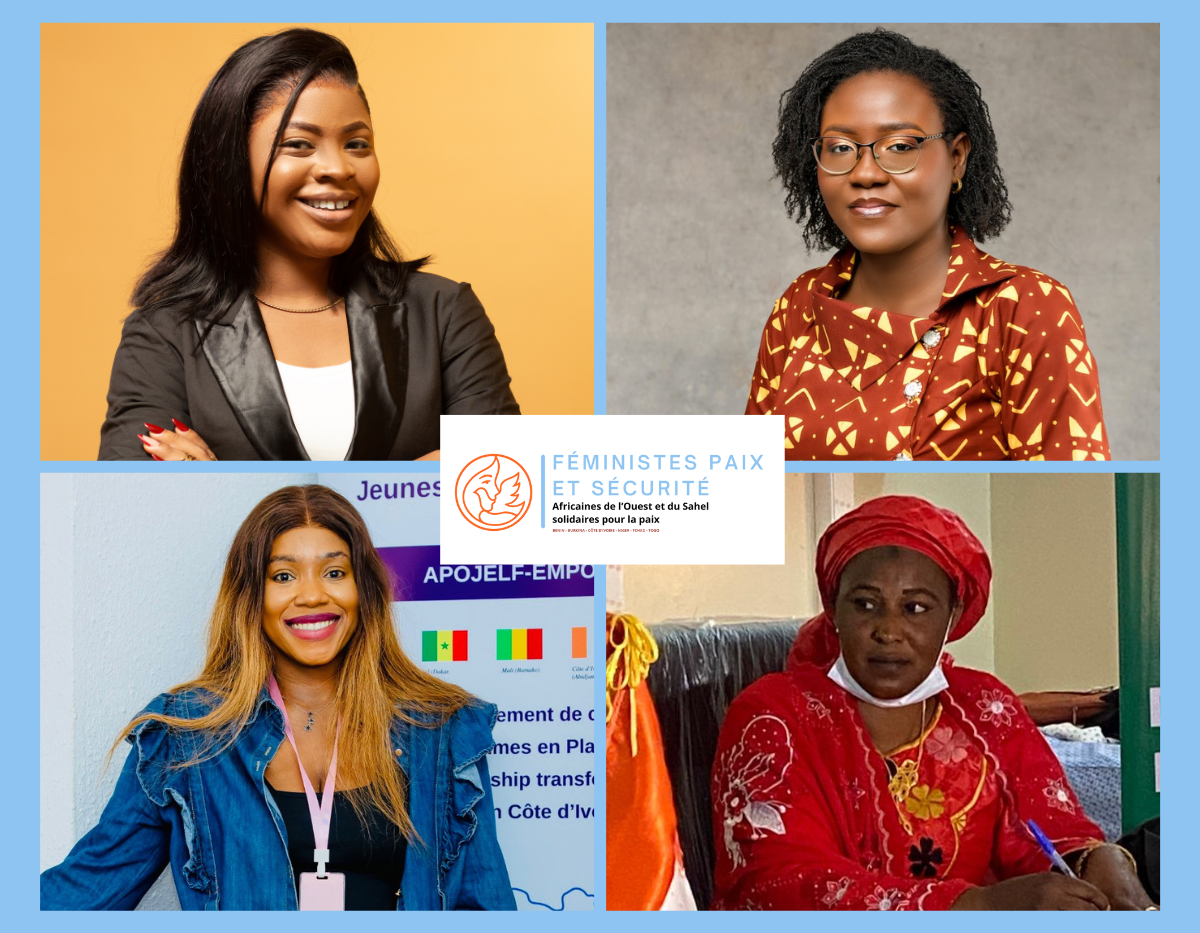
They come from Benin, Ivory Coast, Niger, and Togo. Florence Edéladjo Odjo, project coordinator at the NGO Barika (in northern Benin), Carelle Laetitia Goli, president of the Executive Board of ORAF (Ivory Coast), Rakia Garba, coordinator of the NGO Mère Source de Vie (Niger), and Abra Rosaline Tsekpuia, spokesperson for Négresses Féministes (Togo), are part of a generation of African feminists who are convinced that lasting peace cannot be achieved without women or social justice.
Through their voices and their experiences, they explain what it means, in practical terms, to work for peace in fragile contexts, and how women, by organizing themselves, are able to transform social relations, mentalities, and power structures.
What do you think a feminist approach to peace is?
Rakia: The feminist approach to peace emphasizes recognizing the experiences, expertise, and needs of women and girls in the peace process and conflict resolution. It is an approach that calls for the protection, inclusion, and active participation of women in peace activities and decision-making processes. It combats inequality and ensures that peace policies take into account their impact on women's decision-making power. In short, it is an approach that promotes social justice and equality in peacebuilding.
Rosaline: A feminist approach to peace means refusing to reduce peace to the mere absence of war. It highlights violence, the emotional and economic burden borne by women, and the power relations that fuel conflict. It is a peace that seeks to repair, transform, and liberate.
Carelle: For me, it rests on three pillars:
- The genuine involvement of women in conflict prevention and management;
- Taking their needs and realities into account in public policy;
- The integration of feminist organizations in all decision-making spaces.
It is this approach that guarantees lasting and inclusive peace.
Florence: Above all, it is an approach that puts girls and women at the center of solutions. Here, they are not just beneficiaries but full participants. It is also a way of rethinking peace beyond disarmament or military security. Women bring a human, social, and emotional dimension that is essential for rebuilding just and peaceful societies.
How do women transform peace in concrete terms?
Rakia: They operate on several levels:
- Through community mediation, by facilitating dialogue between groups in conflict.
- Through social mobilization, via campaigns promoting peace and non-violence.
- Through advocacy, by bringing the voices of marginalized women into decision-making spaces.
- Through innovation, using social media, art, and communication to denounce injustice.
They also practice holistic approaches, integrating economic, cultural, and psychological dimensions into the peace process.
Carelle: Women transform peace by becoming aware of their role and then throughcollective action. By training in mediation and negotiation, they become true agents of social transformation.
Rosaline: They bring about change for peace on a daily basis, in their homes, their markets, their villages. They are the ones who mend the damaged social fabric.
Florence: Young women, in particular, are peacemakers. They promote dialogue and build social ties. They take an intersectional approach, reminding us that peace cannot exist without equality and justice. They innovate, using the arts and media to defuse tensions and promote coexistence.
A word or phrase that guides you?
Rakia: "The end begins with a smile. I don't fight to be better than others, but to be useful, fair, and true to my values."
Rosaline: "Peace begins with justice."
Carelle: "Humanity prefers life to reasons for living." " — Simone de Beauvoir
Florence: "Peace must be cultivated, it cannot be decreed, and this applies to girls and women too."