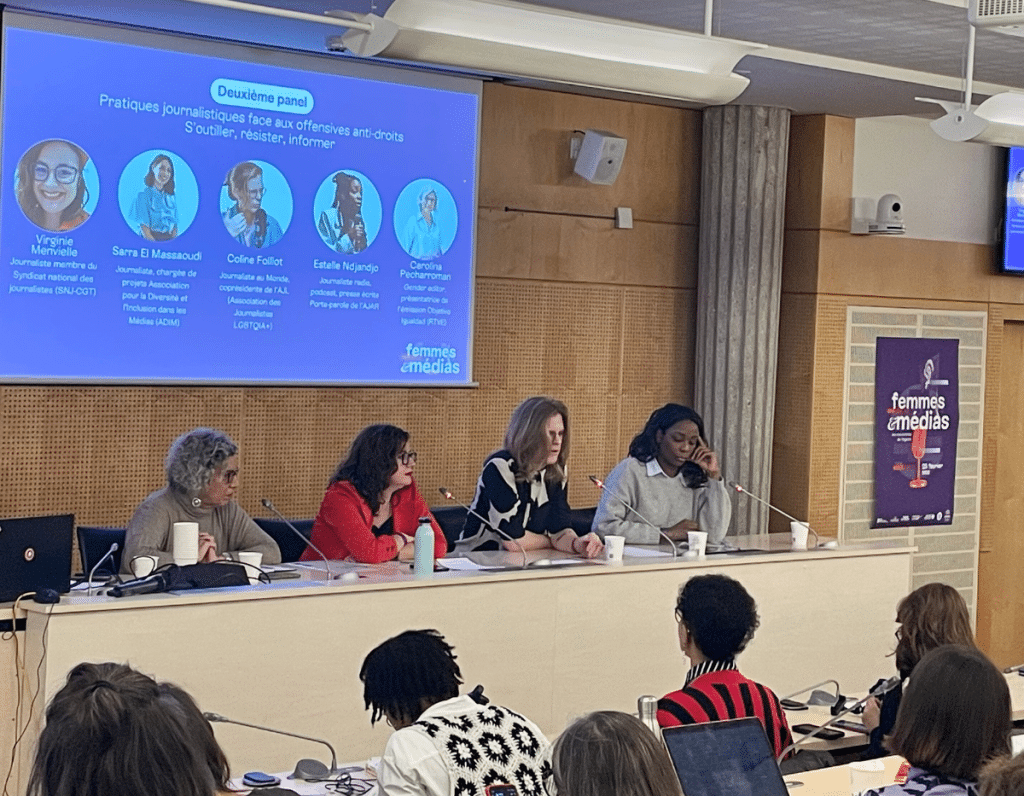
On February 25, 2025, the event "Women & Media, Encounters for Equality" was held, co-organized by Equipop, Prenons la Une! and La Fronde, in partnership with the Economic, Social, and Environmental Council (CESE). The day was punctuated by rich reflections on the challenges and role of the media in the face of rising conservatism and anti-gender backlash.
In recent years, a large-scale conservative offensive has been unfolding worldwide, targeting women and LGBTQIA+ people in particular. In this context of backlash, the media plays a vital role in the functioning of democracy, as it helps to raise awareness. This work of informing the public cannot be done without feminist associations, which are experts in human rights. The morning event, organized by Equipop, Prenons la Une ! and La Fronde, had one main objective: "Understanding and equipping oneself as a journalist in a context of backlash." Around 60 journalists, students, editors, experts, and members of feminist associations from France and Europe came together to discuss ways of taking collective action and resistance. In the afternoon, the EESC's Women's Rights Delegation hosted a radio program where speakers continued to explore the links between women's rights, the media, and democracy. Over the course of the day, more than 200 people participated, demonstrating a shared desire to reflect on these issues. The conclusion of the day was that there is a need for mobilization that brings together the media and feminist associations.
> Réécoutez l’intervention d’Equipop dans le podcast Femmes et Médias, produit par l’Onde Porteuse <
Opponents of women's rights always end up attacking freedom of the press and media pluralism. Their strategy is to first attack women's rights, which often goes unnoticed—because these issues are given little consideration in our societies—and then all the pillars of democracy are attacked, including the right to information. Women's rights are a good barometer of our democracies. Today, it is turning red. The current situation in the United States is a striking example of this. In addition to the conservatives' crusade against abortion rights, there are now attacks on:
- access to knowledge, with threats to suspend funding for scientific research,
- the right to information, with a policy of marginalizing and denigrating traditional media in favor of handpicked pro-Trump influencers,
- the public administration, which Elon Musk is dismantling
This reactionary offensive is international. It is part of a conservative agenda that extends beyond the borders of the United States, based on a misogynistic, masculinist, and racist ideology. Recent support and gatherings between far-right representatives from around the world testify to the networks that exist between these actors. As several speakers from Italy, Belgium, and Spain have pointed out, we are seeing manifestations of this in Europe, directly inspired by Trumpism. In Italy, police intimidation of journalists is on the rise, as is pressure on the media from Giorgia Meloni's government. In Hungary and Poland, similar attacks on press freedom have been reported. Threats, pressure, and sexist violence have become a daily reality for many women journalists, as shown in the exhibition "Journalism in the #MeToo Era" by Reporters Without Borders, which opened on the same day as the event. Behind these attacks, democratic values, multilateralism as defined by the UN, and international solidarity are at stake. The sudden and unilateral decision to freeze US official development assistance, which then turned into a cut of more than 90% of this funding, inspires and reinforces other worrying rhetoric and measures. In the Netherlands, for example, the coalition government, which now includes the far-right party, has made unprecedented cuts to the budget allocated to NGOs. In France, where huge cuts have also been made against a backdrop of budgetary austerity, official development assistance has been strongly attacked by far-right politicians, who take their inspiration directly from Elon Musk. Marie-Cécile Naves, sociologist and director of the Gender and Geopolitics Observatory at IRIS, summed it up as follows: "Trump's United States is the manifestation of a global phenomenon. They engage in blackmail and public lies. It is a theatricalization of predation, presenting dictatorships as having more value than democracies. Domination is considered a value and solidarity a weakness."

The proponents of this backlash wish to impose reactionary, and often false, narratives in public debate, particularly through the media. They rely on methods of disinformation and the inversion of values. Thus, the banning of certain words in the US public administration, the marginalization of several categories of the population (women, people of color, LGBTI+ people), and the denial of science are carried out in the name of freedom, or rather a certain conception of freedom, which aims precisely to prohibit, while accusing the other of being the censor. In this logic, women's rights are exploited for racist purposes, in a form of femonationalism. Journalists who speak out on feminist and economic issues are suspected of "militancy," while words and expressions such as "wokism" are presented as supposedly neutral terms. In France, too, a large-scale strategy is being deployed by reactionary movements: buyouts or attempted buyouts of journalism schools, political and academic publishing houses, and the creation of new institutions that are breeding grounds for far-right media, etc.
To counter this offensive, resistance movements exist. This day highlighted some of these tools of democratic counter-power. The importance of the work of independent media was emphasized several times. Investigative media outlets in particular, such as StreetPress, conduct in-depth investigations into the far right in France. Their expertise is essential in fostering critical thinking among citizens. In addition, the work of local media outlets was recognized. Laëtitia Greffié (editor-in-chief of Ouest France), for example, shared the existence of Ouest France's Equality Network. This initiative, led internally by young journalists in the editorial department, has led to the introduction of inclusive practices, resulting in a more gender-balanced workforce and significant editorial effects. Sara El Massaoudi, a journalist in Belgium and project manager for the Association for Diversity and Inclusion in the Media, presented the media cordon sanitaire established in French-speaking Belgium since the 1980s. It is based on the principle of not giving live airtime on audiovisual media to political parties or movements whose discourse is liberticidal, anti-democratic, or outside the legal framework. This exceptional measure is now under double pressure: from far-right parties that want to break free from it, and from traditional right-wing parties that use their media airtime to relay the sexist and xenophobic rhetoric of the far right. The involvement of associations is also essential in documenting and educating people about this offensive. Take La Une !, a collective of independent women journalists and partner of Equipop, which defends equality in newsrooms and better representation of women in the media. The Association of LGBTI Journalists (AJL) works to improve the treatment of LGBTI issues in the media. Finally, the Association of Anti-Racist and Racialized Journalists (AJAR) fights against racism in the profession and in media productions. These initiatives are essential today and must not remain marginal. The economic balance of power is unfavorable and the attacks are fierce. In the face of this, we must create larger spaces of resistance—like this day—and invest in all media spaces.
Faced with increasingly structured far-right networks, we need resistance networks that are at least as strong, particularly at the European level. The presence of journalists from France, Spain, Italy, and Belgium, representing both public and independent media outlets, gives an idea of the potential of media networks and feminist and human rights associations to share alerts and information, exchange practices in the face of backlash, and tell a different story to citizens in Europe. The construction of this counter-narrative must be collective, through the mobilization of everyone, each with their own means and levels of responsibility. As journalist Salomé Saqué said: "We must move from indignation to resistance." Indeed, while defenders of women's rights and press freedom face the same adversaries, their means of action can also be pooled. Feminist associations and journalists are mutual allies in deciphering and denouncing this global phenomenon of right-wing monopolization and domination. "Feminists are whistleblowers; they have been documenting anti-rights strategies for a long time. It's time for the media to trust them and give them a voice,"said Lucie Daniel, Advocacy and Research Manager at Equipop. Supporting human rights, democracy, and feminist movements: what does this mean for journalists? For example, not contributing to the normalization of the far right. Admitting that not all opinions are equal—and reminding people that incitement to racial hatred, sexism, and homophobia are punishable by law. Not pitting a feminist association against a far-right influencer in an interview. Not giving in to the temptation of a culture of "clash" or polarization: questioning, for example, the relevance of presenting abortion as a divisive issue, when 80% of French people were in favor of its constitutionalization. Do not be distracted by the flood of excesses from populist and far-right leaders around the world. Instead, document, expose, and denounce the broader and deeply anti-democratic political agenda they have in common. And because the training of future journalists is crucial to media coverage, it is imperative that journalism institutes and schools open their doors and work hand in hand with associations specializing in these issues, such as Prenons la Une !, AJAR, AJL, and Equipop.
Equipop, as a feminist international solidarity organization, will continue to actively mobilize against anti-rights movements, notably with its partner Prenons la Une! A full report on this event, including recommendations, is currently being written. The aim will be to bring these conclusions and recommendations to wider audiences, such as journalism schools and public authorities. Next meeting: the 4th International Conference on Financing for Development in June 2025, in Seville. At a time when funding for feminist associations is under attack from all sides, gender equality must not be excluded from these international commitments. In this regard, the Financing Feminist Futures meeting, organized by the Walking the Talk consortium in Madrid, of which Equipop is a member, will be a major venue for collective mobilization. To ensure that these issues are not ignored, we call on the media to take up the cause and report on these struggles.
> Retrouvez le podcast Femmes et Médias, produit par l’Onde Porteuse <