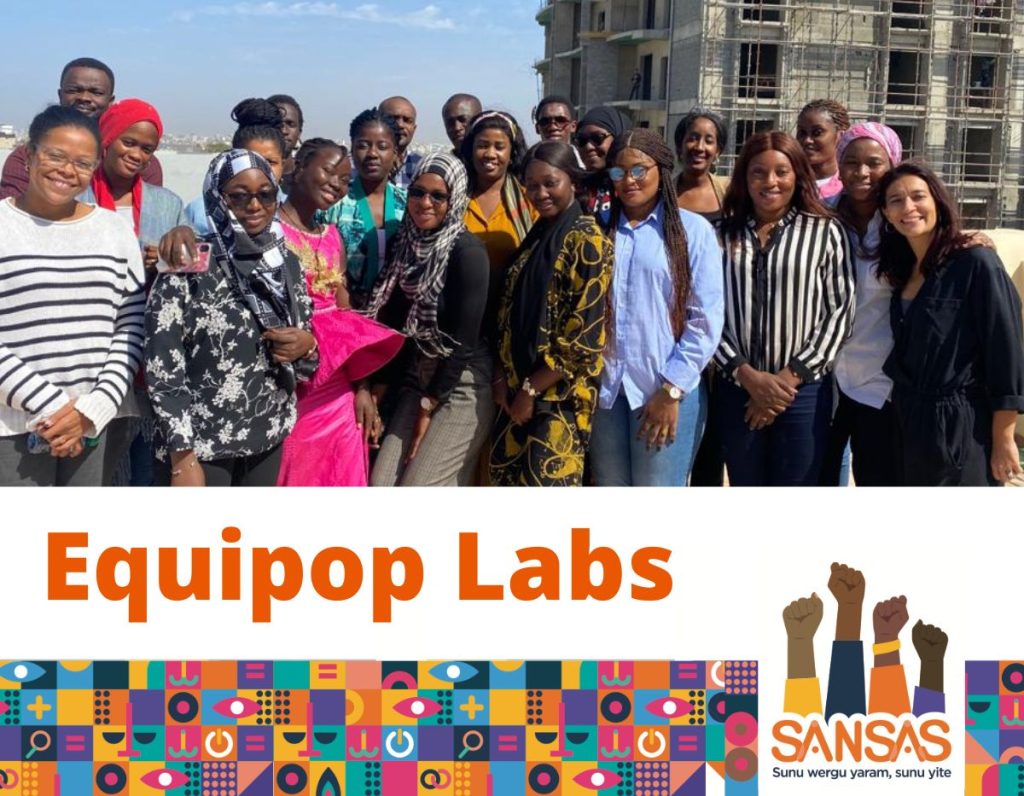
The national incubation lab organized by Equipop as part of the Sansas project (funded by @AFD_France). This Lab brought together 25 representatives of young people and civil society organizations. Together, they co-developed an advocacy project to be implemented at the national level on reproductive health and gender equality. The goal: to achieve greater involvement of young people in decision-making bodies.
[vc_video link= »https://www.youtube.com/watch?v=MNvukU3rVF4″]They had five days to define their vision for greater youth involvement in decision-making bodies in order to take into account SRHR(reproductive rights and health of adolescents and young people) and gender equality. Gathered in a room, they exchanged ideas, discussed issues, and compared their visions in order to seek options and solutions together to promote reproductive health and gender equality. These exchanges led to the establishment of a national action plan.
Young people and organizations at the heart of the discussion
The Equipop team organized and ran the Lab. Consortium member organizations were also present, including Solthis, the lead organization for the Sansas project, and RAES. Finally, there were representatives from local civil society organizations—ANJ/SRPF, YWA (Young Women in Action), Jiggen, and JED—as well as six young leaders from the two project areas, Sédhiou and Mbour. These six young people are part of a cohort of around fifteen young leaders per intervention district who have already participated in the district-level incubation lab and developed their action plans. Equipop wanted to ensure diverse representation by bringing together young people from both academic and non-academic backgrounds, students, and young people working in associations. What they have in common is their involvement in their local communities on these issues. In a way, they are already local leaders. This national advocacy campaign will ensure that the needs of SRHRAJ
Advocacy, a construct beyond intuition
During the five days, participants shared meals, daily life, activities, and games, sharing their motivation and good humor, but above all their thoughts on building a common advocacy platform on DSRAJ. High-level discussions focused on the challenges and roles of the various state actors at the national level. "How do we develop a strategy?" Ndeye Marième Ly Diagne, Program Manager for Senegal, explains the main steps implemented as part of this Lab. " We gave a presentation on the context in which DSRAJs operate in Senegal, on the legal framework, and on the importance of national advocacy. We also worked together to identify the problems faced by young people. This was followed by intense discussions about how to better care for young people and their needs. From this emerged the importance of reflecting on the involvement of young people in the decision-making bodies where their future is discussed!" These sessions enabled the drafting of national advocacy objectives for the DSRAJ "This Lab has enabled me to better understand the different steps involved in developing an advocacy strategy," says Josephine Codou Diatta, a young leader from Sansas. And it made me realize that you can't really achieve concrete results on your own."
Encouraging young people to speak up
The Incubation Lab's methodology has been particularly effective in encouraging young people to express themselves. " Today's youth are tomorrow's hope," says young leader Ndella Sall. So this expression must not be in vain." Equipop's methodology makes young people feel comfortable speaking up. They are given a prominent role in discussions and exchanges during group work. In particular, they highlighted the importance of working on the concept of equality. " For me, gender equality is very important because we live in a society where there is interaction between men and women, and many people have it in their heads that men must always be in charge," protests Ndella Sall.
[vc_video link= »https://www.youtube.com/watch?v=5Rb-GsMmkhM »]