Every day, 300 million women around the world have their periods. Yet periods are shrouded in silence and shame within families and receive little public investment. However, it is a subject that concerns education, rights, and health. For these reasons, Equipop is committed to taking action!
Having a period is a simple biological fact that too often constitutes an obstacle to girls' health, dignity, and respect for their rights. Almost everywhere, taboos surrounding menstruation still cause embarrassment, shame, and stigmatization. In most societies, the appearance of menstrual blood is associated with a stain that must be hidden.
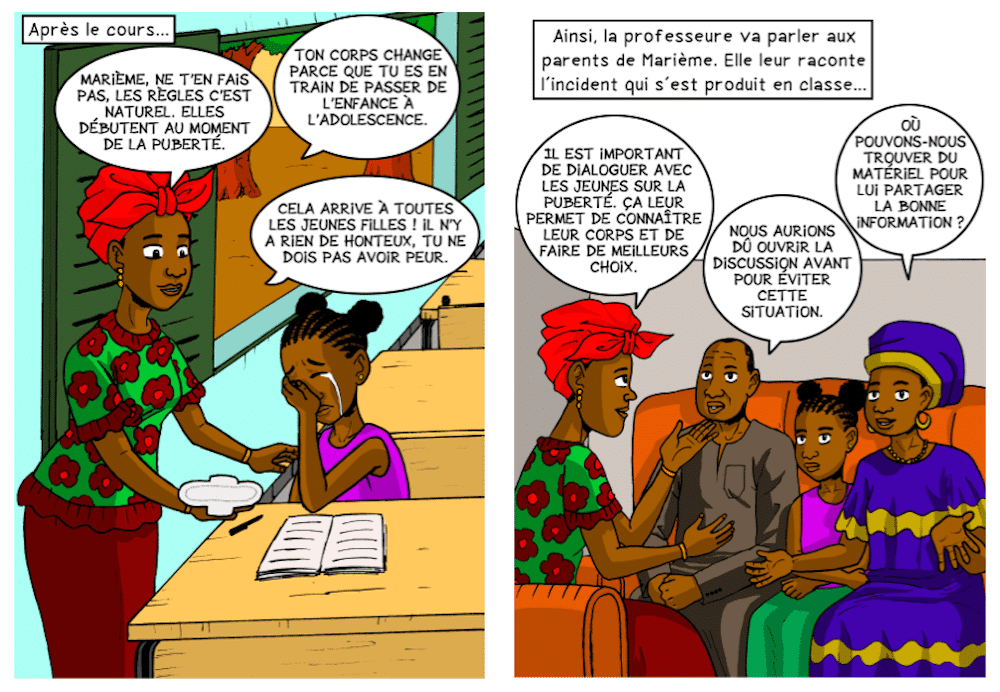
The study we conducted for UNFPA confirms and illustrates that in West and Central Africa, many girls do not know what is happening to them when they get their first period. Even if they have received information beforehand, they still feel anxious and afraid. The first explanations usually given by mothers concern sanitary protection and the risk of pregnancy, but these explanations are vague because the link between periods, the menstrual cycle, and reproduction is often not established. Ultimately, young girls are mainly told to avoid boys and men. At the same time, the first period can be associated with a sign of maturity and adulthood. Young girls are then considered adults who can leave school, work, marry, and have children. Due to difficult access to adequate infrastructure (water, toilets, sanitation) and poverty, menstrual insecurity and its consequences on health and mobility affect the vast majority of women and girls. Finally, false beliefs, myths, dangerous social practices, and the silence surrounding menstruation can turn the period of menstruation into a time of restriction, deprivation, or exclusion. All of this limits girls and women in their personal, domestic, educational, and professional activities, while undermining their self-esteem and self-confidence.
Periods occur at a crucial time in identity formation, and this negative representation has a strong impact on both how girls view their bodies and status and how boys construct their image of women's bodies. Furthermore, this negative representation partly explains the difficulties women and girls face in accessing basic infrastructure such as toilets, essential menstrual products, or appropriate care when associated conditions such as endometriosis arise. Thanks to researchers, activists, and journalists, this issue, which has long remained invisible, is now coming to the forefront. One example of this is the establishment in 2014 of International Menstrual Hygiene Day on May 28 (28 referring to the average number of days in a menstrual cycle and May, the fifth month of the year, referring to the average number of days of menstruation), which has been widely publicized around the world.
MENSTRUAL HEALTH: A LEVER FOR EDUCATION AND THE RIGHTS OF THE YOUNGEST TEENAGERS
In the region, projects are being carried out to provide access to appropriate sanitary facilities and menstrual hygiene products (WASH approach, "Water, Sanitation and Hygiene"). Some include information campaigns, but these are often scattered or still in the pilot stage and rarely incorporate a rights-based approach. Few countries have developed strategies and standards for menstrual health, but there is a willingness to take action, for example by facilitating its integration into all relevant sectoral policies. Finally, while menstruation remains taboo, the study and feedback from task force members show that when dialogue about menstruation is opened up, repositioning it as a normal and natural phenomenon that occurs in girls at puberty, negative perceptions diminish and interest in the subject emerges, including among men and boys.
Menstrual health and hygiene, and more broadly puberty, represent a gateway to facilitating sexuality education in and outside of school and an opportunity for social and health structures to open their services to adolescent girls by integrating them into the DSSRAJ (sexual and reproductive health and rights of adolescents and young people), in the same way as FP (family planning) and STIs (sexually transmitted infections) and HIV/AIDS.
Based on these findings, Equipop systematically integrates the theme of menstrual health into its actions to promote and improve SRHR (advocacy, support, comprehensive sexuality education). It will support the implementation of actions that complement WASH approaches; destigmatization and creation of positive norms around menstruation, support for the creation and dissemination of human rights- and gender-sensitive information and mobilization materials and tools, and support for young feminist movements whose voices are speaking out to break the taboo and silence surrounding menstruation and the discrimination and injustices that result from it.