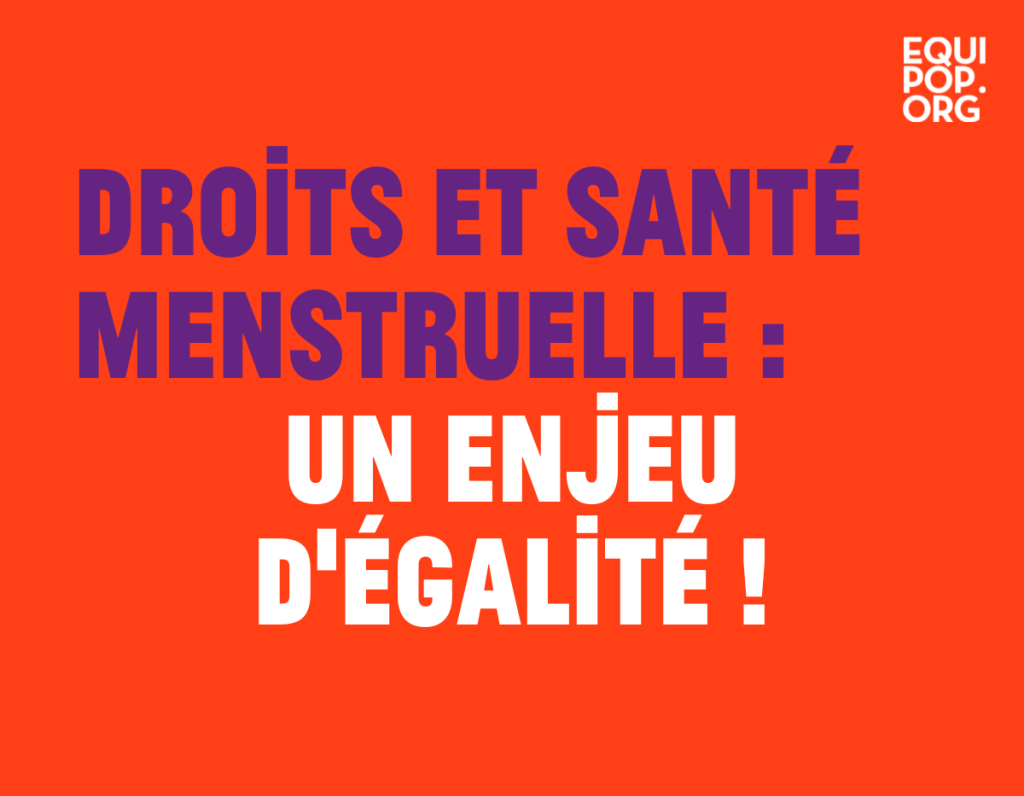
Every day, 300 million women around the world have their periods. Yet periods are often shrouded in silence and shame within families and receive little public investment. On May 28, World Menstrual Hygiene Day, let's remember that periods are a matter of education, rights, and health!
Ending taboo and stigma
Menstruation is a simple biological fact that too often constitutes an obstacle to the health, dignity, and rights of menstruating individuals. Almost everywhere, taboos surrounding menstruation still cause embarrassment, shame, and stigmatization: cultural and societal gender-based violence that only a feminist approach can eliminate. Menstruation occurs at a crucial time in the development of identity, and this negative representation has a strong impact on how girls view their bodies and status, and on the image that boys construct of women's bodies. Furthermore, this negative representation partly explains the difficulties women and girls face in accessing basic infrastructure such as toilets, essential menstrual products, or appropriate care when associated conditions such as endometriosis arise.
Thanks to researchers, activists, and journalists, this issue, which has long remained invisible, is now coming to the forefront. The establishment in 2014 of International Menstrual Hygiene Day on May 28, widely publicized around the world, is one example of this.
Fighting for menstrual justice
The study we conducted in West and Central Africa with UNFPA WCARO confirms, for example, that false beliefs, myths, dangerous social practices, and silence surrounding menstruation can transform the menstrual period into a time of restriction, deprivation, or exclusion, which then becomes part of the continuum of gender-based violence. All of this limits girls and women in their personal, domestic, educational, and professional activities, while undermining their self-esteem and self-confidence. Due to difficult access to adequate infrastructure (water, toilets, sanitation) and poverty, menstrual insecurity and its consequences on health and mobility affect the vast majority of women and girls. In France, we are co-signing the open letter Period poverty: insufficient and discriminatory announcements, to denounce the inadequacy of the announced reimbursement, which is limited to those under 25 and to reusable protection.
Menstrual health: a lever for adolescent education and rights
Menstrual health, and more broadly puberty, provide a gateway to facilitating sexuality education in and outside of school. They provide an opportunity for social and health care organizations to open up their services to adolescents by including them in the package of SRHR (sexual and reproductive health and rights) services for adolescents and young people, alongside family planning, sexually transmitted infections, and HIV/AIDS.
Based on these findings, Equipop systematically integrates menstrual health issues into its activities to promote and improve SRHR (advocacy, support, comprehensive sexuality education). It supports the implementation of actions that complement health approaches: destigmatization and creation of positive norms around menstruation, support for the creation and dissemination of human rights- and gender-sensitive information and mobilization materials and tools, and support for young feminist movements whose voices are rising to break the taboo and the resulting discrimination and injustices. The Gouttes Rouge association, a partner of Equipop in the context of the projects Young Feminists in West Africa, combats insecurity and "menstrual illiteracy." Many girls do not know what is happening to them when they get their first period: Gouttes Rouges raises awareness, informs young people, and debunks misconceptions. On May 27 and 28, the association is organizing the "Menstrues libres" festival in Abidjan in collaboration with the NGO Actuelles, and Equipop is pleased to provide financial and operational support for this initiative. “We are fighting so that girls and women can experience their menstrual periods calmly and without shame. So that they don't have to worry about sanitary protection or clean toilets at school, and can work from home if they are in pain..." – Amandine Yao, founder of Gouttes Rouges. In West Africa and elsewhere, all people who menstruate must have access to appropriate, inclusive, and sensitive information, services, and care—regardless of their gender, level of resources, and geographical location. This is a matter of menstrual justice.It is by approaching menstrual health needs through the lens of human rights and feminism that we can transform our societies.
*In this article, we often use the terms "woman" and "girl." However, it is important to note that all women and girls do not menstruate, and that not all people who menstruate are women.
For more information:
- Study: Menstrual Rights and Health, an Equality Issue in West and Central Africa, 2021 – conducted by Equipop in collaboration with UNFPA WCARO and its summary
- Guide to Menstrual Health and Hygiene, Ivory Coast, 2021 – produced with technical support from Equipop and UNFPA.