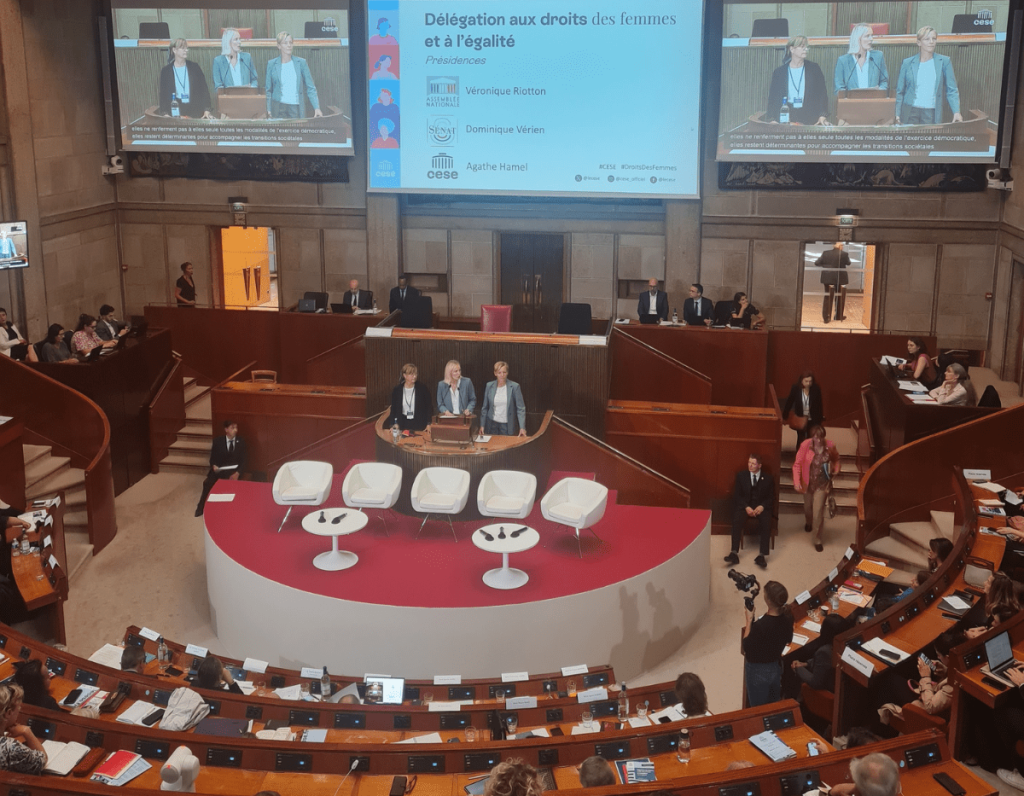
On October 10, 2023, Equipop attended the EESC event on women's rights issues in the run-up to the next European elections. Organized by the presidents of the women's rights and equality delegations of the EESC, the French National Assembly, and the French Senate, this plenary assembly revisited the importance of fighting against anti-choice lobbies. In the general climate of backlash, the speakers highlighted the main issues for the June 2024 elections: uniting feminist struggles in the EU, protecting SRHR (sexual and reproductive health and rights), and strengthening prevention and education.
A unanimous observation on the context of backlash
In their joint speech, the chairs of the women's rights delegations of the three assemblies emphasized the importance of not treating women's rights as an adjustment variable. Véronique Riotton, chair of the National Assembly's women's rights delegation, recalled Simone de Beauvoir's quote: " Never forget that a political, economic, or religious crisis is all it takes for women's rights to be called into question. These rights are never guaranteed. You must remain vigilant throughout your lives." For Senator Dominique Verien, the European elections are very important because they allow us to choose what place women should have in our social model. Agathe Hamel, representing the EESC, pointed out that members of civil society are essential witnesses to the many forms of violence in society and that "women's rights are a barometer of the state of a democracy." Neil Datta, Executive Director of the European Parliamentary Forum on Sexual and Reproductive Rights (EPF), highlighted the increase in funding for anti-rights lobbies. Funding for anti-gender campaigns has risen from $80 million to $120 million per year between 2018 and 2022. Dieynaba Diop, spokesperson for the Socialist Party, for the Progressive Alliance of Socialists and Democrats group, called for European coordination to combat these lobbies. For Sylvie Brunet, MEP (Modem) and member of the Renew Europe group, it is necessary to list them and to strengthen transparency within the European institutions. These analyses are shared by Equipop, which published a report on the Backlash in February 2023.
Mobilizing women for the 2024 elections and uniting feminist struggles within the EU
Three issues emerged from the discussions, the first being the mobilization of women and the unification of feminist struggles in Europe. The European elections next June pose a major challenge: women's participation. Women tend to abstain from voting more than men, regardless of the type of election. Agnès Hubert pointed out that this is particularly true in European elections. In the 2019 elections, women accounted for 53% of abstentions (source: European Parliament 2019). For Aline Brüser, gender equality advisor at the European Trade Union Confederation, it is important to include trade unions in order to protect women's rights and unite struggles within the European Union. For her, "we are stronger if we also have the support of trade unions and their representatives." Noura Raad, feminist activist and co-president of the European Network of Migrant Women, believes that Europe must be a space where women's rights can evolve and be reaffirmed. It is also where, as feminists, we can pool our struggles. In her view, the representation of migrant women is fundamental to this perspective.
Protect SRHR
Another challenge for the June elections is the protection of sexual and reproductive health and rights (SRHR). Whether it is the questioning of abortion rights in several European countries or the increase in the number of people experiencing period poverty (from 2 to 4 million between 2021 and 2023 in France, according to the association Règles élémentaires), SRHR are under threat within the EU. Currently, health is a supporting competence, meaning that European institutions can only intervene to "support, coordinate, or supplement the action of Member States" (Article 6 TFEU). For Nathalie Colin-Oesterle, of the European People's Party group, it must become a shared competence. The MEP believes that it is through public health that we will be able to protect women, inform them, and make reproductive health a public health issue. Sylvie Brunet, from the Renew Europe group, has come out in favor of including SRHR in the Charter of Fundamental Rights of the European Union. For her part, Pascale Martin, the LFI MEP representing the Left group, is calling for the right to abortion to be enshrined in the French constitution.
Strengthening prevention and education
Participants highlighted the importance of strengthening prevention and education efforts on both SRHR issues and sexual and gender-based violence—a position shared by Equipop. Nathalie Colin-Oesterle illustrated this issue by referring to a campaign on the "violence meter," a tool for raising awareness about domestic violence. The campaign highlighted the fact that young people sometimes consider situations of extreme violence to be "normal." Strengthening education on these issues is therefore a real challenge at both the French and European levels. For Pascale Martin, each country's budgets dedicated to combating such violence should be used for prevention purposes.
Issues at the heart of Equipop's work
The issues raised at the EESC therefore echo those identified by Equipop in its work in Europe and West Africa. As part of the public debate on the upcoming elections, Equipop will work to keep the debate alive in various forums, both in France and across Europe. Giving a voice to different feminist perspectives is essential in absolute terms, but even more so in the current political climate.