Convinced of the transformative potential of collective and multidisciplinary action, since 2017 Equipop has chosen to expand its support for change makers through a new methodology for project development, deployed within its Innovation Fund: the Equipop Labs.
What are Equipop Labs?
Designed in partnership with specialists in Design Thinking methodology, Equipop Labs are project incubation spaces developed to enable civil society organizations (CSOs), institutions, and other actors working to promote, protect, and implement sexual and reproductive health and rights (SRHR) to take the time to reflect and develop collective actions.
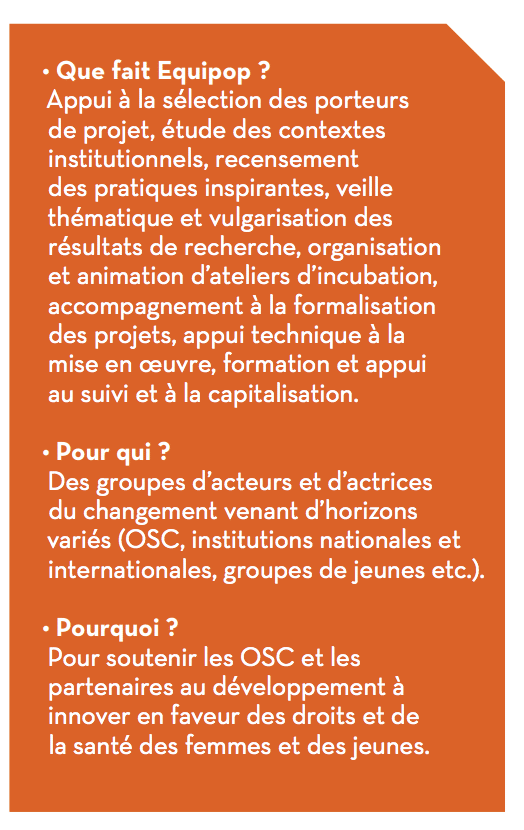
The deployment of Equipop Labs takes place in three main stages, summarized in the diagram below:
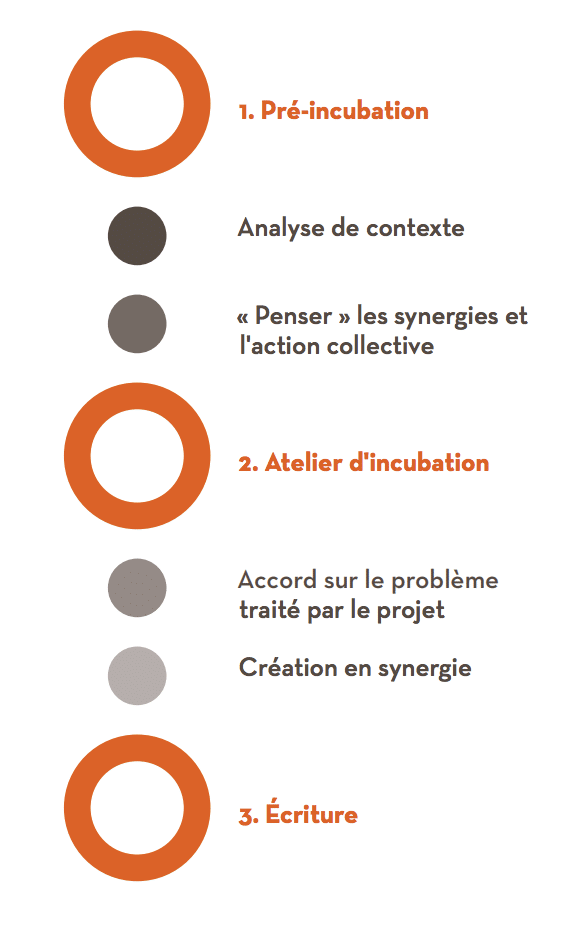
1. Preparing for incubation: developing a detailed and shared understanding of the context and the forces at play Conducted by Equipop in collaboration with its partners, this context analysis provides an overview of the challenges in each territory, identifies gaps to be filled, synergies to be built, and stakeholders whose expertise and positioning will be useful for project creation.
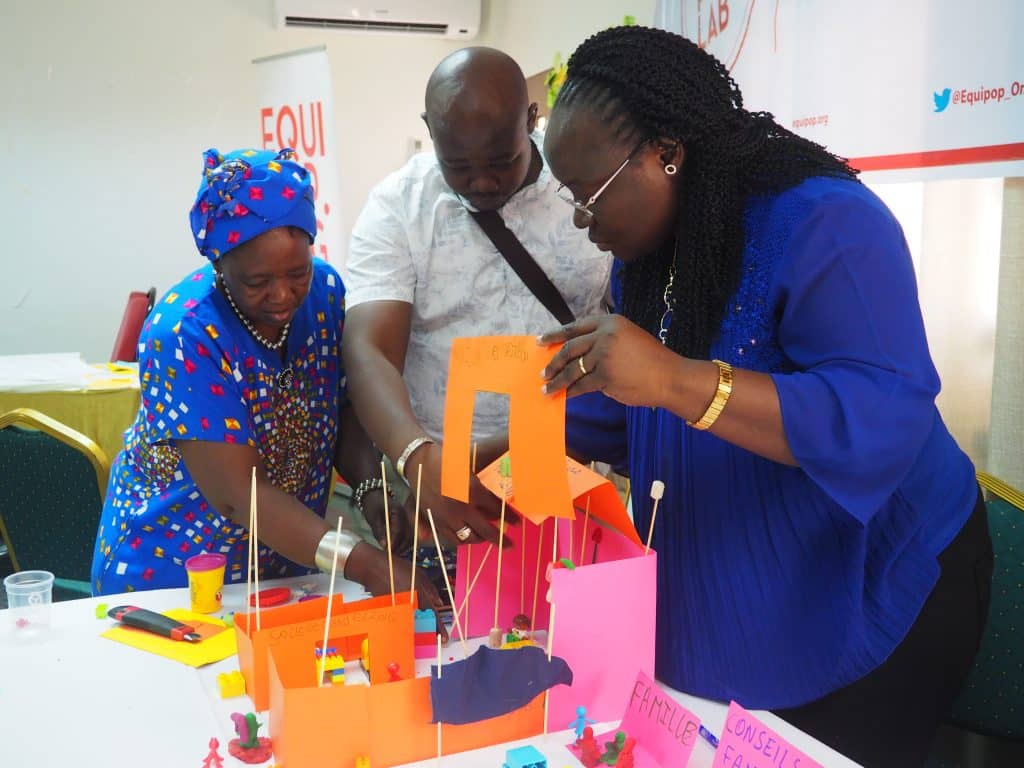
2. The incubation phase: equipping collective intelligence Using the Design Thinking methodology, the aim is to bring together various areas of expertise during a workshop lasting an average of one week to create joint actions. To do this, the incubation phase focuses on: 1 – collectively identifying a key issue that needs to be addressed, 2 – thinking about how to tackle this issue through the incubated project, 3 – prototyping the chosen solution, testing it, and refining it to improve it.
3. Writing
Finally, once the incubation workshop phase is complete, the organizations in charge of the future project set about finalizing the draft based on the discussions that took place during the workshop.


An approach that revisits the concept of partnership
Funding for incubated projects is provided by the Innovation Fund. The system set up by Equipop is designed to separate the project design phase—which requires time and consultation—from the fundraising phase. When these two phases are combined, they can tend to slow down the creation of shared diagnoses and collective reflection, which are key elements in "thinking about innovation."
Organizing Equipop Labs means creating the conditions for bringing together a diverse range of actors and different types of expertise right from the project design phase. Government partners, civil society, parliamentarians, young people, United Nations experts, teachers, researchers, and journalists are invited to share their in-depth knowledge of a territory and the needs of target audiences that are key to taking action. This sharing facilitates the collective emergence of transformative solutions. It allows for an assessment of existing initiatives, an evaluation of what works well and what does not, and the organization of a project within a facilitating framework. This mobilization from the design stage has the advantage of anchoring the project in a territory, creating new partnership dynamics, and ensuring greater ownership of the future project by the various stakeholders who will have a role to play in its implementation.
A cross-functional approach
After two years of implementation, the cross-cutting nature of the methodology has been confirmed by the diversity of the projects incubated and the fairly broad scope of application of the Equipop Labs. The projects incubated in most countries combine activities to support youth leadership development, citizen mobilization through alliances with the arts sector and the media, and targeted advocacy actions.
These actions are intended to strengthen and ensure compliance with and implementation of national commitments to adolescent and youth SRHR. In terms of scope, Equipop Labs have so far been applied in a variety of contexts, from the simplest to the most complex, and to actions/projects involving social, political, and community mobilization in particular. Some fifteen Equipop Labs have been conducted for projects led by youth groups, consortia of associations, and institutions such as UN agencies.