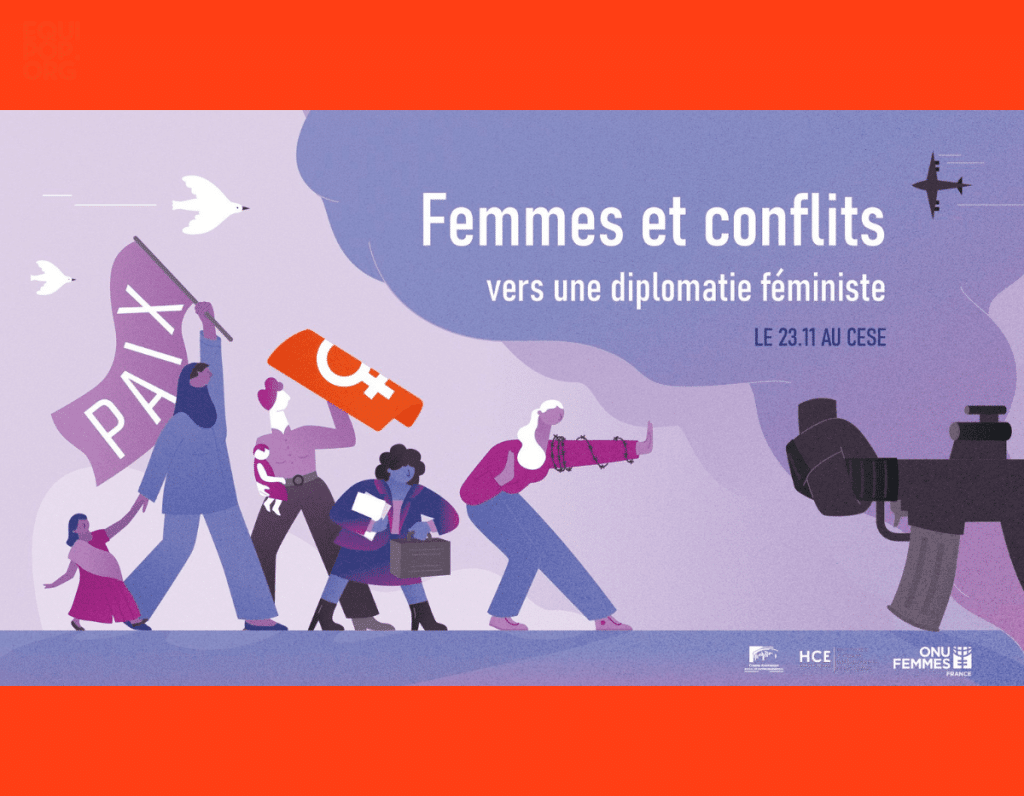
On November 23, 2022, the event "Women and Conflict: Towards Feminist Diplomacy" organized by the CESE (Economic, Social, and Environmental Council), the High Council for Equality (HCE), and UN Women France, brought together more than 2,000 people in person and online, demonstrating growing interest in the subject and high expectations of the government. Equipop, as a member of the HCE, spoke to reaffirm the importance of feminist foreign policies as a response to many global challenges.
This gathering of international experts, activists, and prominent figures committed to addressing the impact and role of women in conflicts and peace processes took place during a particularly intense week for the fight against gender-based violence. The week was marked by numerous demonstrations around the world and culminated in the International Day for the Elimination of Violence against Women. November 25 also marked the launch of the annual "16 Days of Activism Against Gender-Based Violence" campaign, initiated by the UN and implemented by civil society: 16 days of awareness-raising, mobilization, and calls to action that run until December 10, International Human Rights Day. The EESC, the HCE, and UN Women France organized this major event against a backdrop of multiple humanitarian crises and armed conflicts. In France, the climate is also favorable for rethinking action in favor of gender equality internationally: the International Strategy for Gender Equality (2018-2022), a framework document of the Ministry for Europe and Foreign Affairs, is coming to an end.
The crucial role of women in conflicts and peace processes
The meeting began with Thierry Beaudet, President of the CESE, Sylvie Pierre-Brossolette, President of the HCE, and Céline Mas, President of UN Women France, who, after outlining the context and purpose of the discussions, gave the floor to the winner of the 2022 Nobel Peace Prize. Oleksandra Matviichuk began by highlighting the multiple and essential roles played by Ukrainian women since the start of the war, in both the civilian and military spheres. She then called for a reform of the international security system in order to "break the cycle of impunity" for war crimes. During the first roundtable discussion entitled "Survivors of violence in times of conflict: prevent, protect, rebuild," Svitlana Valko, who is responsible for coordinating relief and protection within the International Partnership for Human Rights (IPHR) in Ukraine and Georgia, pointed out that rape as a weapon of war is an integral part of Russian military strategy and represents a model of warfare that is tending to spread. Lawyer Céline Bardet, director of the NGO We are NOT Weapons of War, then issued a very clear appeal to states and donors: substantial funding is needed to document sexual violence committed in the context of war. Through her perspective as a sociologist and psychotherapist, Esther Mujawayo, founder of the Rwandan association AVEGA, survivor of the 1994 genocide, and co-author of the book Survivors (2004), Esther Mujawayo, founder of the Rwandan association AVEGA, survivor of the 1994 genocide, and co-author of the book Esther Mujawayo and Justine Masika, founder of La Synergie des Femmes pour les Victimes des Violences Sexuelles (SFVS) in Goma, Democratic Republic of Congo, and speaker at the second round table "Conflicts, mediation, and peace processes: the crucial role of women," both highlighted the central role of women in the context of peace negotiations and national reconstruction. In this second round of speeches, Iranian sociologist and writer Chahla Chafiq emphasized "the interconnection between all the themes we are exploring: the absence of human rights, the absence of freedom, and the sanctification of gender-based and sexual violence." All of this is embodied in the Iranian regime, whose presence and recognition at the UN runs counter to all feminist diplomacy. Dr. Anarkali Honaryar, an Afghan politician, senator until the fall of Kabul in 2021, and representative of the Hindu and Sikh minorities, made the same observation about the Taliban regime.
France expected to take the lead on feminist foreign policy
The discussions concluded with a round table discussion entitled "To build peace, the urgent need for feminist diplomacy." The co-chairs of the HCE's feminist diplomacy commission, Jocelyne Adriant-Mebtoul and Nicolas Rainaud (advocacy manager at Equipop), shared some keys to understanding feminist diplomacy through three areas in particular: a transformative approach, policy coherence, and the affirmation of international solidarity with feminists. Magali Lafourcade, Secretary General of the CNCDH, summed it up as follows: "gender must become an essential transformative lever in foreign policy.". These remarks echoed the introductory speech by Parwana Paikan, an Afghan diplomat who worked in France before the Taliban took power. She urged France, a member of the European Union and the UN Security Council, to take the lead in feminist foreign policy and to bring a significant number of other states with it. Florence Cormon-Veyssière, Deputy Director of the Department of United Nations, International Organizations, Human Rights, and Francophonie at the Ministry of Foreign Affairs and International Cooperation, emphasized the need to include civil society organizations in the development of the new international strategy for gender equality. This is indeed essential, as CSOs will bring a wealth of perspectives and a demand for accountability. While several questions raised by the CNCDH and the HCE remain unanswered, the MEAE will soon have the opportunity to provide more specific answers in 2023, during the mid-term evaluation of the implementation of the 3rd National Action Plan on Women, Peace and Security 2021-2025.
At the end of the meeting, civil society activists were invited to express their views on the priority action France should take to implement feminist foreign policies in practice.
[vc_video link= »https://youtu.be/jZDx2AFLgTs »]