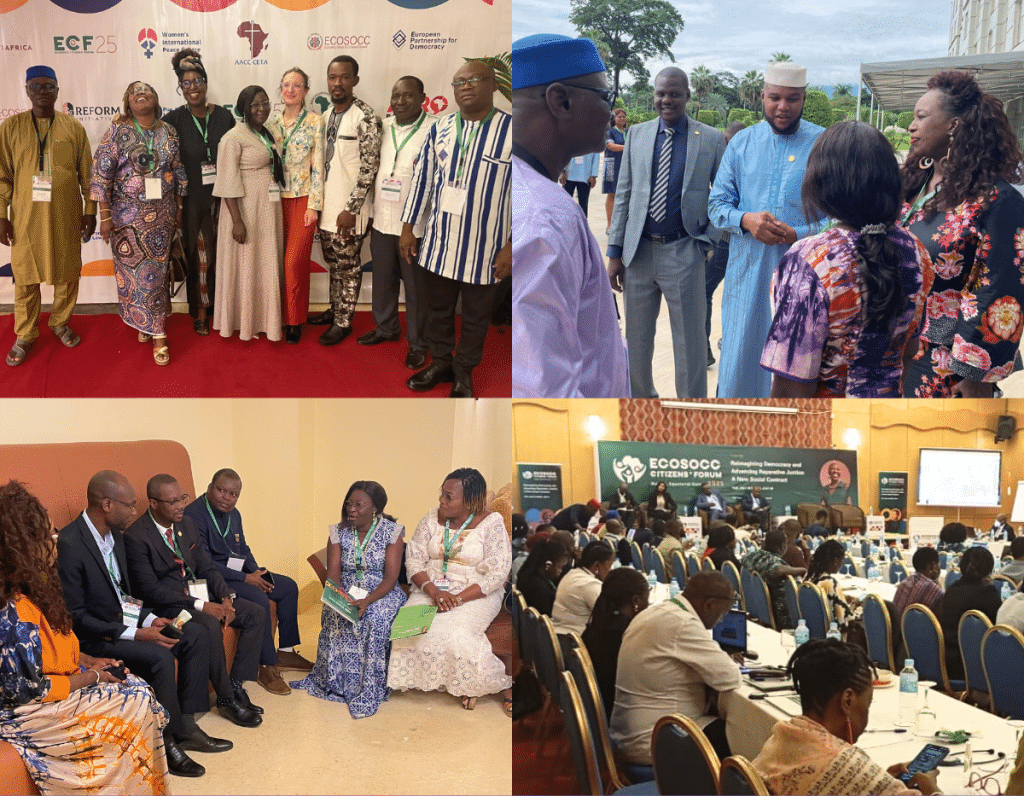
The Economic, Social, and Cultural Council of the African Union (ECOSOCC AU) held an Interregional Dialogue of Civil Society Organizations in Malabo, Equatorial Guinea, on the sidelines of the 47th Ordinary Session of the Executive Council of the African Union. We were there to amplify the voices of committed actors, with one mission: to make a feminist voice heard at the heart of the African Union, rooted in the realities experienced by women and girls in West Africa.
The African Union held the 47th Ordinary Session of the Executive Council and the 7th Mid-Term Coordination Meeting (MYCM) in Malabo, Equatorial Guinea, from July 10 to 13, 2025. In this context, ECOSOCC AU organized an Interregional Dialogue of Civil Society Organizations (CSOs) on common challenges and opportunities in peacebuilding on July 7, followed by the ECOSOCC 2025 Citizens' Forum on July 8 and 9, 2025. This Citizens' Forum was dedicated to democracy, peace, and restorative justice. During three intense days, Equipop, alongside a delegation of representatives from five member countries of the Rights and Health Alliance Network, advocated for gender justice to be at the center of African political commitments.
When we talk about peace, let's also talk about gender-based violence!
From the very first day, devoted to peace and security, our position was clear: no lasting peace is possible without recognizing the realities of gender-based and sexual violence, without comprehensive care for survivors, and without their full inclusion in the processes of reparation and remembrance. Women are both the first to be exposed to violence and the first to provide solutions. During the plenary sessions, but also in informal exchanges, we highlighted the central role of women in the processes of prevention, mediation, and post-conflict reconstruction. Gender-based and sexual violence (GBV) must be recognized as a political issue in its own right, inseparable from discussions on peace. We have defended a feminist interpretation of peace, which refuses to separate physical security, political recognition, and social justice. Peace without the transformation of patriarchal structures remains fragile. Solutions to prevent and resolve security crises, particularly in West Africa and the Sahel, must be contextualized, based on conflict mapping and an in-depth analysis of their causes. Consequently, they cannot be complete without the active and collective contribution of women and young people in all their diversity, who are key actors in social and political transformation.
Reparation, power, and truth
The Forum's central theme, "Reimagining Democracy and Advancing Reparative Justice," gave rise to rich debates on colonial legacies, debt, and structural inequalities. For us, this reflection cannot take place without a gendered reading of historical and contemporary injustices. Reparation is not a symbolic act, but a political gesture. It cannot be conceived without starting from the experiences of the women most affected, their need for recognition and justice, but also for concrete reforms: access to healthcare, effective justice, security, and autonomy. Through our regional campaign conducted with Alliance Droits et Santé, we have reaffirmed the importance of the recently adopted AU Convention on the Elimination of Violence Against Women and Girls, a historic step forward that we have advocated for as a tool for transformation.
Governance, climate, health, artificial intelligence: women's rights at the heart of the future
Discussions on the final day focused on cross-cutting issues: climate change, taxation, artificial intelligence, and health sovereignty. The findings are clear:
- Women are on the front lines of climate crises, but absent from negotiations.
- The underfunding of health systems primarily affects sexual and reproductive health.
- Technologies are not neutral: they reproduce existing exclusions.
Collective action, a firm stance
In Malabo, we were not alone. We were with members of Alliance Droits et Santé, a network active in six West African countries. This Forum was an opportunity to amplify our regional campaign, meet key partners, and build bridges to other areas of continental mobilization. As an active member ofAlliance for Rights and HealthEquipop contributed to a collective voice, rooted in the field, also supported by French-speaking feminist organizations in West Africa. We defended:
- A political vision of restorative justice, which includes VSS as systemic violence to be combated.
- A feminist approach to democracy, based on the redistribution of power and the recognition of situated knowledge.
- Transnational transnational solidarity, essential for confronting anti-rights movements, budget cuts, and the shrinking of civic space.
- Once again too few women were visible on the opening panels, and still too few French-speaking West African voices attend these types of continental gatherings.
- Simultaneous interpretation, which is essential in a multilingual continental space, was sometimes inadequate, effectively excluding some of the participants from the debate, raising questions about linguistic justice.
- And despite the wealth of feminist activism on the ground, women remained underrepresented in civil society as a whole.