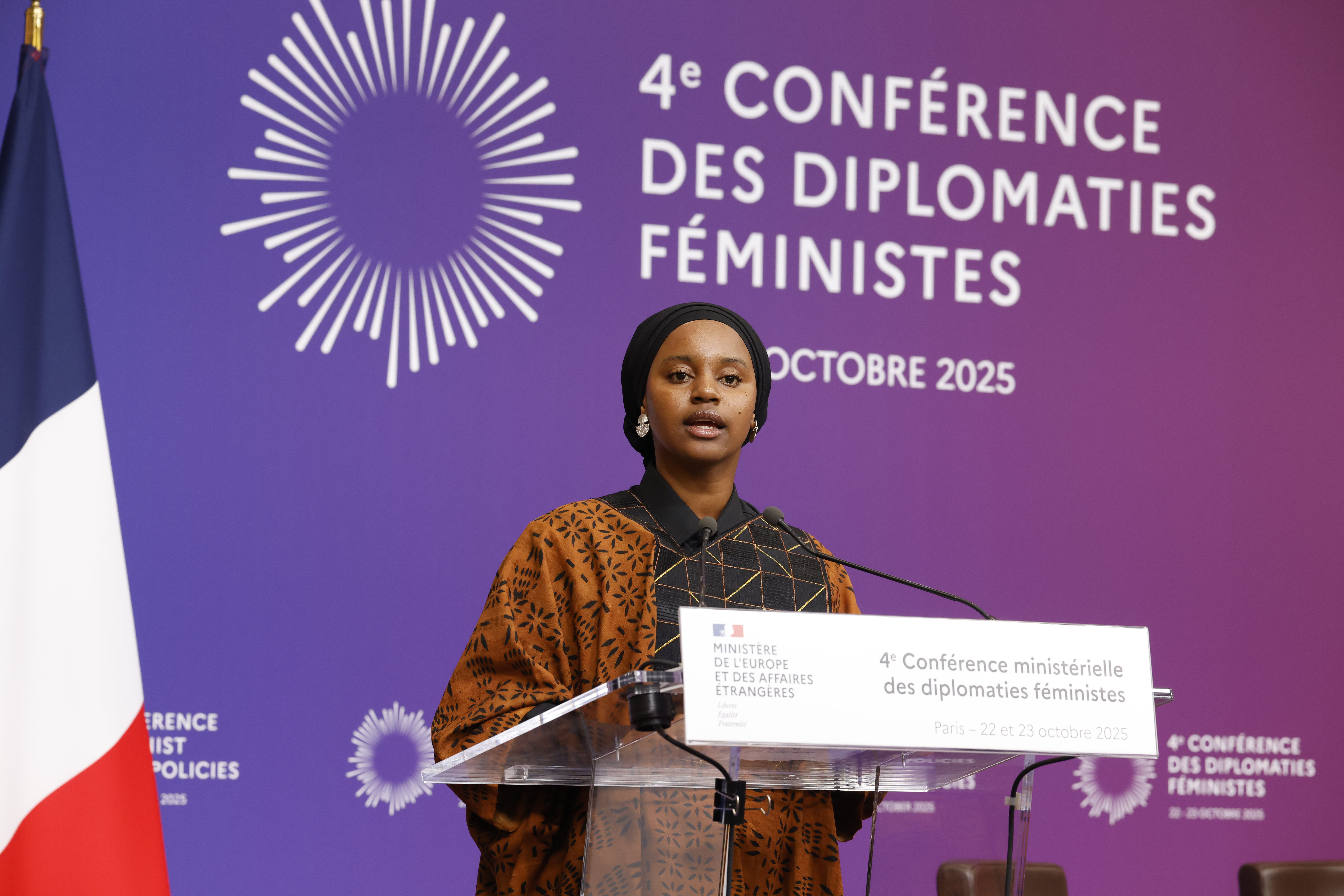
Against a backdrop of declining rights and funding crises, the Ministerial Conference on Feminist Diplomacy brought together 31 states in Paris. Feminist activists who made their mark at the event analyze the official announcements and reiterate the urgent need for truly transformative diplomacy, built with actors on the ground, rather than simply proclaimed.
Feminist diplomacy at the heart of global issues
The concept of feminist foreign policy (FFP) emerged in the 2010s with Margöt Wallström's Sweden, the first country to officially adopt feminist diplomacy based on the "three Rs" — Rights, Resources, Representation. Inspired by this approach, a dozen countries, including France, Canada, Mexico, Spain, and Chile, have committed to this path. But while some states are backtracking, such as Sweden and the Netherlands following major political changes, the fourth Ministerial Conference on Feminist Diplomacy, held in Paris on October 22 and 23, 2025, marked a key moment in consolidating international commitments to gender equality. This commitment was formalized with the adoption of a ambitious Political Declaration by 31states, which includes several calls to action. Respect for fundamental rights and the fight against gender-based violence, support for feminist civil society, sexual and reproductive rights and health, women's participation, and strengthening mobilization in the multilateral sphere. These cross-cutting issues have long been championed by feminist civil society and are at the heart of the collective advocacy work carried out by the Francophone Feminist Alliance.
A crucial 2025 edition for women's rights, marked by backlash and a context of global polycrisis
Bringing together more than 400 participants—representatives of states, international organizations, parliamentarians, foundations, and civil society—the Paris conference was held in a tense context. The global crisis in official development assistance, massive budget cuts by traditional donors, and the closure of USAID have weakened funding for the promotion of equality. At the same time, anti-rights movements are gaining ground and organizing, from the United States to Europe and Latin America. In the face of this conservative offensive, feminist diplomacy appears more than ever to be an essential tool for defending the rights of women, girls, and LGBTQIA+ people, and for reaffirming a strong international commitment to gender justice.
Similarly, current crises—wars, climate change, democratic regression—highlight the urgent need to put gender equality back at the heart of foreign policy. Lasting peace cannot be built without the voices of minorities. This is the whole point of feminist diplomacy: to articulate human rights, social justice, economic redistribution, and democracy in every area of international action.
The Paris conference thus provided an opportunity to question diplomatic practices that are still too marked by patriarchal and militarized logic, and to pave the way for reflection on more inclusive, transformative, and truly feminist foreign policies.
The voices of French-speaking feminist activists: perspectives from the Conference
Invited by theFrancophone Feminist Alliance, Oumou Khairy Diallo, Bénédicta Aloakinnou, Yousra El Barrad, and Nafissatou Hassane Alfari took part in the conference debates. Their contributions highlighted the realities on the ground and the high expectations for feminist diplomacy.
Rethinking power: our call for inclusive and transformative feminist diplomacy
| Rethinking power means accepting the redistribution of power and resources. Rethinking power means refusing to speak on behalf of others and working together to build transformative feminist diplomacy. Rethinking power means rethinking women in crisis contexts and recognizing their participation in governance and peace processes. Rethinking power means redefining support as a coalition of solidarity that gives confidence and freedom. Because as long as a woman somewhere in the world is deprived of her freedom, none of us will ever be truly free. And without women actors on the ground, there can be no real feminist diplomacy. |
Oumou Khaïry Diallo (Guinea Young Women Leaders Club)
Speaking at the opening ceremony of the Conference on Feminist Diplomacy on behalf of civil society, Oumou leads the Guinea Young Women Leaders Club, mobilizing more than 520 volunteers for education, protection against violence, and gender equality.
“Every day, I participate in the lives of women and girls on the ground. I see, I listen, I care for and I rebuild, often with very little, but always with conviction. These experiences give me unique expertise, which must be recognized as such. For me, true feminist diplomacy cannot be just another international posture; it must profoundly transform power relations and decision-making processes. I reject diplomacy that is built without us, the feminist civil society. It must include us as full partners, not as mere consultants. Every budget cut, every international disengagement takes away hope from those who have no one but us. Establishing feminist diplomacy means restoring justice to those from whom society has stolen it, and rebuilding our societies on the basis of equality and dignity, without leaving anyone behind."
Yousra El Barrad (Federation of Women's Rights Leagues, Morocco)
A Moroccan intersectional activist committed to women's rights and gender equality, Yousra works both in the field and in legal and political advocacy, promoting intergenerational dialogue and transformative approaches to gender.
“Ishare this vision. For me, feminist diplomacy must remain true to its transformative vocation. It cannot be reduced to an institutional slogan or a framework for thematic cooperation. It must challenge the hierarchies, inequalities, and power dynamics that permeate our societies and international relations. This means financing and supporting feminist movements directly, sustainably, and without political conditions. These movements are the driving force behind transformative responses, rooted in the reality of the injustices experienced. Feminist diplomacy must be built with movements in the Global South, sharing power and co-constructing strategies in a spirit of equality and solidarity. As long as civil society remains confined to the role of "consultative partner," feminist diplomacy will remain incomplete. The strength of this diplomacy lies in its ability to connect the local to the global, to listen to and amplify the plurality of feminist voices, and to transform these political commitments into concrete actions.
Feminist diplomacy and militarized contexts: rethinking international action
Nafissatou Hassane Alfari (Women in Nexus, Niger)
A Nigerian feminist activist and co-founder of Women in Nexus, Nafissatou has been working for seven years to include women and young people in peace and security initiatives, mobilizing community mediation and advocacy.
“Based on my experience in the field, I have observed that one of the most persistent blind spots in feminist diplomacy is its ability to operate in contexts where democracy is fragile, militarization is intensifying, and political transitions are reshaping power relations. These realities are not abstract: they affect many countries facing military regimes or periods of unstable transition. In these environments, institutional frameworks are fragile, civic spaces are shrinking, and women engaged in the defense of rights find themselves on the front lines, often without adequate protection.
For us as activists, it is crucial to ask a question that is rarely discussed at major international conferences: how can feminist diplomacy remain relevant and transformative in a context dominated by military rule or transition? This challenge requires rethinking partnerships, creating flexible support mechanisms, and recognizing that women's participation in governance and peace processes cannot be suspended in times of crisis.
Feminist diplomacy tailored to these contexts must:
- maintain clear commitments to human rights, even when the bilateral partner is part of an authoritarian regime;
- support women mediators and community leaders who work for peace and social cohesion;
- document and denounce the impact of security policies on bodies and rights;
- protect threatened women defenders;
- ensure that political transitions systematically include women as key actors.
Ignoring these realities means disconnecting feminist diplomacy from the areas where rights are most threatened.
Funding feminist civil society: a global coalition based on solidarity and trust
Benedicta Aloakinnou (Young Amazons Foundation for Development, Leadelles.com, Benin)
A feminist activist and lawyer from Benin, Benedicta heads the Fondation des Jeunes Amazones pour le Développement (FJAD) and Leadelles.com, combining activism, technology, and advocacy for women's participation, digital security, and the fight against gender-based and sexual violence.
“For me, feminist diplomacy cannot be reduced to declarations or symbolic budget lines. To intervene in this space is to speak the language of struggles, experiences, and bodies, the language that forged my activism in Lokossa, in southern Benin. Today, our movements face a triple threat: financial insecurity, harassment, and criminalization. Drastic cuts in official development assistance, sometimes up to 60%, reduced international funding for women's rights, and the rise of increasingly well-organized anti-rights movements are undermining our actions.
True feminist financing must be direct, flexible, sustainable, and based on trust. Less than 1% of global funding goes directly to local feminist organizations: this reality is unsustainable. However, our initiatives, such as Sang Pour Sang – Unies pour la Dignité (Blood for Blood – United for Dignity) and Elles Pour Elles(Women for Women), show that with real support, we can transform lives, mobilize women, and create spaces for care, discussion, and collective action.
That is why I insist on the urgency of international solidarity conceived as a political alliance, not as vertical aid. Feminist diplomacy must become a global coalition where capitals—Paris, Dakar, Niamey, Conakry, or Cotonou—exchange power, resources, and respect, not just speeches. Feminist organizations do not just want to be protected: they want to be funded, believed, and given breathing space. When they are supported, they become a force for peace, care, and justice. Feminist civil society is not fragile: it is a transformative force. And it is women who carry this force.
1Germany, Armenia, Australia, Belgium, Canada, Chile, Cyprus, Colombia, Spain, Estonia, France, Ireland, Iceland, Kosovo, Latvia, Liberia, Lithuania, Luxembourg, North Macedonia, Mexico, Moldova, Norway, Netherlands, Portugal, Dominican Republic, United Kingdom, Rwanda, Slovenia, Thailand, Ukraine, and Uruguay.
-
Equipop, at the forefront of feminist diplomacy
For more than thirty years, Equipop has been working to ensure that French diplomacy fully integrates feminist principles. Present at all previous editions of the conference, the association played a key role in co-developing France's International Strategy for Feminist Diplomacy 2025-2030, formulating concrete recommendations through its work with the High Council for Equality and a position paper on the subject.
As an actor in feminist multilateralism, Equipop actively contributes to international forums—from the Commission on the Status of Women to coalitions such as Countdown 2030 Europe, Walking the Talk, and the Francophone Feminist Alliance.
In the face of a global decline in rights, Equipop also acts as an observatory of backlash, documenting reactionary offensives and supporting feminist resistance through its publications and advocacy actions.