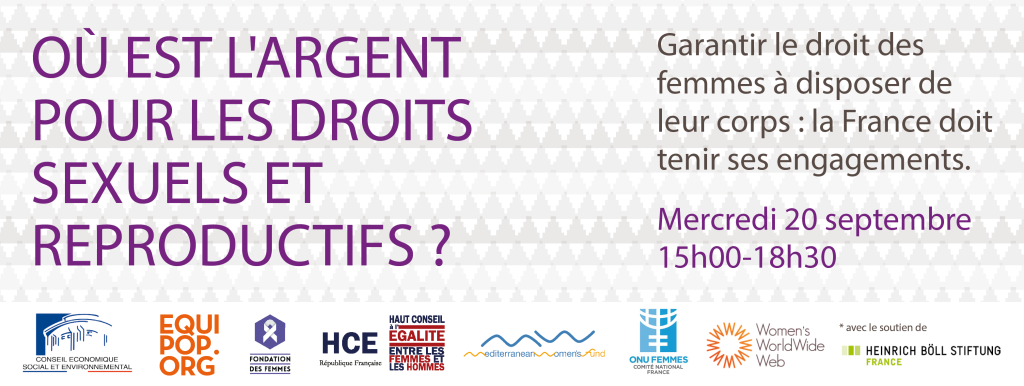
To guarantee women's right to control their own bodies, France must honor its commitments
Every year, 303,000 women die as a result of unsafe abortions or poorly attended childbirth . This situation requires funding for information and access to contraception and abortion. France's official development assistance can, and must, contribute to this.
On the occasion of International Safe Abortion Day on September 28 and World Contraception Day on September 26, and in response to actions and policies that threaten women's lives and rights, the Economic, Social, and Environmental Council, UN Women France, Equilibres & Populations, the Fondation des Femmes, the Fonds pour les Femmes en Méditerranée, the High Council for Gender Equality, and Women's WorldWide Web are joining forces for an event to be held on September 20 at the CESE.
The aim is to call on French politicians to make concrete financial commitments to promoting women's sexual and reproductive health and rights (SRHR) in France and around the world, thereby making up for the significant shortfall in official development assistance in this area.
Gender equality was declared a major national cause for the five-year term. However, the promised ministry dedicated to women's rights ended up being a State Secretariat with an unprecedented budget cut of 27%. As for official development assistance, it currently amounts to only 0.38% of gross national income, far from the historic commitment of 0.7%, and the share specifically dedicated to promoting women's rights is much lower than in other major OECD countries.
International events call for a response. The rise of religious fundamentalism and reactionary right-wing movements is seriously undermining women's rights around the world. If we had to cite just one example, Donald Trump's policies would surely be the most emblematic. The US president's new Global Gag Rule directly threatens nearly $10 billion allocated each year to health programs around the world.
Because access to sexual and reproductive rights is a prerequisite for women's autonomy and gender equality, the French government must translate its commitments into action and finance the protection and enforcement of women's rights, both in France and internationally.
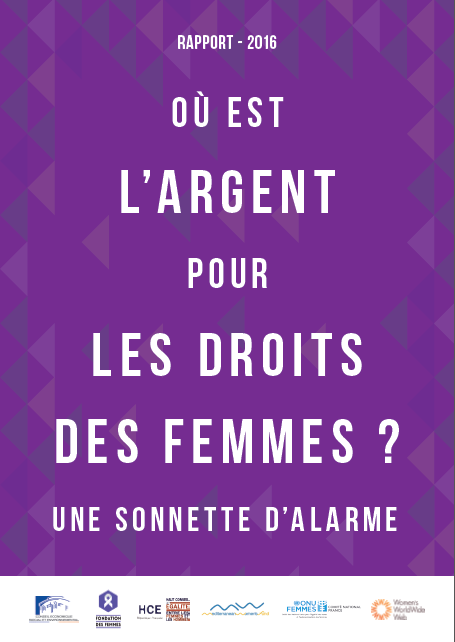
In September 2016, a consortium comprising the Economic, Social and Environmental Council, UN Women France, the Women's Foundation, the Fund for Women in the Mediterranean, the High Council for Gender Equality, and Women's WorldWide Web published the first report assessing the state of funding for women's rights in France: "Where is the money for women's rights? A wake-up call."
Press contact: Economic, Social and Environmental Council – Charlotte Lazimi, +33 (0)7 77 16 46 85, charlotte.lazimi@havas.com UN Women France Committee – Céline Mas, +33 (0)1 57 27 94 58, celine.mas@onufemmes.org Equilibres & Populations – Nicolas Rainaud, +33 (0)6 73 72 25 37, nicolas.rainaud@equipop.org Fondation des Femmes – Anne-Cécile Mailfert, +33 (0)6 58 47 72 68, annececile@fondationdesfemmes.org Fund for Women in the Mediterranean – Caroline Brac de la Perrière, +33 (0)6 12 09 58 09, cbdlp@medwomensfund.org High Council for Gender Equality – Margaux Collet, +33 (0)6 09 14 43 06, haut-conseil-egalite@pm.gouv.fr Women’s WorldWide Web – Lindsey Nefesh-Clarke, +33 (0)6 88 27 50 25, lindsey@w4.org