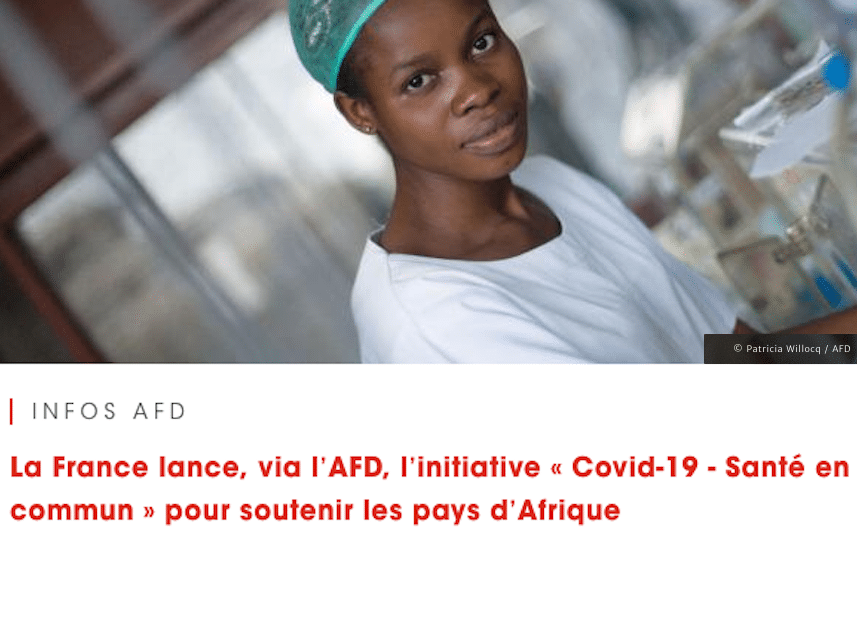
On April 9, France, through the French Development Agency (AFD), launched the "Covid-19 – Santé en commun" initiative to support the 19 priority countries for French official development assistance, most of which are in Africa. Equipop emphasizes the need to developing a response that is not "gender blind."
Last week, AFD announced an initiative to respond to the Covid-19 crisis. The main areas of focus for this initiative are: strengthening regional epidemiological surveillance networks; contributing to African countries' national Covid-19 response plans; supporting the main French actors involved in the Covid-19 response (NGOs, foundations, networks, research organizations, etc.); and providing budgetary support to strengthen health systems. The announcement mentions the sum of €1.2 billion allocated " ly by summer 2020." €150 million will be allocated in the form of grants, and nearly 90% of this envelope will be in the form of loans.
Equipop, with support from AFD, has been working alongside West African associations for twenty years. In Benin, Burkina Faso, Côte d'Ivoire, Guinea, Mali, Niger, and Senegal, partner associations are developing projects that address health, gender equality, and citizenship in a cross-cutting manner. Today, these associations are joining forces with researchers and health professionals to highlight the need, as called for by the UN Secretary-General, to "place women and girls at the center of the response to the pandemic." However, the AFD's communication on its initiative does not mention gender equality, the specific needs of women, or the need to guarantee the health of marginalized groups. That is why we want to sound the alarm: let's not repeat the mistakes of the past, especially when France has been loudly and proudly championing the fight against gender inequality for several months now!
Recognize the specific role of women in healthcare and ensure their equal participation in developing responses.
Recent pandemics, including Ebola, have shown that women are particularly vulnerable in health crises. They make up the vast majority of caregivers in the formal health sector, and even more so at the community and family level, often at the risk of their own health and safety. At the same time, due to unequal social norms, they are excluded from the decision-making processes that determine how to respond to crises. Health emergency plans must recognize the care work provided by women and support it without adding to their burden. More broadly, all responses to the crisis must fully integrate women, from their development to their implementation.
Moving beyond the biomedical lens
Responses to epidemics are often characterized by the "tyranny of urgency" and focus on immediate biomedical needs with a strong androcentric bias.
While there is now broad consensus on the need to invest more in strengthening health systems, the need to combat gender and other inequalities seems to be less widely recognized. In fact, these investments remain "gender blind." However, a health crisis and the responses to it have many serious secondary consequences that affect people unequally, depending on their gender but also on other characteristics such as their economic resources, origin, or age. For example, lockdown, curfew, and quarantine measures increase the exposure of women and girls to the risk of domestic and intra-family violence. School closures pose a greater risk of long-term school dropout for girls.
Pay special attention to SRHR
During health emergencies, access to sexual and reproductive health services can become much more difficult. Weak health systems, combined with the temptation to redirect budgets toward immediate crisis responses, create a very unfavorable context. Between 2014 and 2016, maternal mortality rates rose by more than 75% across the region affected by the Ebola virus.
There is also a high risk of a return to old patterns based on coercive and conservative approaches that reinforce discrimination. For example, there has been a worldwide increase in messages promoting sexual abstinence or renewed stigmatization of populations considered to be particularly susceptible to the virus—young people, migrants, sex workers, etc. The crisis has led to renewed attacks on fundamental rights that have been hard-won, such as sexual and reproductive rights.
Only one option: placing gender at the center of the response
The AFD Group emphasizes that the launch of this initiative "demonstrates its responsiveness and effectiveness." It was indeed necessary to quickly devise a response, but in the operational phase that is now beginning, AFD, Expertise France, and their partners must not repeat the mistakes made by many actors in the past. It is imperative that, in operationalizing this mechanism, these agencies apply the principles of feminist foreign policy in practice and take into account the direct and indirect effects of the Covid-19 epidemic on gender relations. It would be unacceptable for the responses to this crisis to reinforce inequalities, particularly gender inequalities. On the contrary, this is an opportunity to change the way we respond to the major challenges facing humanity, and this is certainly what Equipop and its partners expect from AFD.
To learn more about Equipop's position during this health crisis, you can also read: