On May 12, 2022, the partners of the CHAIN project—the European Network End FGM, ActionAid International Italia Onlus (Milan, Italy), Equipop (Paris, France), TERRE DES FEMMES (Berlin, Germany), and Save a Girl Save a Generation (Madrid, Spain)—celebrated the second anniversary of the CHAIN project, which is coming to an end.
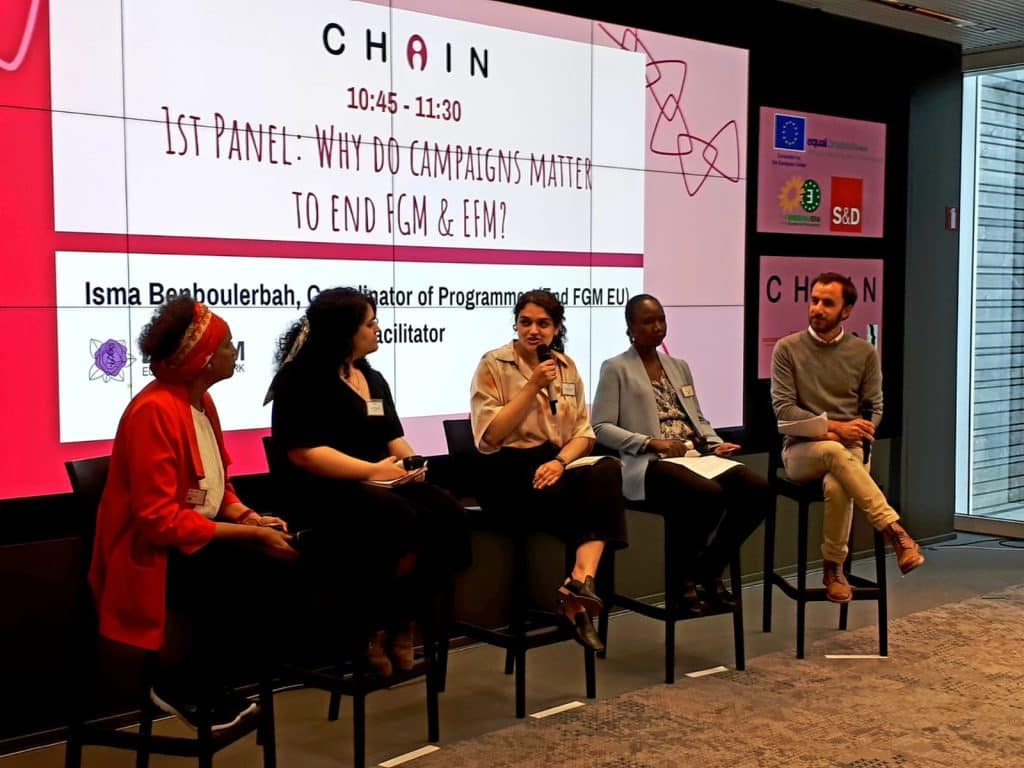
Through presentations, speeches, and panel discussions, the conference showcased all the work that has been carried out through CHAIN and the project's successes in community learning and the results of the "Chain For Change" awareness campaign.
End FGM EU, together with the CHAIN project partners, organized a hybrid international conference to take stock of the CHAIN project's results. Held simultaneously in Brussels at the TownHall Europe conference center and via online videoconference, this high-level event brought together key stakeholders involved in the project's objectives, European Union politicians such as Commissioner Helena DALLI, MEP Evin INCIR (S&D, Sweden), and MEP Pierrette Herzberger-Fofana (Greens/EFA, Germany). The event also saw the participation of Equals Brussels – For Equal Opportunities, represented by Mr. De Buyst, head of regional action to combat violence against women.
In her pre-recorded introduction, Commissioner DALLI stated, " The development of a community-based approach is the key to your success. It is thanks to the work of NGOs—as demonstrated by the CHAIN project—that effective public policy can be implemented ."
Through presentations, speeches, and panel discussions, the conference showcased all the work that has been carried out through CHAIN and the project's successes in community learning and the results of the "Chain For Change" awareness campaign.
The CHAIN project worked on the link between the prevention of female genital mutilation (FGM) and early forced marriages (EFM) in Europe, focusing on strengthening prevention, protection, and support for survivors of gender-based violence through capacity building, community empowerment, and awareness-raising, while helping to give a voice to the communities concerned at the political level. For community trainers—who are members of the affected communities and involved in the project—this event provided an opportunity to exchange ideas with policy makers on how to better support community involvement in ending the two harmful practices of FGM and EFM in Europe and beyond. We would like to thank Sulekha Ismail, Amsatou Ba, and Sekou Kaba for sharing their expertise and insights with us during the conference. CHAIN partners hope that the success of the project and the introduction of these conversations at this European-level conference will inspire future initiatives to combat harmful practices, starting with the upcoming European Commission Recommendation on Harmful Practices, despite the taboos surrounding these topics. Furthermore, we hope that the example of intervention chains will motivate greater involvement from the communities concerned and key professionals who are the first to deal with cases of FGM and FFM. We believe that the CHAIN project has demonstrated the significant impact of supporting and involving communities. It is not only their right to take control of the policies that directly affect them, but also essential in order to encourage the cultural and political change necessary to end FGM and FFM practices for good.