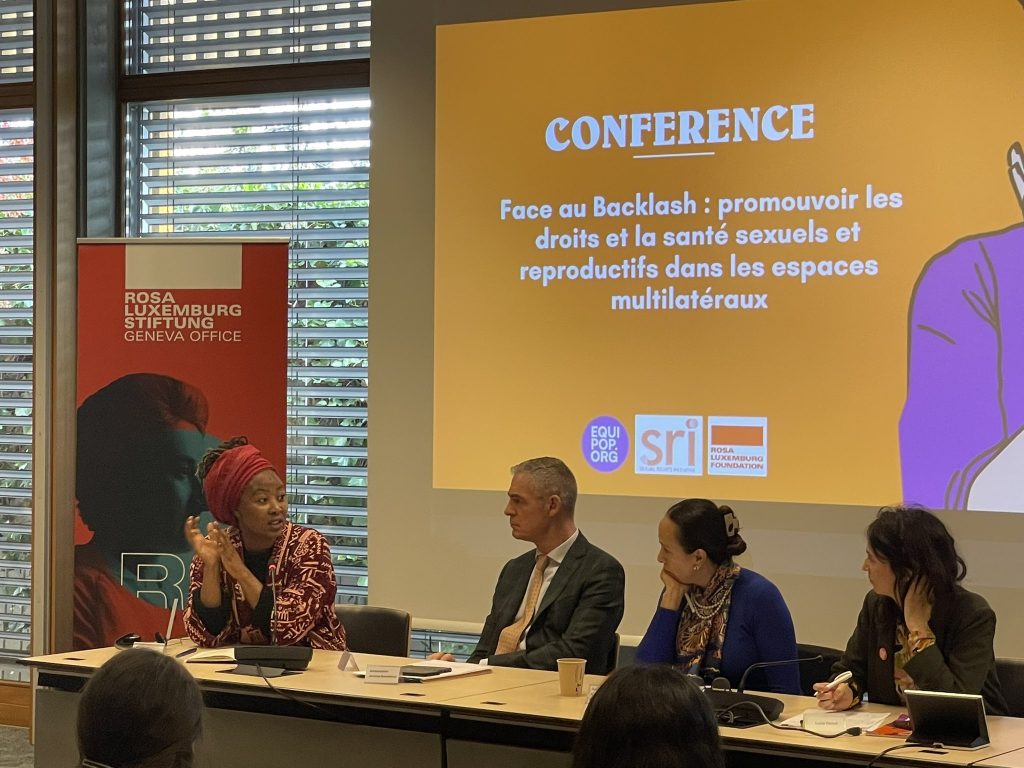
On Tuesday, November 21, 2023, Equipop organized a conference in Geneva on the theme "Facing the Backlash: Promoting Sexual and Reproductive Rights and Health in Multilateral Spaces" in partnership with the Rosa Luxembourg Foundation and the Sexual Rights Initiative. The event welcomed around 100 participants, both online and on-site, demonstrating strong interest in this issue. Discussions among panelists from a variety of backgrounds identified courses of action, including the creation of multi-stakeholder alliances to counter backlash in all its forms and in all multilateral forums.
As the 75th anniversary of the Universal Declaration of Human Rights approaches, Equipop, the Rosa Luxembourg Foundation (Geneva office), and SRI organized a conference in Geneva. The goal was to analyze the dynamics of backlash against human rights around the world and to strengthen alliances and collective strategies in response to this phenomenon. This conference is also part of the Countdown 2030 Europe #AWorldWhere campaign. The conference venue, Geneva, was particularly strategic: the Palais des Nations and the Human Rights Council are spaces where the international community advances human rights standards. But Geneva is also a hotbed of anti-rights movements. It was there that the "Geneva Consensus Declaration" was adopted in 2020, marking a major milestone in the anti-rights offensive. Another event of this kind, positioned against abortion rights and LGBTQIA+ rights, held this time at the UN in New York a few days before the conference, confirmed the urgency of collective action.
The backlash against sexual and reproductive rights and health: controlling bodies and sexualities
Clara Dereudre, advocacy officer at Equipop, presented the report published this year with the Jean-Jaurès Foundation on the backlash against women's rights. This term refers to " the reactions of conservatives, or anti-rights movements, to advances in women's rights and, more broadly, human rights. It also describes the strategy deployed by these conservative movements and the tools they use to threaten, attack, and violate these rights. " Historically, the main objective of these anti-rights movements has been to control bodies and sexualities. In addition to the issue of abortion, these movements now deny the rights of anyone who does not conform to the heteronormative and cisgender model. Their attacks take various forms, in a continuum of sexual and institutional violence: systematically reducing women's bodies to their reproductive function, denying the identity of transgender people, and criminalizing the sexuality of homosexuals. Building on this anti-SRHR crusade, anti-rights movements have expanded their agenda to attack other fundamental human rights. There is thus a convergence of anti-gender, anti-rights, anti-democratic, and climate-skeptic agendas.The interdependence of rights and systems of oppression
In light of this observation, conference speakers highlighted the interdependence of systems of oppression. Vuyiseka Dubula (Director of the Communities, Rights and Gender Department at the Global Fund to Fight AIDS, Tuberculosis and Malaria) emphasized that the communities most affected by anti-rights movements are also the most affected by climate change, despite their lesser contribution to it. This is particularly the case in the Sahel, where the backlash is compounded by a security and climate crisis. Wendyam Micheline Kabore, Executive Director of IPBF, pointed out that 75% of displaced populations are girls and women. She also stressed the urgent need to provide more support to activists, many of whom have been attacked because of their commitment. To combat these conservative movements, it is necessary to organize and defend human rights consistently, taking into account their indivisible nature. This approach must guide the actions of states that advocate for a feminist foreign policy, such as France, Mexico, and Spain, represented at this conference by their respective embassies. The Permanent Representative of France to the United Nations Office in Geneva and to international organizations in Switzerland, Ambassador Jérôme Bonnafont, emphasized that rights cannot be achieved through segmented approaches, “economic, social, and cultural rights and civil and political rights are indivisibleEstelle Wagner, International Advocacy Expert at IPPF Geneva, highlighted the fact that SRHR and economic and social rights are interconnected. Francisca E. Méndez Escobar, Ambassador and Permanent Representative of Mexico to the United Nations Office in Geneva and international organizations in Switzerland, emphasized the importance of feminist foreign policy at all levels, in all diplomatic missions, and in all multilateral agencies. Anthea Taderera, Advocacy Expert for SRI, stressed the importance of a coherent approach: “A state may consider itself a champion of SRHR and yet be regularly criticized for its failures to uphold rights related to economic justice, freedom from racism, freedom of movement, and the right to development.”Strengthen alliances and increase funding for feminist movements
Fighting against backlash requires building strong collaborations across borders between actors from different sectors. The central role of UN agencies on this issue was highlighted by Aurora Díaz-Rato Revuelta, Ambassador and Permanent Representative of Spain to the United Nations Office in Geneva. The panelists highlighted the strategies used by anti-rights movements to break feminist solidarity, in a context where struggles are already fragmented by a competitive funding model and siloed political and budgetary approaches. This crucial issue of funding was raised by several speakers. Damjan Denkovski, Deputy Executive Director of the Center for Feminist Foreign Policy, highlighted the significant financial resources available to anti-rights movements, which enable them to exert influence in multilateral forums. Citing a report by the European Parliamentary Forum on Sexual and Reproductive Rights, he noted that funding for anti-gender movements in Europe had quadrupled between 2009 and 2018. This trend is on the rise and must be viewed in the context of the situation of feminist movements and associations, which suffer from a chronic lack of funding. On this subject, Sharlen Sezestre, a member of the Black Feminist Fund's board, has warned of the even more glaring lack of access to funding for Black feminist organizations. According to a report by the Black Feminist Fund, 59% of these organizations have never received structural funding (core fundingShe called for a culture of trust towards feminist organizations and more flexible funding arrangements, both public and private. Finally, Vuyiseka Dubula emphasized the importance of investment in sexual and reproductive health and rights: "When it comes to SRHR, if we don't move forward, we move backward. Right now, we are standing still and we are going to fall because we cannot afford to stand still. If we don't invest enough, all investments are at risk of being wasted," she said, issuing a call to action to governments and donors.Bringing together states, multilateral bodies, and civil society organizations, this conference is intended to be a step in a longer-term mobilization process. The presence of three embassies is a positive sign, and efforts should be made to consolidate this momentum and extend it to other states. Equipop will continue to contribute to this mobilization by strengthening its alliances with actors in the Geneva ecosystem.
* On October 22, 2020, 35 UN member states signed the Geneva Consensus Declaration, in which they reaffirmed their opposition to abortion rights. For more information, read the Equipop/Fondation Jean Jaurès report.