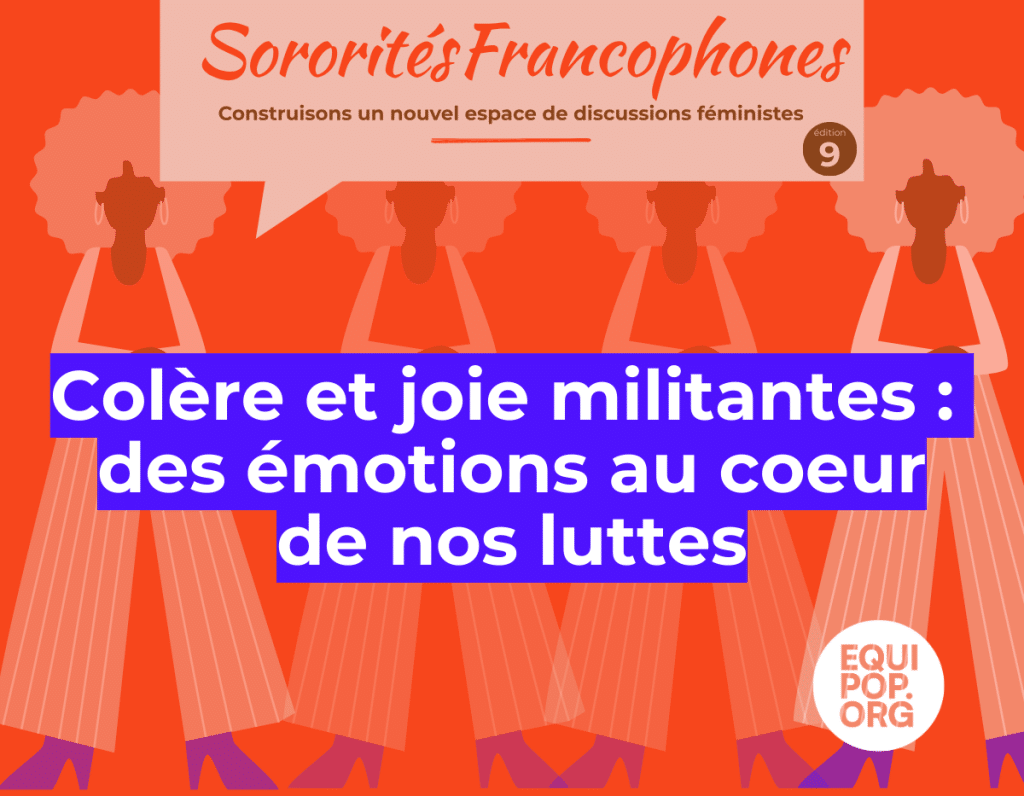
Emotions are at the heart of activist struggles, particularly in feminism. Anger and joy are two feelings often experienced by activists, but their roles and impacts differ. The eighth edition of the Sororités francophones cycle highlighted the place and legitimacy of emotional expression in feminist struggles. Three feminist activists discussed the role of these emotions in their commitment and activism:
- Désirée Dénéo, feminist activist, teacher, and secretary general of the Ivorian League;
- Kiyémis, author, Afro-feminist poet, and host of the podcast "Rends la Joie" (Bring Back Joy);
- Judicaelle Irakoze, feminist activist, community organizer, and social entrepreneur.
The speakers all emphasized that anger is a fundamental emotion in feminist activism. It is often a source of awareness of injustices and motivation to take action. "Anger has been a way for me to wake up, stand up, and confront injustices; it revitalizes our commitment," says Kiyémis. "During my early twenties, my relationship with anger was marked by a real emotional journey. I learned to legitimize my anger in the face of an oppressive and unjust world. We had to wake up from our slumber and illusion. We are angry because we face a world that seeks to oppress us and convince us that we are worth less as women." She continues: “We are angry because we aspire to better things for ourselves, but also for those who are like us and, more generally, for the majority. Situations of violence naturally provoke anger. This can be a powerful force for bringing people together and mobilizing them.”
Healthy anger
For Désirée Dénéo: "This anger directed at a patriarchal system, at oppressive practices, at violence, pushes us to move from emotion to concrete action. We transform this emotion into tangible initiatives, into associations that we create, into activism that we develop, into concrete engagement in the field." She gives the example of the Ivorian League, a feminist organization she helped to create, composed of young Ivorian women committed to promoting women's rights and combating violence against women. For her, anger is a familiar emotion, reflecting our reactions to the injustices and tensions we observe. It is a driving force, an indispensable lever for mobilization in our struggle for equality.
“I have never met a feminist who has been effective in her movement, in her actions, without feeling anger,” shares Judicaelle Irakoze. “It is from this emotion that we develop empathy for everything that is happening around us, for everything we observe. When I first became involved, it was also because of anger. I remember situations where I saw women around me feeling pain in the face of patriarchal violence and the resulting powerlessness. All that anger was one of the reasons I became a feminist." However, she points out that anger alone is not enough to build a collective feminist movement. "At the end of the day, you realize that anger alone is not enough. You need other emotions such as hope, joy, and honesty." She insists on the importance of not remaining stuck in anger, but also of cultivating joy and hope to nurture a collective, inclusive, and sustainable feminist movement.
Joy, a political act
Far from being contradictory, joy is an essential pillar of feminist activism. The speakers emphasized its fundamental role in maintaining hope, inspiration, and cohesion within the movement. Désirée reminds us that "joy is not the antithesis of feminist struggle or our demands; it is a transformative element that allows us to remain hopeful." She highlights the importance of celebrating every victory. By celebrating even modest successes, activists strengthen their resilience and determination in the face of ongoing challenges.
Cultivating joy, she believes, helps maintain hope and motivate activists in their daily struggle. For Kiyemis, joy is a family and community legacy. Joy becomes a political act, a means of challenging power structures that seek to limit and control the expression of female emotions. She explains: "Anger is not enough to overcome this anxiety and anguish. I wanted to think about another emotion that would allow me to create a creative dynamic."
As for Judicaëlle, she emphasized the role of joy in building a strong and supportive feminist community. Although social media brings us together, it also distances us. It is important to practice a form of feminism where we create communities outside of classrooms and digital tools. Judicaëlle emphasizes the need to create physical, tangible feminist communities. She highlights the importance of solidarity and mutual aid in spaces where women can support each other and share their experiences and resources.
Joy allows activists to connect with one another, share their experiences, and build bonds of solidarity. It strengthens their sense of belonging and hope, enabling women to support one another in their struggle for equality.
The balance between anger and joy
In feminist activism, anger and joy are two powerful and complementary emotions. While anger provides the energy and momentum needed to act against injustice, joy nourishes hope and strengthens solidarity. The speakers agree on the importance of finding a balance between these two emotions in the feminist movement. Anger is an essential driver of change, while joy maintains motivation and cohesion. By integrating these two emotions, feminists can build a more powerful and inclusive movement, capable of overcoming challenges and celebrating victories.
Denouncing gender stereotypes, Judicaelle insists on the full expression of women's emotions, without restrictions or judgments. She calls for the deconstruction of these norms to allow women to express themselves fully, both in their anger and in their joy. Women must be allowed to feel and express a full range of emotions, without being judged or limited by cultural or social stereotypes. Kiyémis emphasizes the need to cultivate joy: "We must seek out joy and embody it. Joy is propaganda!"