Since this year, Equipop has been working with its partners to introduce change-oriented approaches (COA) to monitor transformations and improve the actions implemented as part of social and political mobilization projects.
" We are constantly questioned by donors about the impact and change generated by our actions, and we often find it difficult to answer."
Agathe Blanc, Project Manager, Association of Women Lawyers of Côte d'Ivoire
This observation, widely shared by our partners in civil society, illustrates the difficulty of conveying the complexity and richness of the changes brought about by our social and political mobilization efforts.
Implementation from the project design stage onwards
In its role of supporting the emergence of civil society organizations (CSOs) in West Africa, Equipop is introducing a shift in the way it monitors and highlights these changes in projects promoting sexual and reproductive health and rights (SRHR), which it facilitates throughthe Equipop Lab.
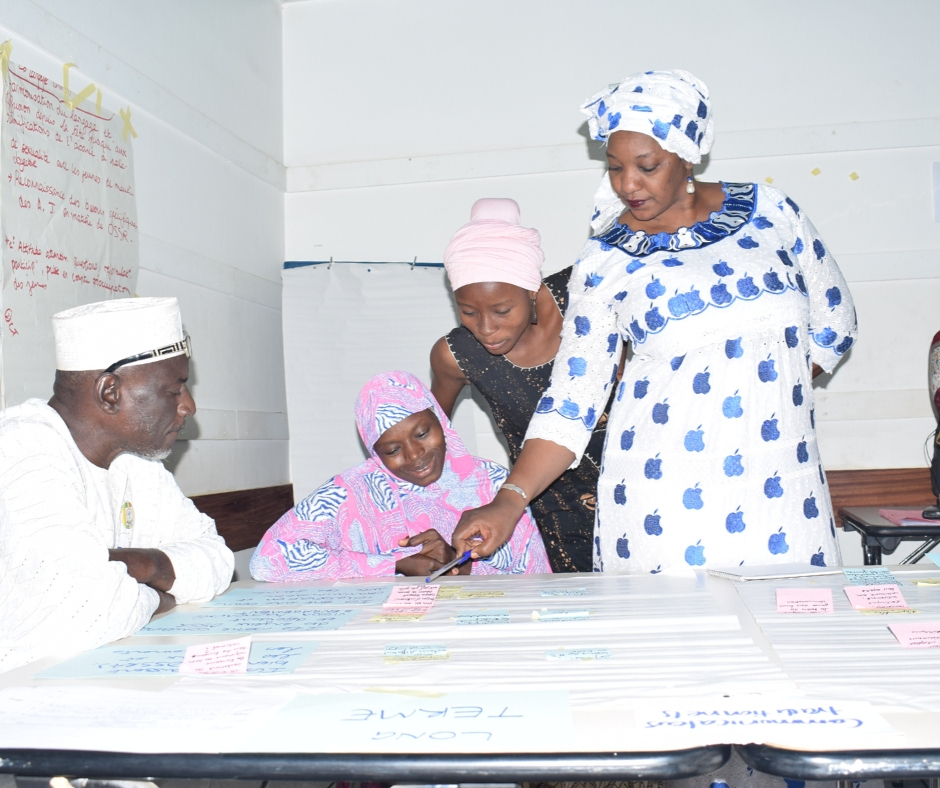
At the start of projects, workshops to implement change-oriented approaches are used to identify the various actors who will be observed. For each actor, the changes that need to occur during the project are defined, along with the intermediate steps to achieve them and how these developments will be monitored.
Between July and November 2019, these workshops to implement the AOC system with partners from the six countries involved provided an opportunity to take a step back from the operational aspects and consider the changes targeted by the initiative. Can the activities planned in the projects bring about these changes? Are the various actors expected to bring about change receiving sufficient support? The AOC method can therefore have a significant impact on everyday working practices, by reorienting not only the way changes are perceived, but also the action itself:
"I realized that sometimes I can't overcome obstacles because I'm simply not looking in the right place. This method helps us understand that the changes made to achieve results are just as important, if not more important, than the results themselves. I'm going to use this method with my colleagues to better highlight the changes brought about by the work we do every day with children and young people."
Mr. Félix Balet, special education teacher, director of the Cocody Nord socio-educational complex in Ivory Coast
"With change-oriented approaches, I feel more comfortable sharing small changes observed with donors, because I now know that this is also very important. AOCs are evaluation with a human face; they create bonds and allow us to develop a different perspective. "
Agathe Blanc, Project Manager, Association of Women Lawyers of Côte d'Ivoire
The “My Reality” project in Côte d’Ivoire – analysis of the impact on policies and programs
In Côte d'Ivoire, the workshop to set up the AOC system made it possible to design a monitoring system that will help us understand how publicly revealing the reality of young people in Côte d'Ivoire changes the discourse of political leaders and questions programs and their implementation. It will also provide insight into how the modus operandi of the "Ma réalité" project is changing individual and professional practices and attitudes by developing activist stances.
Monitoring based on AOCs will enable a better understanding of how citizen movements take shape in West African civil society across the six countries where the ChangeLab and Fondemsan projects are being implemented, with a view to accelerating progress on SRHR.