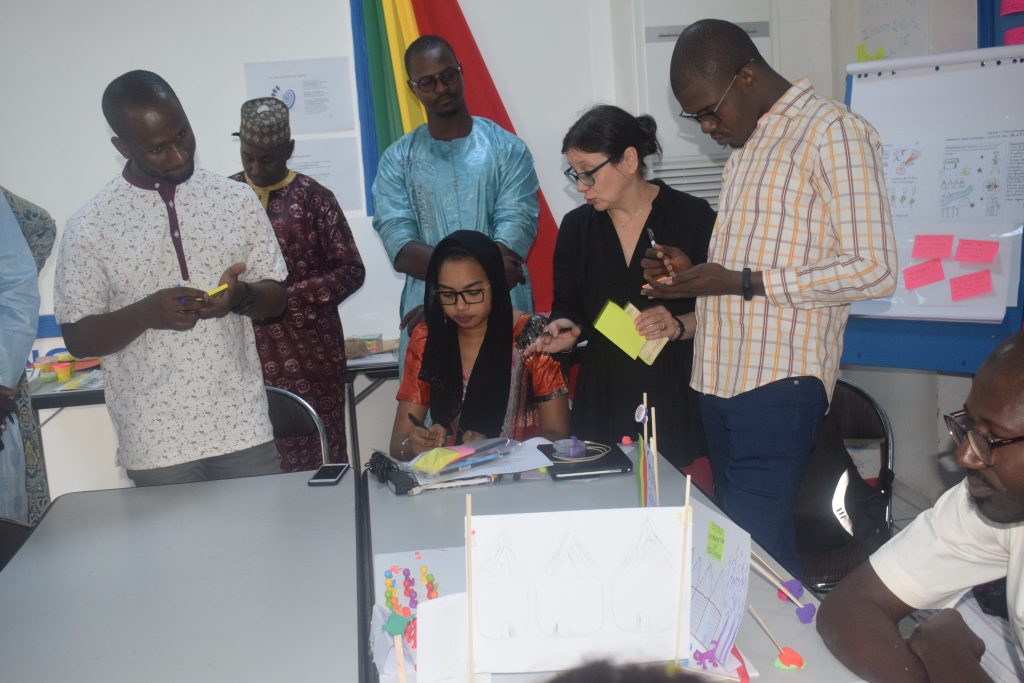
In April, May, and June 2019, with technical support from Equipop, associations from Benin, Burkina Faso, Côte d'Ivoire, Mali, Niger, and Senegal, beneficiaries of the Innovation/Change Lab Fund, incubated six social and political mobilization projects in favor of Sexual and Reproductive Health and Rights (SRHR). These initiatives were co-developed thanks to the Equipop Lab program, inspired by Design Thinking for the emergence of innovative projects.
Civil society organizations (CSOs) are key partners in changing social norms and in monitoring and implementing government plans and programs. Building on its experience with CSOs, Equipop has expanded its support services for CSOs through the rollout of a new project incubation methodology called Equipop Lab.

Equipop Lab, a Change Lab tool
This initiative is part of the Change Lab program, implemented by Equipop and supported by the French Development Agency (AFD) and two American foundations. Its goal is to strengthen the capacity of civil society organizations to advocate more effectively for family planning and SRHR in West Africa.

A methodology well received by partners
Although the methodology was unfamiliar to them at first, the partners greatly appreciated the deployment of this new project incubation method, which they considered innovative. "In addition to being fun, this approach allowed us to build our future project step by step. It's a really practical and participatory approach," said Rolland AGBESSI, Executive Director of Benin Scouting, the lead organization of the Benin consortium.
A new dynamic for the Alliance Droits & Santé network
For each country, at least one of the organizations participating in the project had to be a member of the Alliance Droits & Santé network. Launched in 2013 by Equipop, this network aims to improve the status and health of women and girls in West Africa. By joining forces with other civil society organizations to implement projects, members of the network strengthen the weight and impact of their actions, particularly at the national level, through planned social and political mobilization efforts. The network has thus positioned itself as an essential source of expertise in advocacy for SRHR in West Africa.

What are Equipop Labs?
Designed in partnership with specialists in Design Thinking methodology, Equipop Labs were developed with the aim of creating a space for CSOs and their partners to reflect and collectively create projects focused on innovation and relevance. By drawing on a range of expertise, the workshop format developed by Equipop encourages knowledge sharing and in-depth analysis of the context of Adolescent and Youth Sexual and Reproductive Health and Rights (AYSRH) in which CSOs operate. This analytical work forms the basis of any innovation process. To this end, the workshop is structured around:
1 – identifying a key issue,
2 – reflecting on how to address this issue,
3 – prototyping the chosen action, testing it, and then improving it.
This is a collaborative, user-centered, and action-oriented approach.
Benin: #WeMustAct
Supported by Scouting Benin, the West African Network of Young Women Leaders (Roajelf Benin), Young Volunteers for Health (JVS), and the Youth Advisory Body (OCJ), the #WeMustAct project will reveal the barriers and obstacles to accessing family planning services and information through a photo contest. It will enable the effective and critical mobilization of young people, whose skills will be strengthened to defend their access to information and services related to sexual and reproductive health and rights (SRHR). It will also help to document this issue in order to initiate a dialogue with the authorities responsible for ensuring compliance with and implementation of national and international commitments related to SRHR.
Burkina Faso: Reporting and challenging online violations of sexual and reproductive rights
In Burkina Faso, the incubated project plans to use the social network WhatsApp and community focal points to enable victims or witnesses of sexual and reproductive rights violations to report incidents and then be referred to organizations that can help resolve their situation. Once the alert and referral system is in place, an information/awareness campaign on the WhatsApp number and sexual and reproductive rights will be conducted. The data collected from the population following the campaign will be capitalized on and used to challenge political decision-makers. SOS/JD, Asmade, and Marche Mondiale des Femmes are responsible for implementing the project.
Ivory Coast: My Reality on Video
Led by the AFJCI, MESSI, and ASAPSU consortium, the My Reality project aims to highlight the realities experienced by young people in all their diversity, so that parents, decision-makers, and health workers become aware of what young people are really going through, their needs, and the urgent need for action. The project has three main focuses: the production/creation of video clips by young people about their experiences, the creation of a grand prize for the "best youth-friendly health worker," and political advocacy based on the video clips and a wall of testimonials that will be created throughout the project.
Mali : Griots amplify the voices of the "voiceless"
In Mali, the griot ("djeli"), a master of words who speaks in public and can make or break a reputation and settle disputes within communities, still wields considerable influence. The "Demisew ka keneya bé koungo do" project will enable the development of communication and advocacy actions led by marginalized adolescents and young people, the "voiceless," supported by griots. Led by three youth CSOs (AJCAD, member of Alliance Droits et Santé; RAOLJEF and RENAJEM), it will contribute to improving the normative and social framework in favor of DSSRAJ by mobilizing populations, local elected officials, and leaders around the experiences of the "voiceless" (dissemination of testimonials). It will encourage political leaders to honor their commitments and take appropriate measures (targeted campaign via social media and organization of a major televised debate).
Niger: Debunking myths
Led by Lafia Matassa, Scouts du Niger, SONGES, and CNJ, the project aims to create a genuine citizen movement to debunk myths about birth rates and marriage. Supported by a pool of young female experts, the project aims to take stock of the aspirations of Nigerien youth while laying the foundations for new forms of CSO mobilization on the issue of SRHR.
Senegal: Corporate social responsibility in the service of SRHR/YH
In Senegal, the Woomal Elegu Ndawyi project will strengthen the collective action of CSOs in order to engage new allies, mainly from the private sector, in citizen and political mobilization and the mobilization of domestic resources in favor of the sexual and reproductive health and rights of adolescents and young people (SRHR/AY). Key actions include: establishing a network of allies in the private sector and extractive industries; organizing a hackathon to incubate projects for social and political mobilization and/or domestic resource mobilization in support of SRHR for adolescents and young people; and hosting a fundraising dinner to finance the incubated projects. Led by the Senegalese members of the Alliance Droits et Santé network (NGOs JED, RAES, and Réseau Siggil Jigeen), the project could be a breeding ground for innovative proposals for financing SRHR for adolescents and young people by the private and extractive sectors in West Africa.