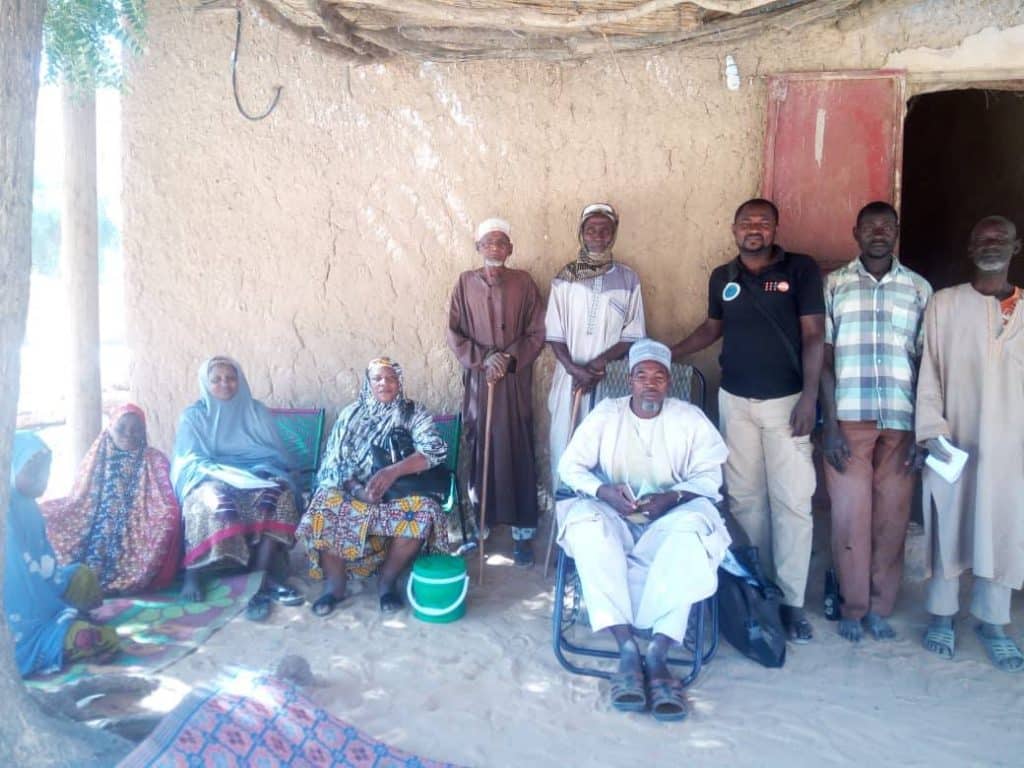
Equipop and its partners in Niger—NGO SongES, Ratanga Club, COJEFIL, and the SR/PF Coalition—have launched the first activities of the C'est la vie project in Filingué! Over the course of 12 months, this project will bring together young couples from five villages—selected in the Filingué area (Gao sohon gari, Gao Gardi, Gao sabon gari, Taramnou, Louma) – to discuss Sexual and Reproductive Health and Rights (SRHR) through training in life skills, including communication on SRHR and conflict management.
How can we address issues surrounding SRHR dialogue among newly married couples and, more broadly, within families? This is the challenge taken up by the C'est la vie Lab project in Filingué. Throughout 2019, teams laid the groundwork for the project's launch. The first mission, from December 20 to 24, 2019, provided an opportunity to present the project to the authorities, recruit local resource persons, and conduct a gender-specific analysis in the five villages. The latter made it possible to analyze gender relations in the communities and understand how to implement a project on these (often taboo) issues in these rural villages.
The project C'est la vie Lab Niger aims to encourage young couples to discuss SRHR through training in life skills, including communication about SRHR and conflict management.
In Filingué, groups will be formed between mothers-in-law, co-wives, young girls, and young boys. Each group will be led by a local influencer: the Tarmamoua Gari (community members). Due to their proximity to the group members, the Tarmamoua Gari will be able to establish a climate of trust in order to address sometimes sensitive topics. A facilitator (who is not a member of the community) will ensure that the messages conveyed by the Tarmamoua Gari are accurate and of high quality. The screening of excerpts from the television series C'est la vie (a series that promotes SRHR among adolescents and young people) and the use of the activity kit created by Raes (a debate activity booklet and box set with educational games) will enable each participant to consider appropriate and inappropriate behaviors, thereby initiating the debate.
2019: a year of preparation to ensure the project's impact
During 2019, an incubation laboratory helped define the scope of action, thanks to the Equipop Lab system inspired by Design Thinking.
After writing up the project, the teams took part in a workshop to develop monitoring and evaluation mechanisms based on Change-Oriented Approaches (COA). COAs aim to assess the impact of the project on those directly involved in it (working partners) in order to identify sustainable behavioral changes. The workshop helped to identify the project's working partners (the facilitators and the Tarmamoua Gari) and the changes they are aiming to achieve. These partners will play a central role in data collection.
Finally, in December, the team of facilitators received additional training in facilitation skills, their ability to convey accurate and high-quality messages, and the use of the C'est la vie tools (educational kit).
2020: a year of implementation and dialogue on SRHR
Following the presentation and gender-specific analysis mission, the teams will soon return to the field to train the Tarmamoua Gari to begin the viewing sessions scheduled for February 2020. The viewing sessions consist of screenings of episodes from the television series C'est la vie in Hausa, followed by discussions. These will take place until October 2020.