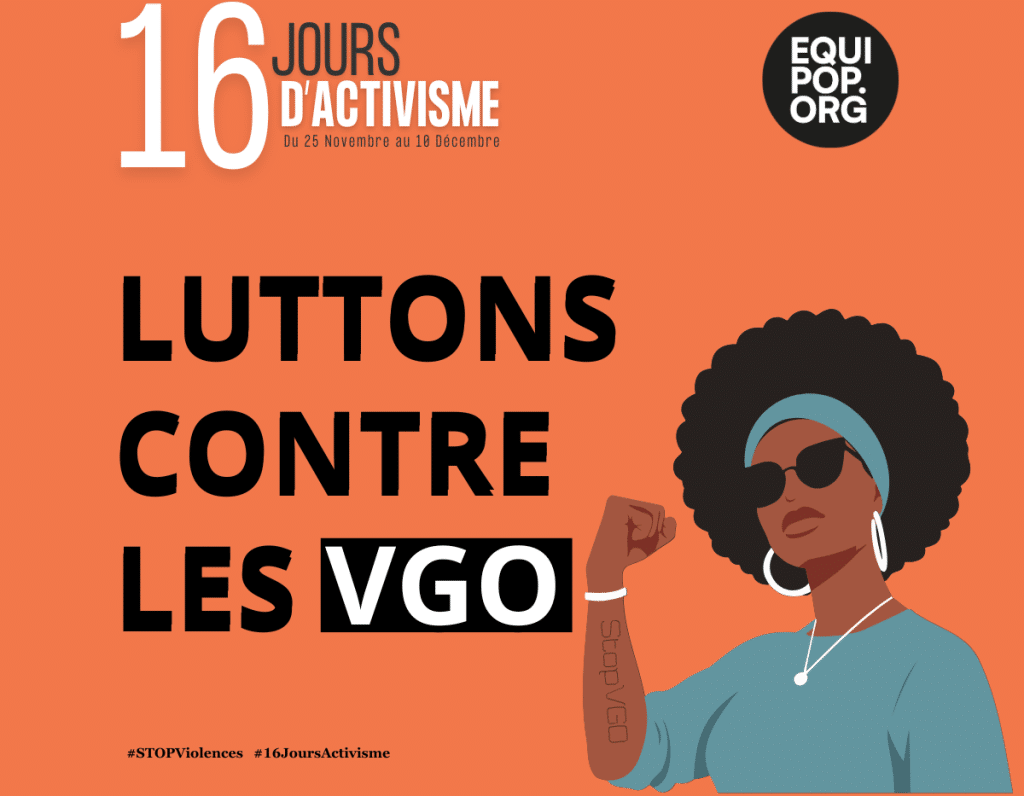
The 16 Days of Activism Against Gender-Based Violence (GBV) are a key moment to raise awareness and mobilize around the different forms of violence against women. In 2024, under the theme "Responding and rebuilding after violence," we are highlighting not only the importance of resistance in the face of injustice, but also strategies for healing from gynecological and obstetric violence (GOV). This is a fight we are actively pursuing in Senegal through our project "Our bodies, our health."
16 Days of Activism: raising awareness and collective mobilization
During the 16 Days of Activism, we intensify our awareness efforts to inform the public about the extent of GBV and encourage survivors to break their silence. We carry out various actions to inform the public, encourage survivors to break their silence, and promote support. In partnership with community and feminist media outlets, we organize debates and broadcasts that share the stories of survivors, experts, and activists. These initiatives are accompanied by a digital campaign on social media, featuring testimonials and infographics to reach a wide audience. A launch webinar will bring together specialists and activists to discuss measures to be taken to combat violence and support survivors. In addition, awareness-raising sessions are organized in schools, such as the one held at the Mermoz school, to educate younger generations and change attitudes.Gynecological and obstetric violence: a silent reality
Gynecological and obstetric violence (GOV) refers to all forms of physical, psychological, and verbal abuse inflicted on women during medical care related to gynecology and obstetrics. It includes acts such as physical assault, failure to obtain informed consent, verbal humiliation, and excessive medicalization during childbirth. This violence, which is often invisible, occurs in a setting that is supposed to be protective, namely healthcare, and constitutes a serious violation of women's dignity and fundamental human rights. In Senegal, as elsewhere, it is urgent to denounce and combat these practices. Such violence causes women physical and emotional suffering. But it is not only the result of inappropriate medical practices; it is also part of a broader patriarchal system in which women are often subjected to restrictive social roles and expectations. Many women experience this violence on a daily basis. Fatou, 32, tells us:"During childbirth, I was insulted and humiliated. I was told that I had to try harder to give birth, and that, on the contrary, when I was enjoying myself, everything seemed easy and pleasant for me. I was made to understand that a woman must suffer to give birth. That day, I realized that my body no longer belonged to me. This trauma stayed with me long after the birth."For her part, Mame Diarra, 28, recounts:
"During my gynecological exam, I wasn't even warned about what was going to happen. I was physically hurt, but it was the shame and helplessness I felt that affected me the most. Even today, I still find it difficult to talk about what I went through."These testimonies illustrate the extent of gynecological and obstetric violence and the suffering it causes women. But these acts are not isolated: they are part of a broader continuum of gender-based violence.
Fighting back and rebuilding: a shared commitment
Recovering from violence is a difficult journey, but it is possible. Ndeye, 45, shares her story: "After everything I've been through, I decided to share my story. Attending support groups helped me understand that I wasn't alone and that healing is possible, with time and support. Today, I campaign so that other women can be heard and heal." These stories show that after suffering, it is possible to get back on your feet and regain control of your body. In this process of healing and resilience, it is essential to support women in their reconstruction process. As part of our "Our Bodies, Our Health" project, we have implemented several concrete actions to combat this invisible violence and support women on their path to healing:- Support groups and counseling for survivors
- Awareness-raising and training for healthcare professionals
- Research and Data Visibility Committee