Convinced of the importance of organizational development for civil society organizations (CSOs) in improving sexual and reproductive rights and health, Equilibres & Populations has been working since 2014 with member associationsof Alliance Droits et Santé to establish a dynamic of continuous improvement. To achieve this, a common structuring approach adapted from the EFQM model .
From the first training workshop on the approach and organizational self-assessment...
The first step in the quality approach is to familiarize yourself with the tools, "scan" your organization's operations in nine areas (see box), and identify two or three initial priority actions to take in order to achieve better results.
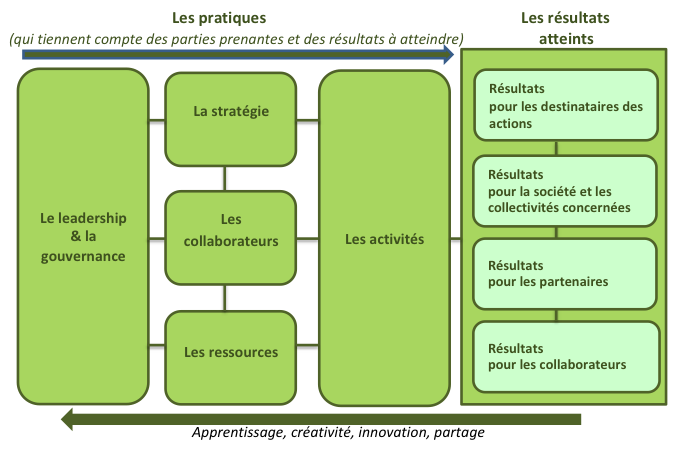
Adapted from the EFQM model by Équilibres & Populations, the SCAN tool offers a self-assessment method that reviews all the components of a CSO in terms of practices and results, using a comprehensive approach.
"Through self-assessment, we have found that the various results obtained by the NGO are neither sufficiently documented with evidence nor stored in a structured manner. Opportunities for meetings that allow the NGO to publish the results of its actions are also not sufficiently exploited,"shares Dr. Issa Sabo, President of Lafia Matassa in Niger.
It is designed for and adapts to all types of structures (small and large) and can be used to identify a wide variety of improvement projects. In Benin, during the first cycle, BACAR, for example, revised its procedure manual and statutory texts and renewed the membership of its board of directors, which is now fully functional again. For its part, the Beninese Scouting movement has implemented a financial policy and new management tools approved at the general assembly. It has moved from annual operational planning to more strategic planning, which it communicates more widely, resulting directly in the establishment of new technical and financial partnerships.
Finally, within CeRADIS, work on resource management has enabled the transition from cash accounting to accrual accounting, the acquisition of new accounting software, and the strengthening of the administrative and financial team. At the same time, the association has introduced a weekly project monitoring meeting to strengthen team involvement and update personnel files with the addition of a "career plan" dimension in order to help reduce turnover.
To define the projects to be implemented (the diagnosis reveals strengths and weaknesses in each area), organizations make decisions based on the expected impact, the degree of importance, and the capacity to implement them in light of available resources and context. Thus, actions with moderate impact but which are easy or inexpensive to implement may be favored, particularly in the early stages. If an organization does not have specific financial resources to allocate, it can choose important actions that mainly require time and the use of internal skills, as confirmed by Pascaline Fagninou, director of BACAR: "Our capacities have been strengthened and this support has awakened hidden skills within us.". As the operation is set to be repeated, costly projects can be considered in a subsequent cycle.
… The implementation of a continuous quality improvement process
For the first members of the Alliance (three from Burkina Faso, three from Niger, and three from Benin), more than 25 improvement actions were undertaken during the first 18-month cycle (2014–2016). These were evaluated at the start of a second cycle in each country, with a workshop to share experiences, support from Equipop to explore the tool in greater depth, and the identification of three new improvement projects per structure.
After Burkina Faso and Niger at the end of 2016, it was Benin's turn at the end of March 2017. As part of this second cycle, BACAR will work, among other things, on developing a three-year strategic framework and promoting its values, missions, and vision internally and externally. Beninese Scouting will work on developing a risk management framework and updating its stakeholder mapping, and CeRADIS will evaluate its collaboration with its stakeholders. "We have learned to carry out reforms ourselves. We have put in place a set of governance rules that apply to us. This way of working is difficult at first, but it is gradually becoming part of our habits," says the team from the Scout Movement of Benin.
Meanwhile, each member of Mali and Senegal (countries that joined the Alliance in early 2016) is embarking on the continuous improvement process and implementing its first three improvement projects.
In total, 45 improvement projects are currently underway within the Alliance's 15 CSOs, with support from Equipop and thanks to the mutual support and advice provided by members, who no longer hesitate to call on each other for help!