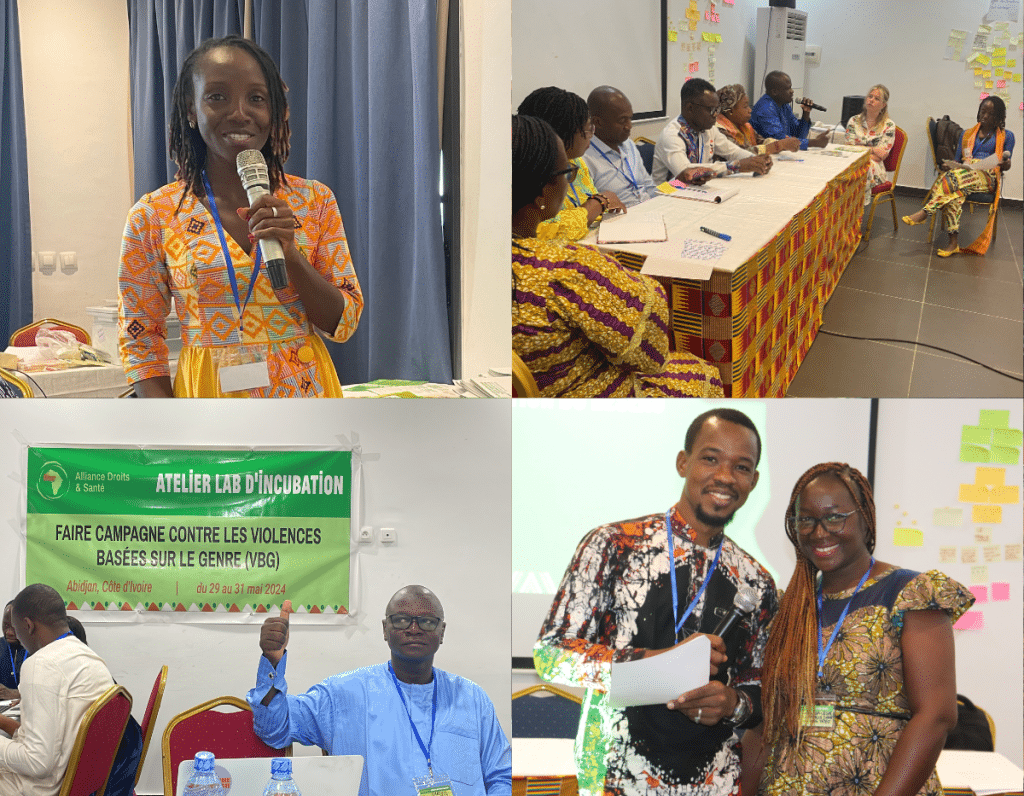
Since 2013, Equipop has been a member of and has provided technical and financial support to the Alliance Droits et Santé network: 22 associations of young people, women, and SRHR technicians in six West African countries committed to the sexual and reproductive health and rights (SRHR) of women and young people. The network met in early June in Abidjan (Côte d'Ivoire) to launch a regional advocacy campaign against gender-based and sexual violence (GBV) and hold its annual general meeting.
Strengthening our common position on VSS for more effective political mobilization
May 28, 2024 marked the launch of the "incubation lab" for the next regional advocacy campaign of the Alliance Droits et Santé network. This three-day workshop enabled members to clarify their values, strengthen common positions on VSS, and define a strategic objective and concrete advocacy actions. Indeed, in a context of increasing VSS, particularly in crisis areas, the network wishes to mobilize government authorities in the six member countries (Benin, Burkina Faso, Côte d'Ivoire, Mali, Niger, and Senegal) to develop and effectively implement budgeted national action plans for the care of survivors of VSS by October 2025.
Participants also took advantage of their in-person reunion to begin collectively considering how to harmonize their national advocacy efforts, identify opportunities to mobilize and pool their resources, and refine their advocacy messages, always working in synergy.
Sharing our visions for the network, its governance, and the structuring of our movement: a crucial and iterative step
Following the regional campaign incubation workshop, the network's annual meeting was held, attended by some 60 members determined to consolidate their achievements, improve the network's governance, and strengthen the capacities and skills of all members. This annual workshop was a valuable opportunity to share visions, update missions, and discuss the structure and path of the network towards autonomy. Caroline Tapsoba, President of the network, opened the discussions by emphasizing the importance of this collective dynamic for the promotion of the rights and health of women and girls in West Africa. She presented the current challenges, including the definition of the main strategic priorities for 2025-2030 and the revision of the network's vision and missions to better respond to the changing and volatile challenges of our contexts. In recent years, members have intensified their reflections to better take into account the security context of the region. This reflection takes into account the humanitarian consequences, particularly for internally displaced women, who are more exposed to gender-based and sexual violence, but also the economic consequences for civil society actors faced with political and budgetary prioritization to the detriment of SRHR in their countries. Members are also considering a strategy to take into account the impact of the ecological crisis. This analysis is intended to be comprehensive and aims to understand how these challenges interact, exacerbate the vulnerabilities of women and girls in the region, and tend to undermine access to rights. By integrating these dimensions, the network aspires to formulate more coherent and effective strategies to advance SRHR in West Africa. The meeting also featured in-depth discussions on the governance of the network. Members continue to explore ways to move toward greater empowerment by strengthening accountability and promoting active and inclusive participation by all members, especially young people. Finally, the meeting provided an opportunity to share the results of the network's expertise mapping exercise: a tool currently being consolidated that members will soon be able to refer to according to their needs for support and mutual capacity and knowledge building.
The 2024 General Assembly of Alliance Droits et Santé was a crucial moment for strengthening common positions on SRHR in a region facing increased challenges, sharing visions for the future of the network, and improving its autonomous and inclusive governance. By harmonizing advocacy actions and developing solid institutional strategies, the network is positioning itself as a key player in SRHR in West Africa. The discussions laid the groundwork for increased collaboration and effective resource mobilization, which are essential to ensuring the network's sustainability and impact in the years to come.