WHAT WE LEARNED FROM OUR PARTICIPATION IN THE 58TH SESSION OF THE COMMISSION ON POPULATION AND DEVELOPMENT
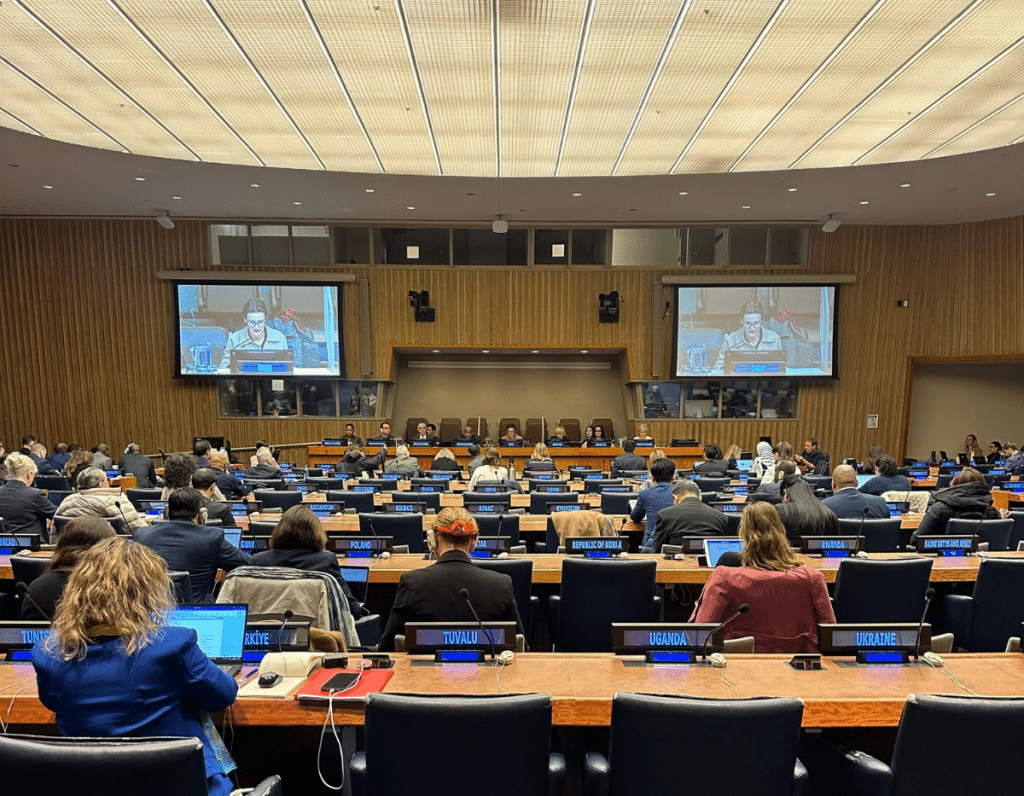
From April 7 to 11, 2025, Equipop took part in the 58th session of the United Nations Commission on Population and Development (CPD). This year's theme was "Ensuring healthy lives and promoting well-being for all at all ages." A dense, institutional space, largely dominated by states... and yet a space that is more than essential and central to defending sexual and reproductive health and rights (SRHR) as pillars and levers of equality.The United Nations Commission on Population and Development (CPD) is responsible for monitoring the implementation of the Program of Action adopted at the International Conference on Population and Development (ICPD) in Cairo, Egypt. This program marked a turning point by placing human dignity and rights, particularly in the area of sexual and reproductive health, at the heart of sustainable development policies. Each year, the CSD assesses progress and guides policies through resolutions. A month ago, we were at the 69th session of the United Nations Commission on the Status of Women (CSW69) with the Francophone Feminist Alliance. This time, it was the CPD: a more discreet, more technical but equally strategic space. Fewer side events, fewer activists, more technocrats and diplomats. Discussions often take place behind closed doors, and every word is the subject of fierce negotiations. While the energy there seems less palpable than at the CSW, the stakes remain high: to shift the consensus around SRHR in a global context of ideological hardening. In this context, a central question arises: how can civil society and feminists continue to exert influence?
WHEN RIGHTS ARE NO LONGER CONSENSUS: THE BATTLE FOR SRHR AT ICPD+15
Right from the start, the speech by Dr. Natalia Kanem, Executive Director of UNFPA, set the tone: reaffirming the legacy of the ICPD and putting SRHR back at the center of the global agenda. This was a necessary call in a fragile multilateral context, where sexual and reproductive rights are under pressure, as evidenced by the total erasure of these rights in the final declaration of CSW69. CPD58 thus represented one of the few institutional spaces capable of bringing these issues to the agenda. But the negotiations and statements in plenary quickly highlighted the structural tensions within the UN system, revealing an increasingly polarized multilateralism and a sharp decline in international consensus. On the one hand, there were strong and unexpected positions: on the first day, Sierra Leone, on behalf of 78 countries, defended an ambitious and comprehensive declaration on SRHR. This text links health to systemic inequalities (social, economic, racial, gender) and clearly states that dignity, choice, and social justice cannot be separated from the transformation of power structures. This was a rare statement that resonated far beyond the conference room. Norway also reaffirmed its historic position in favor of gender equality, highlighting the worrying setbacks observed in many countries. But these positions were met with an organized offensive. The United States, continuing its stance at CSW69, adopted a clear break with the past: explicit rejection of the 2030 Agenda, disengagement from the Sustainable Development Goals (SDGs), retreat to a traditionalist vision of the family, promotion of the Geneva Declaration, an ideological tool mobilized to challenge reproductive rights, particularly abortion. Argentina, Iran, and a few other states supported this dynamic, revealing a concerted attempt to redefine multilateral norms on reactionary grounds, disregarding the realities experienced by millions of people around the world. More than isolated statements, these interventions are part of a global offensive aimed at delegitimizing reproductive rights and reinstating patriarchal norms at the heart of international institutions. In this tense context, resistance has been organized. South Africa, supported by 42 countries from all regions, expressed deep concern about repeated attempts to undermine long-standing consensus rights, which were at stake during the COP20 negotiations. The country reiterated the urgency of protecting the historic achievements of the ICPD program of action, defending multilateralism, and reaffirming commitments to the 2030 Agenda, including the SDGs in their entirety. Uruguay and Paraguay also spoke out to denounce the lack of consensus, while reaffirming their commitment to the founding principles of the ICPD. This moment illustrates a paradox that has become structural: a majority of states are mobilized to defend rights, but their efforts are thwarted by the obstructionist capacity of a diplomatically powerful minority. The battle for SRHR is no longer being fought solely on the merits, but on the very mechanisms of international governance. Over the past ten years, the adoption of a resolution at the end of ICPD sessions has become the exception rather than the rule. This is a sign of growing political deadlock around sexual and reproductive rights and health, but also of a weakening of the normative scope of this space. In 2025, divisions between progressive and anti-rights states once again prevented any conclusive progress. The 58th session therefore ended without a text, once again.
A STRATEGIC AREA, BUT ONE IN WHICH FEMINISTS HAVE INVESTED LITTLE
In this space, feminist voices, particularly those from West Africa and the French-speaking world, are rarely heard. This lack of representation has concrete consequences: perspectives based on our realities are rarely visible, and our priorities are rarely defended. This forces us to think strategically: how can we continue to exert influence in a space where official results are frozen, but where power struggles crucial to our rights are being replayed? What this session has shown is that without collective action and coordination, influence remains limited. Some coalitions in which we have been involved, such as the International Sexual and Reproductive Rights Coalition (ISRRC), have played a structuring role. They decipher the wording of UN texts, propose alternatives, and facilitate the transmission of clear messages to delegations. Without being anchored in these dynamics, even a presence on the ground is not enough. The voices of civil society were heard, occasionally, in the plenary sessions. But their total absence from the opening plenary session remains symptomatic of a persistent imbalance. In this highly institutionalized space, the voices of activists and feminist movements must be heard more than ever to counterbalance purely state-led discourse, but also to bring other narratives to the fore. These narratives are based on lived experiences, grassroots practices, and political approaches promoted by civil society. Unlike the CSW, the CPD remains largely uninvolved in parallel events, even though they often play a role in rebalancing the debates. And when they do take place, some are hijacked by anti-rights movements. One of them even went so far as to label fake news the arguments put forward in Sierra Leone's statement. This is an example of their organizational capacity and discrediting strategy. However, other spaces in which we participated provided an opportunity to make powerful voices heard. Activist organizations defended clear messages on maternal mortality, menstrual health and dignity, and self-managed and community-based care. All of them placed the knowledge, experiences, and actions of women directly involved in their contexts at the heart of the discussions.
ONE THING IS CLEAR: WE CAN NO LONGER REMAIN ON THE SIDELINES.
Although the CSD is not the most visible or accessible forum, it remains a strategic space in which international commitments on SRHR are redefined and revised, sometimes for the better, often under pressure. It is therefore important to attend. It is even more important to go prepared, together, with a shared strategy. Equipop will continue to make the voices of its partners heard, to defend a feminist interpretation of sexual and reproductive health and rights policies, and to work to ensure that our stories—those of choice, justice, and dignity—are heard where the standards that impact our lives are decided.