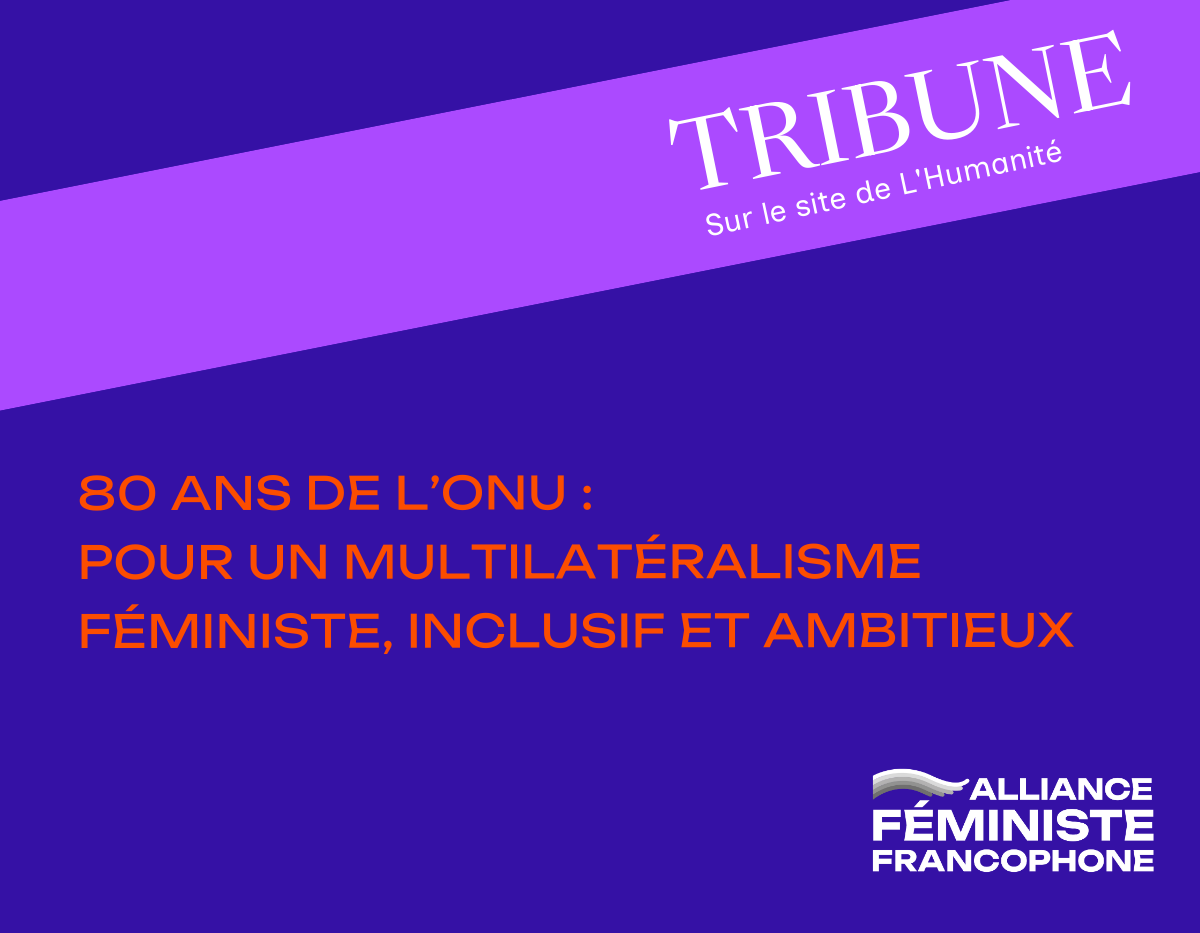
As the United Nations celebrates its 80th anniversary, more than 80 feminist and human rights organizations and activists from 17 French-speaking countries in Africa, Europe, and the Middle East, brought together by the Francophone Feminist Alliance, are calling on the international community to place gender equality and the voice of feminists at the heart of the reform of multilateralism.
The full text of the opinion piece and all of its signatories can be found on the L'Humanité website. As the diplomatic season gets underway, all eyes are on New York, where the 80th United Nations General Assembly is opening. This is a symbolic edition, marked by the urgent need to take action in the face of a weakened multilateral system: weakened international institutions, rising nationalism, the climate crisis, an increase in armed conflicts and human rights violations, etc.
Against this backdrop, the ongoing reform of the United Nations—known as “UN80 Reform”—is a historic opportunity to rebuild a more just, effective, and representative multilateral system. But it also carries a major risk: that of sacrificing the rights of women and minorities on the altar of diplomatic consensus. Yet the rights of women and gender, sexual, social, and cultural minorities, the fight against gender-based violence, and the principles of equality, social justice, and peace are non-negotiable. These were reaffirmed last year by Member States in the Pact for the Future, they form the very foundation of the UN project. Yet international commitments to gender equality—from the Beijing Declaration to the 2030 Agenda—are now being undermined and called into question.
No retreat can be tolerated in the face of anti-rights attacks.
For several years now, we have been witnessing a coordinated global offensive against women's rights, sexual and reproductive rights, and gender equality. In multilateral forums, certain states, supported by conservative coalitions, are attempting to erase past commitments or weaken them by replacing them with vague wording. Around the world, civic spaces are shrinking and reprisals against human rights defenders are on the rise. This strategy of deliberate regression is unacceptable. States that claim to uphold the values of the United Nations must adopt a firm and concerted position to defend existing international standards and conventions on gender equality, particularly in the area of sexual and reproductive rights, without compromise.
Truly inclusive multilateralism must include feminist and Francophone voices
Feminist movements are at the forefront of defending these rights and fighting against the backlash. And yet, our voices are still too often absent from international power centers. Francophone feminists from the Global South, in particular, are systematically underrepresented in international forums. Despite the recognition of multilingualism as "a fundamental value of the Organization,"English dominates, and budget cuts, which have accelerated in recent months, directly affect translation and interpretation services, thus limiting access to official bodies, websites, and documentation related to the protection of human rights.
The crisis of confidence facing the UN stems, among other things, from the issue of representation and full, equitable, and meaningful participation in multilateral spaces. As long as linguistic, geographical, financial, and digital barriers continue to exclude essential voices, the UN will never be a truly inclusive space. The full and effective participation of civil society and feminists must be ensured in all multilateral discussions and supported by concrete measures to break down the systemic barriers to their participation. Ethical application of artificial intelligence to ensure translations, inclusion of civil society in government delegations, financial and logistical support, facilitation of visa application procedures—there are many possible solutions, and states that promote feminist diplomacy, such as Canada, France, and Mexico, have a particular role to play in this regard. This inclusiveness must also give full recognition to young French-speaking people, who are key players in the future.
With major celebrations on the horizon—80 years of the UN, 30 years of the Beijing Declaration, and 25 years of Resolution 1325 on women, peace, and security, Fourth Ministerial Conference on Feminist Diplomacy in Paris—the time has come to do much more than just make commemorative speeches. It is time for concrete action. In this crisis of global confidence, gender equality can no longer be relegated to the background. The future of multilateralism is at stake. It can only be saved if it becomes more democratic, accessible, intergenerational, and representative. For the next 80 years of the United Nations to be ones of justice, peace, and equality, multilateralism must become feminist, inclusive, and rooted in the reality of struggles on the ground. The full op-ed and its signatories can be found on the L'Humanité website.