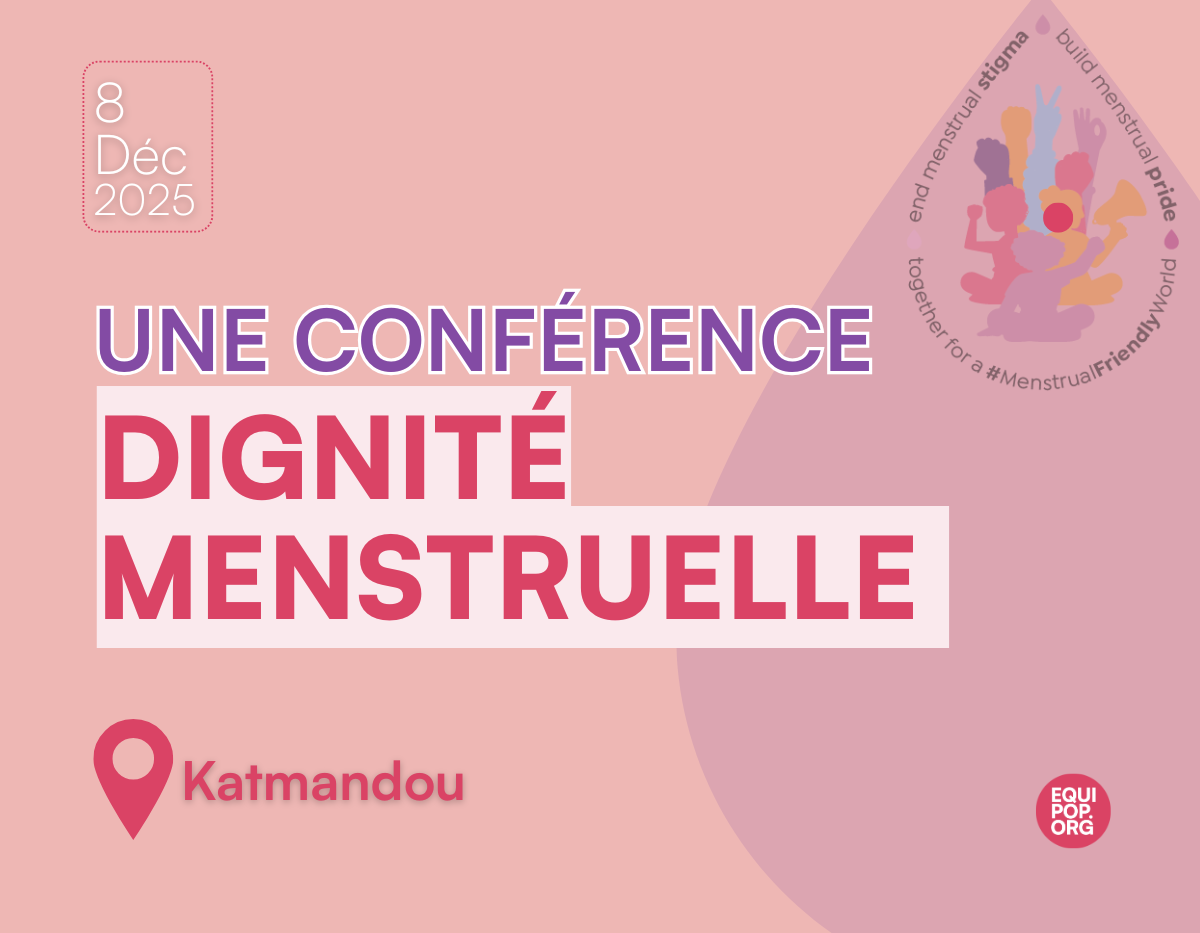
Since 2018, December 8, International Menstrual Dignity Day, has been part of the 16 Days of Activism Against Gender-Based Violence (
). This date serves as a reminder that menstrual discrimination is not simply a health or hygiene issue, but a profound violation of human rights deeply rooted in gender inequality.
In 2025, this mobilization took on a special dimension with the 7th International Conference on Menstrual Dignity, held in Kathmandu, Nepal, from December 8 to 10, 2025, organized by the Global South Coalition for Dignified Menstruation and the Radha Paudel
Foundation. More than 140 participants from 21 countries gathered to promote a political and transformative vision of menstrual dignity
.
A strong presence from the Global South, supported by the Sang pour Sang consortium
This edition was marked by significant participation from actors from the Global South,
including people from Benin, Guinea, Cameroon, Pakistan, and the
Philippines. Their presence in Kathmandu was made possible thanks to the support of various
member organizations of the Sang pour Sang – Uni·es pour la dignité consortium, which is committed to
strengthening feminist movements and the fight for menstrual justice.
These delegations brought voices rooted in local realities, sharing experiences
from the field related to menstrual stigma, gender-based violence, child marriage
, discriminatory social norms, and structural barriers to the exercise of rights.
Their participation helped to make the conference a truly decolonial, pluralistic
, and political space, where knowledge from the Global South was not peripheral but central.
A political space dedicated to feminist struggles
The conference theme, "Dignified Menstruation: Reclaim Inherent Dignity, Equity, and
Inalienable Rights," helped reposition menstruation as a cross-cutting issue at the
intersection of human rights, gender-based violence, social justice, and
gender equality. The discussions highlighted the limitations of technical and hygienist approaches, in favor of a systemic understanding of menstrual discrimination.
For the organizations and activists supported by Sang pour Sang, this space has also enabled
to strengthen South-South solidarity, share advocacy strategies, and nurture a common vision
based on a transformative feminist approach focused on the empowerment of
communities and menstruating people.
A declaration for the future
The conference concluded with the adoption of the Kathmandu Declaration, calling for
explicit recognition of menstrual discrimination as a form of violence and
exclusion, and for the integration of menstrual dignity into national and international legal, policy, and
programmatic frameworks.
Building global menstrual justice
Beyond panels and recommendations, the Kathmandu conference was a place of
convergence, recognition, and legitimization of the struggles waged by the Global South. For the
consortium Sang pour Sang – Uni·es pour la dignité, this collective participation illustrates
the importance of supporting the mobility, voice, and leadership of feminist organizations, so th
menstrual justice can be conceived with and from those who experience its
discrimination on a daily basis.