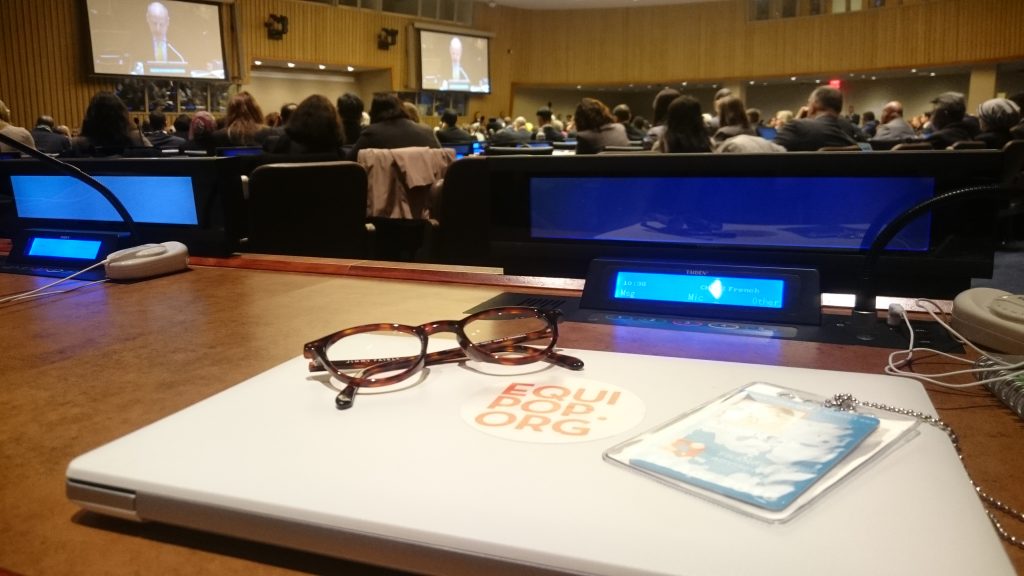
Equipop was in New York from April 11 to 15 for the 49th Commission on Population and Development, which takes place every year at the United Nations. Between demographic data and working methods, it was a week packed with debates!
PROGRESS IN SEXUAL AND REPRODUCTIVE HEALTH AND RIGHTS
[vc_column width= »1/2″]The 2016 United Nations Commission on Population and Development was unique. Discussions focused on two texts, around which a consensus had to be reached. The first concerned the commission's working methods, while the second, the theme of the session, concerned the enrichment of demographic data to support the Sustainable Development Goals. This year's theme was particularly technical and seems rather distant from SRHR as such.
[vc_column width= »1/2″]
The decisions taken this year reflect two main advances. The first relates to the inclusion of data collection for girls aged 10 to 14 in the thematic resolution on this topic, and the second to the fact that civil society participation and contribution have been highlighted in the thematic resolution, as well as in the working methods. On the other hand, it is regrettable that, as every year since 2012, the thematic resolution includes a paragraph on sovereignty. This paragraph is in itself a constraint, as it minimizes the obligation of countries to implement the actions recommended by international bodies and weakens the scope of the efforts made.
CIVIL SOCIETY MOBILIZES FOR GOVERNMENTS TO IMPLEMENT THE RESOLUTIONS OF THE COP
The conclusions of the CPD will prove useful in promoting SRHR and the contribution of civil society. To this end, Equipop will cooperate with its partners in the South to enable them to participate more actively in UN committees. They will also be trained on the content of the resolution so that they can hold their governments accountable for what has been agreed in this text.
Equipop will also continue to encourage European governments to advocate for SRHR and issues specific to women and girls within international bodies. It is therefore certain that the conclusions of the CSD will help to develop ambitious indicators and improve the capacity to advance data collection and analysis, including on sexual and reproductive health and rights issues.