– Make menstruation a health, education, and equality issue

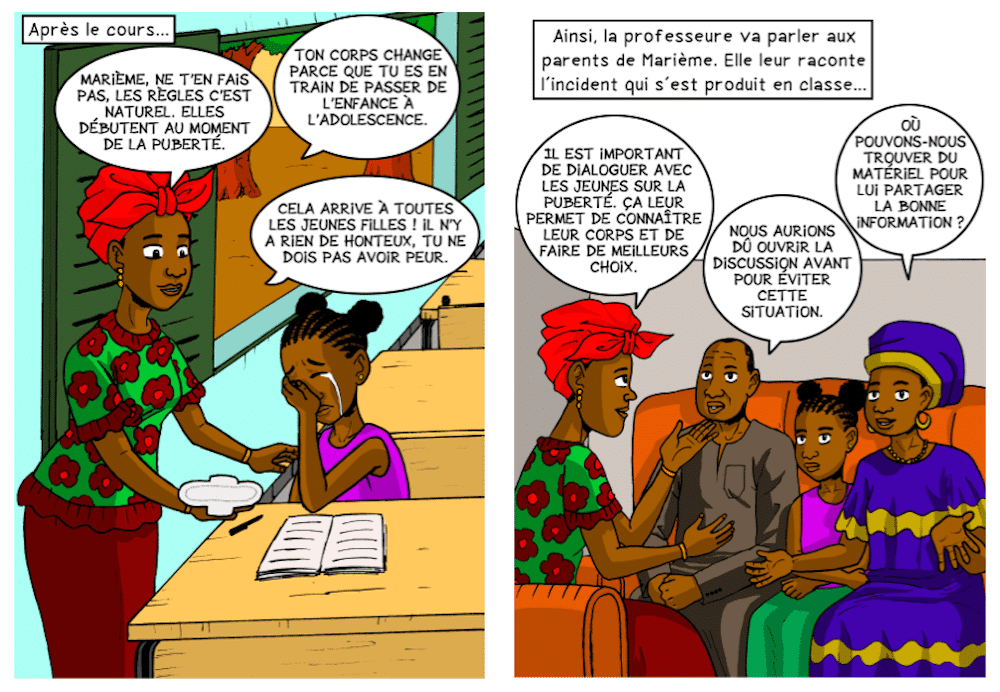
Every day, 300 million women around the world get their period. Yet within families, menstruation is shrouded in silence and shame; in public, it receives little funding even though it is an education, health, and rights issue. For these reasons, Equipop is taking action! Menstruation is a simple biological fact that too often constitutes an obstacle to young women’s health, dignity, and rights. Taboos about menstruation still cause embarrassment, shame, and stigma nearly everywhere. In most societies, menstrual blood appears to be a stain that must be concealed. The study we conducted for UNFPA confirms and illustrates that in West and Central Africa, many girls do not know what is happening to them when they get their first period. Even if they have received information beforehand, they still feel anxious and afraid. The first explanations usually given by mothers concern sanitary protection and the risk of pregnancy, but these explanations are vague because the link between periods, the menstrual cycle, and reproduction is often not established. Ultimately, young girls are mainly told to avoid boys and men. At the same time, the first period can be associated with a sign of maturity and adulthood. Young girls are then considered adults who can leave school, work, marry, and have children. Due to difficult access to adequate infrastructure (water, toilets, sanitation) and poverty, menstrual insecurity and its consequences on health and mobility affect the vast majority of women and girls. Finally, false beliefs, myths, dangerous social practices, and the silence surrounding menstruation can turn the period of menstruation into a time of restriction, deprivation, or exclusion. All of this limits girls and women in their personal, domestic, educational, and professional activities, while undermining their self-esteem and self-confidence. Since periods begin at a crucial time in the development of girls’ identities, this negative image strongly affects the way girls view their bodies and status; it also affects the way boys think about the female body. This negative image partly explains why women and girls have difficulty accessing basic infrastructure, such as toilets, essential menstrual hygiene products, and appropriate care for associated pathologies, such as endometriosis. Researchers, activists, and journalists are now bringing this long invisible issue to public attention, as illustrated by the establishment in 2014 of the International Day of Menstrual Hygiene, May 28, now celebrated across the world.

Menstrual health serves as a gateway to education and rights for the youngest adolescent girls.

In the region, so-called “WASH” projects are increasing access to appropriate menstrual health infrastructure and hygiene products. While some WASH projects include information campaigns, they are often scattered or simply pilot projects. Such projects rarely integrate a rights-based approach. Few countries have adopted menstrual health strategies and standards, but there is a willingness to facilitate, for example, the mainstreaming of menstrual health and hygiene into all relevant sectoral policies. Even though menstruation remains a taboo subject, the Equipop study findings and task force member feedback show that an open dialogue that repositions menstruation as a normal and natural phenomenon for girls at the time of puberty reduces negative perceptions about periods and increases interest in them, including from men and boys. The subjects of menstrual health and hygiene, and puberty more broadly, serve as gateways to in-school and out-of-school sexuality education. Social welfare and health centers would better serve girls and young women if they included menstrual health in their adolescent and youth sexual and reproductive health and rights service packages, as they do with family planning, sexually transmitted infections, and HIV/AIDS. Based on these findings, Equipop systematically incorporates menstrual health into its actions to promote and improve SRHR through advocacy, support, and comprehensive sexuality education. Equipop supports a variety of actions that complement WASH programs, such as de-stigmatizing menstruation, setting positive norms for periods, and creating and disseminating information, communication tools, and materials to promote human rights and gender equality. Equipop also supports young feminist movements and activists who raise their voices to break the silence and taboos around periods and who call for an end to menstruation-related discrimination and injustice.  

Further information

February 9, 2026

A participatory and engaging learning environment In a context marked by persistent gender inequality, systemic violence, and conflict, strengthening the capacities of feminist actors remains

February 2, 2026

The Union of Feminist Action – Tangier branch – has been working for nearly thirty years to defend women's rights and combat gender-based violence.

January 30, 2026

In a global context marked by increasing conflict, the rise of authoritarianism, and the weakening of human rights, feminists continue to imagine and build political alternatives.

Looking for something?