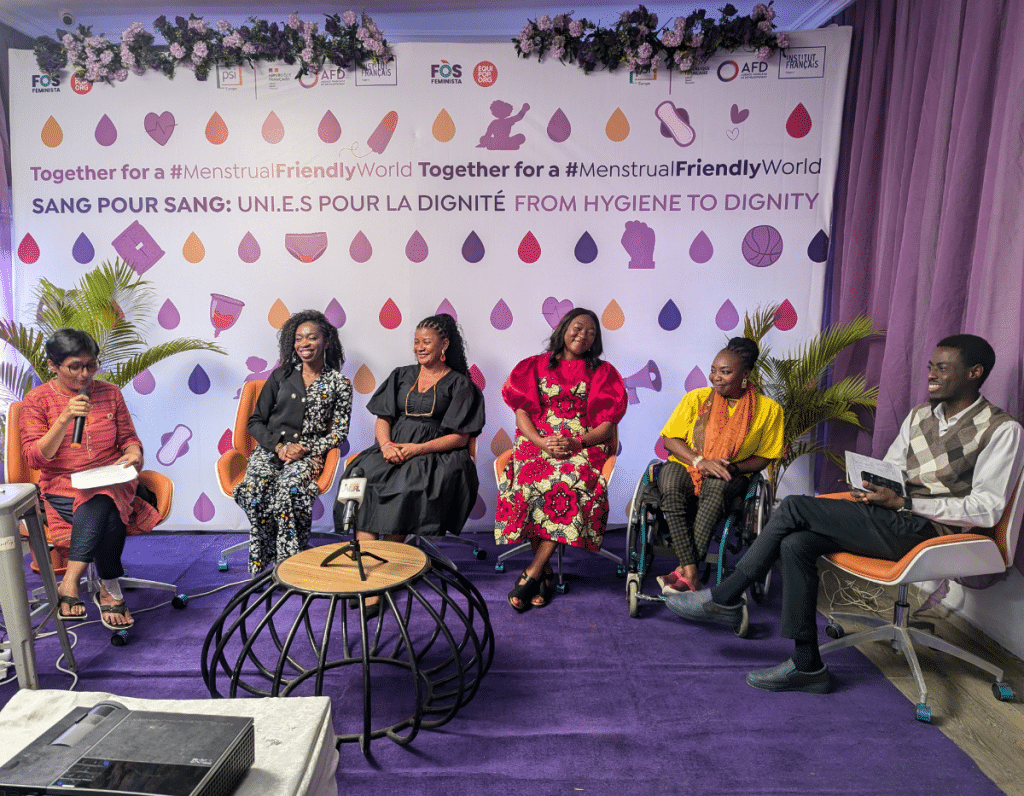
Launched in October 2024, the Sang pour Sang: uni.e.s pour la dignité project aims to change the narrative treatment of menstruation, which is not reduced to a simple question of hygiene. Thanks to funding from AFD - FSOF (Fonds de soutien aux organisations féministes), this project, carried out in consortium with three other NGOs, aims to put gender equality and human rights at the heart of menstruation, so that menstruating people experience them with dignity. Interview with Floriane Klinklin Acouetey, Togolese feminist and gender expert, in charge of the Sang pour Sang project at Equipop.
What's at stake in Sang pour Sang: uni.e.s pour la dignité? Floriane Klinklin Acouetey: In many parts of the world, whether in Africa, Asia or Europe, menstruation is still considered dirty, impure or taboo. When they menstruate, menstruating women are not allowed to go to school or work, and are isolated from the rest of the population. On the ground, civil society organizations, especially feminist associations, are already fighting against this discrimination, but they lack funds. In consortium with the NGOs Fos Feminista, PSI-Europe, and Global South Coalition for Dignified Menstruation (GSCDM), Equipop therefore proposed a project selected by the French Development Agency (AFD) to benefit from a Support Fund for Feminist Organizations (FSOF). Every year, May 28 marks World Menstrual Hygiene Day. But it's not just about hygiene, it's about human rights, at the heart of the menstruation issue. This is the major challenge of the Sang pour Sang: uni.e.s pour la dignité project, which is present in nine countries in West Africa, Asia, Latin America and the Caribbean, including two learning countries (Nepal and Ethiopia).
This project aims to rethink menstruation as a question of dignity and human rights. How is this approach innovative? Patriarchal society tends to reduce menstruation to a hygiene issue, neglecting questions of dignity and the need for information. For example, menstrual pain, disorders such as endometriosis or PCOS (polycystic ovary syndrome) are little understood or addressed. In addition, menstrual products are presented in a limited way, with no explanation of their impact on health and the environment, or of possible alternatives. Menstruation is often the source of social, educational and professional discrimination. For example, a girl who menstruates at school may fear being mocked or isolated, which has an impact on her schooling. In some cultures, menstruation also marks the transition to practices such as forced marriage. Finally, society's perception of menstruation stigmatizes it, reducing it to a private matter, whereas it should be recognized as a natural and legitimate aspect of life, requiring inclusion in fundamental rights. All these issues will not be resolved by health infrastructures alone. A feminist, rights-based approach is needed to combat discrimination and promote the dignity of menstruating people.
Who are the target groups for the Sang pour Sang project? The project is aimed at menstruating people, i.e. women and girls, but also gender non-conforming people, LBTQ+ and marginalized groups, such as those with disabilities or living in humanitarian/fragile contexts. Young girls and boys are also targeted, as menstruation touches on the issue of sexual and reproductive rights. Particular attention is paid to men and boys, who are often poorly informed about menstruation. The aim is to make them vectors of information and allies, rather than sources of ridicule or stigmatization. Raising awareness helps to deconstruct taboos and prevent trauma for menstruating people. This feminist approach emphasizes education, mutual understanding and the fight against inequalities linked to menstruation.
How is Equipop involved in this project? The Sang pour Sang project is being implemented in nine countries in the South, including three in West Africa (Benin, Côte d'Ivoire and Guinea Conakry) where Equipop is active. We began by mapping the players and ecosystems actors and ecosystems (political and legal frameworks) in these countries First, we mapped the actors and ecosystems (political and legal frameworks) in these countries: civil society organizations and activists already active on menstrual issues, in particular feminist associations and those working with marginalized groups (disabled people, in prisons, in humanitarian settings, or gender non-conforming). We will then provide the most flexible financial support possible, as well as technical support in the form of "à la carte" coaching for volunteer associations. The project will also support collective political and social mobilization initiatives at national and regional level to change mentalities and influence laws and policies, which are still not very inclusive. Spaces for exchange and learning will be created between the different countries of intervention around best practices and actions that have worked. Synergies between feminists and social enterprises will be strengthened to facilitate access to menstrual products that respect the environment and menstruating women. Last but not least, Equipop will be able to capitalize on the experience of feminist associations, while learning from them. By drawing on the strength of the collective, this project will enable us to grow and act together. It's essential to change the narrative around menstruation so that menstruating people can experience it with dignity.